

Is Burnham about to fall headfirst into the education policy trap?
Jim is an Associate Editor (SUs) at Wonkhe
Tags
Who said that we need an education system that is about parity (of esteem) between academic and technical education?
In 1943, the Norwood Committee, reporting on secondary education, helped establish the postwar idea that grammar, technical and modern routes should command “comparable public status”.
In 1949, MPs were already warning in Parliament that there could be no real “parity of esteem” while technical education remained structurally underprovided.
In 1991, Michael Howard, then Secretary of State for Employment, said “parity” meant “maintaining high standards for both academic and vocational education.”
In 1993, Ann Taylor, then Labour MP for Dewsbury, said “we want parity of esteem between academic and vocational work.”
In 1996, Sir Ron Dearing’s review of 16–19 qualifications became a major attempt to secure “parity” between academic and vocational qualifications.
In 2000, David Blunkett, then Secretary of State for Education and Employment, used vocational GCSEs as part of a New Labour attempt to put “vocational and academic qualifications on a more equal footing”.
In 2001, Margaret Hodge, then higher education minister, was determined to achieve “parity of esteem” between vocational and academic awards.
In 2005, Charles Clarke, then Secretary of State for Education and Skills, argued that employer- and university-recognised qualifications were the way to achieve “parity of esteem between the academic and vocational.”
In 2005, Ruth Kelly, then Secretary of State for Education and Skills, defended 14–19 diplomas as a route towards “parity” between traditional academic subjects and practical study.
In 2010, Nia Griffith, then Labour MP for Llanelli, criticised a system in which academic qualifications were treated as the “premiership” and vocational qualifications as the “lower leagues.”
In 2014, John Hayes, then Minister of State for Skills and Enterprise, said vocational and academic education would only be valued equally when they were “equally valuable.”
In 2018, Theresa May, then Prime Minister, called for “parity of esteem between academic and technical options” and rejected the idea that vocational training was “for other people’s children.”
In 2018, Damian Hinds, then Secretary of State for Education, said the aim was “parity of esteem when it comes to technical and academic routes” as “equally valid choices.”
In 2018, David Hughes, chief executive of the Association of Colleges, said business, education institutions and government needed to work together to secure “parity of esteem between academic and technical education.”
In 2019, Lord Baker, former Education Secretary and founder of the Baker Dearing Educational Trust, argued that governments had long tried to make vocational education achieve “parity of esteem” with the university route.
In 2019, the Department for Education said ministers “can’t legislate for parity of esteem between academic and technical routes”, but could improve the quality and clarity of those routes.
In 2020, Baroness Berridge, then Parliamentary Under-Secretary at the Department for Education, said the department wanted to promote “parity of esteem” for vocational and technical qualifications.
In 2021, Robert Halfon’s Education Committee framed apprenticeships and skills around “parity of esteem for vocational and technical education.”
In 2023, Rishi Sunak, then Prime Minister, used the Advanced British Standard paper to promise “genuine parity” across the technical and academic landscape.
I won’t go on. We even made a special podcast about one of politics’ oldest and hardest promises to deliver on the eve of the publication of the Augar review.
Well guess what. It’s back!
In an interview for the Observer, bookies’ favourite for next PM Andy Burnham says:
We overpromoted university and that has been to the detriment of lots of young people in this constituency. We need an education system that is about parity between academic and technical education.
As ever, the implication is never that we’ve pushed too many middle class people into university.
It’s that we’ve sold the pup to the working classes, who’d have been better off training to fix graduates’ boilers than trying to be a graduate with a broken boiler.
Why has the aspiration been so repeatedly difficult to pull off? My hunch is that you can’t fix the class system through qualification reform alone.
You might be able to get close with a massive wedge of cash. But Burnham’s already been calming the bond markets.
And as I keep saying on here, even if you thought the solution was to rob the HE Peter to fund some esteem for FE Paul, you’d soon realise that once you’ve had the money back that you loan to graduates, you actually spend pennies on HE in comparison to every other stage of education.
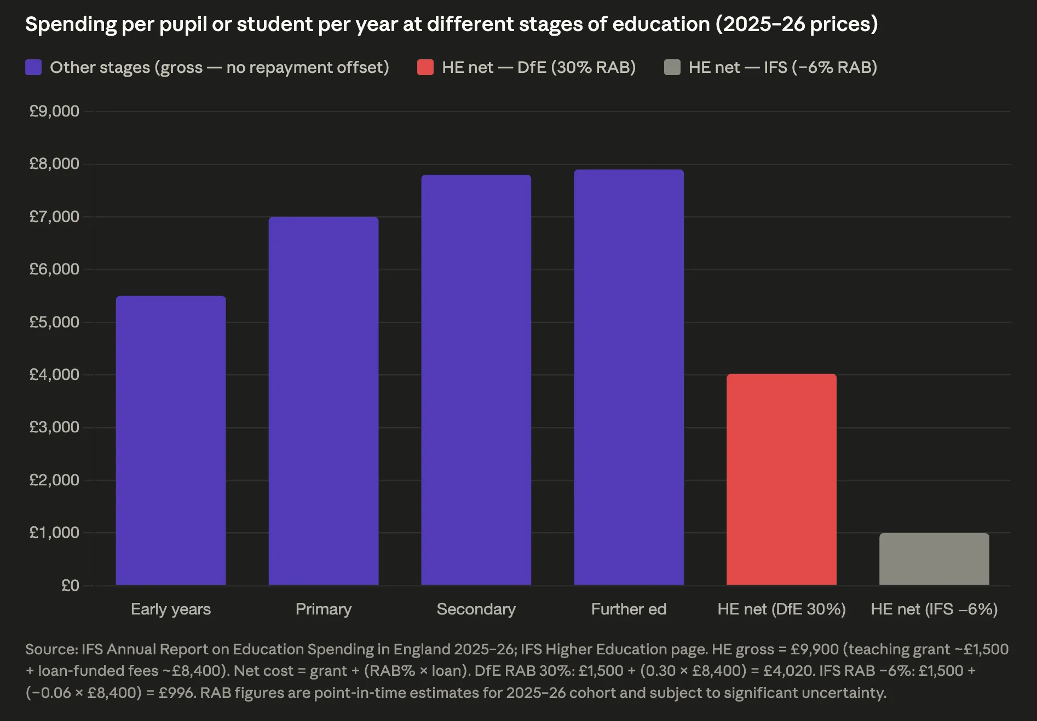
But more important than that, I have a little chart for politicians to look at.
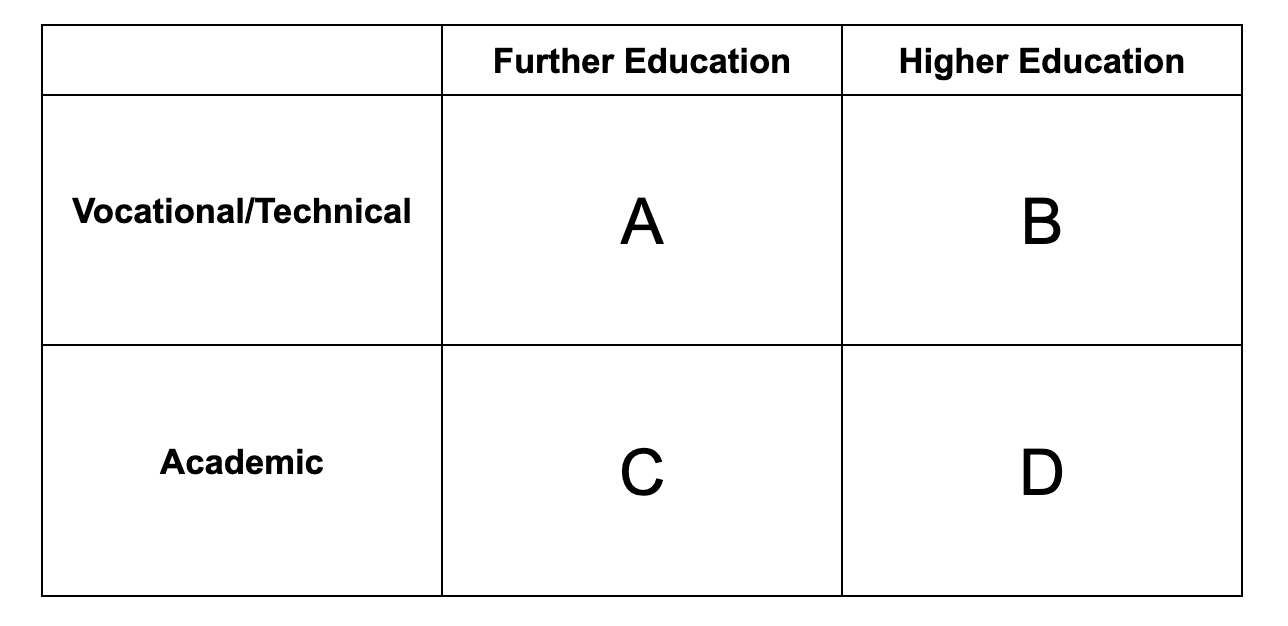
Every serious analysis of the future of the economy says we need a lot more B.
It happens in universities.
A is not an alternative to B. It is also important.
Universities do not only consist of D.
Thanks for coming to my TED talk.
Now before you take to the comments to point out that humanities and the arts matter too, or that the lines should be fuzzier, or that there should be a separate column for Level 7 and 8, I’d simply urge you to resist the temptation.
It’s a table in a Google Doc designed to make a point, and it’s not about you. Stop making it about you.
I have banged on before here about the ways in which the structures and governance of UK don’t help higher vocational/technical surface in policymakers’ minds.
They think everyone in HE is studying gender studies, sat under a tree thinking about trigger warnings and demonstrations.
For the avoidance of doubt, there’s nothing wrong with trees, sitting, trigger warnings or protest.
But if the public can’t see the rest of it, we have a problem.
I’ve banged on before here about how dated and daft the division between head and hand is in educational thinking. If it was up to me every humanities student would have to do a bit of STEM, vice versa, and they’d all be able to get (a bit of) (academic) credit for non “academic” learning.
Universities would also open up more opportunities in their civic work for students to learn crafts from local craftspeople.
Did outcomes improve when West Herts College shut down A-Levels? Yeah. As long as you’re happy with the other “outcome” of signalling to young people that thinking is for some people and doing is for others, and we’re going to make damn sure you don’t spend any time together from here on in.
I’ve also pointed out that while it’s not true that we don’t need more graduates, it is true that what they study, where they study it and where they can then afford to settle really does matter.
As such, my main thought on Burnham’s comments isn’t to just dismiss them.
It’s that he does at least accept that places need a plan, politicians and power of their own.
The danger for HE – and its obsessive belief that anyone having any power over what students study or where they study it would destroy the sector – is that whether it’s through grant funding or loans, politicians tend to want to exert influence over it.
That’s a) fair b) necessary c) inevitable in a mass system and d) what we expect a democracy to be able to do.
The choice, then, other than surfacing all the higher technical work, runs like this.
Burnham, if he wins, may or may not make progress on devolution.
For what it’s worth, I hope he does (make progress on devolution. I’m less enamoured with him per se).
If it was up to me, those devolved powers would include student numbers planning, both home and international.
Yeah yeah, Reform etc. Take the long view and you realise that it’s a very good idea to align the trade-offs so that we don’t end up with Mayors championing skills while the D team in DfE designs an LLE there’s no demand for.
And anyway, just as prisoners learn to love their guards, politicians learn to love the things they spend money on. If you think the answer to the HE funding crisis is to say to Metro mayors “sorry, you can’t do X on education or Y on housing because we need to keep lending money to students in a way nobody even has a plan for”, you are dooming the UK’s places to resenting and blaming their universities.
And you’re dooming the sector’s students to a thinner and thinner student experience.
I don’t know if Burnham will win – either way, the UK’s hyper-marketised version of autonomy that manifests in intense opposition to student numbers planning or control has a cost.
In the end, “leave us alone…” isn’t far away from “…to manage our own decline.”
I was nodding like a dog all through this – especially this: “As ever, the implication is never that we’ve pushed too many middle class people into university.” YES! The nasty unspoken belief that, when things get tight, working class people should get back in their box…
Too much attention on NEETs is being paid to education providers in my opinion – when are we going to really start unpicking employer behaviours that make it so difficult for young people without experience (graduates or otherwise) to enter a career? Thinking about the young people I support, I am seeing consistently poor practice from employers who refuse to give feedback on unsuccessful interviews or even consider applicants who are not already fully skilled for the job – when did this start happening? When I first started working after graduation, there were many ‘entry’ graduate-level jobs that did not expect you to arrive fully skilled and experienced – the employer saw it as their responsibility to train and mould you into the role. Now this seems to be lost, it’s become next to impossible for some people to get through any doors and get experience because … they’ve been unable to get any experience. The old catch-22 in operation – and it is NOT the fault of the education providers. This lies wholly with the employers.
The dog nodding continues!
We cannot ignore the fact that employer investment in workplace learning has fallen (almost) in proportion to public investment in HE & FE. As it stands, the learner (whether through fees or relative disinvestment), staff (via pay freezes & redundancies) and public purse pick up the cost.
Prior to the 2024 election, there was talk of a hypothecated graduate or post-16 surcharge on qualified employees. Instead, we are subjected to a flat employer contribution increase which (in the case of HE and Welsh colleges) applies to the very institutions whom the proponents of the original scheme had sought to rescue!
Throughout Continental Europe, we frequently find something approaching functional integration. Whether mediated through dual-professionalism or a coherent relationship between all stakeholders in pursuit of a common purpose, the position of tertiary is bolstered by a settled apprehension of its vital necessity in pursuit of wider goals.
To that end, it seems clear that this nonsense will continue for as long as the UK and its constituent nations lack 1: an industrial strategy commensurate to scale and, 2: a development body capable of curating energies around some accepted, common purpose.
The article uses further education in two different senses. In the table the spending per student figure is for “16-18 year olds in further education colleges”. Average spending per 16-18
college student is higher because more qualify for disadvantage premiums and more take higher cost courses. IFS do a good job in quantification but note that they don’t count either the pupil premium or VAT refunds when calculating school figures. They also don’t calculate a funding per student number for adult further education and it’s adult FE that, I’d say, should be the title of the box (to avoid confusion). Twenty years of incremental budget reductions has shrunk both vocational and academic adult FE (boxes C and A). There is also minimal living cost support for adult FE, not even maintenance loans. However, as the Milburn review notes (paragraph 372), the UK has fewer 18-to-21 year olds on vocational routes than Germany, Netherlands and Denmark but more on general ones. Surely it’s a sensible question to ask whether there are better choices. England’s education system funnels young people towards three year degrees (both general and vocational) whereas a system with different incentives (and “architecture” to use a Milburn review term) might offer slightly different choices.
Andy Burnham is a Cambridge graduate who has spent almost his entire career in politics. You couldn’t find a better example of a technocrat. If Labour recruited fewer people like this to be MPs/ministers and more from a technical background, they might have more popular support and a better idea of governing.
“If Labour recruited fewer people like this to be MPs/ministers and more from a technical background, they might have more popular support and a better idea of governing”
I doubt that – they would just be mocked for being “thick” and not clever enough to be a senior government minister, as John Prescott and Angela Rayner both were.