

HESA has updated financial data to the delight of international fee levy modelers everywhere
David Kernohan is Deputy Editor of Wonkhe
Tags
I’ll level with you, there’s not really a HESA Spring, it’s just an idea I made up to cheer people up during the cold, dark, winter months early in the year.
As we’ve seen in the previous two years, spring is very much a state of mind – new data arrives these days largely at random based on the ability of providers to submit it properly, and (to a lesser but still valid extent) the ability of Jisc to collect it properly.
And no, this isn’t another piece complaining about what we must now refer to as the current model of collecting student data (the “Data Futures” years are very much in the past) – indeed, we learned recently that fresh data for 2024-25 will arrive in neatly described .csvs in the traditional month of January next year.
Today’s issue concerns HESA Finance data, which those with long memories may recall we first published (after a fashion) in January of last year and was first officially published in May (with many providers yet to provide data at that point). As the year has rolled on more of these providers have managed to get their audited financials signed off and in to HESA – meaning that when the collection was last updated on 2 December we had information for everyone but the Dartington Hall Trust and the University of Dundee, both for obvious reasons.
This means that we reopen our HESA Spring 2025 scrapbooks one last time to look at Key Financial Indicators across the whole sector.
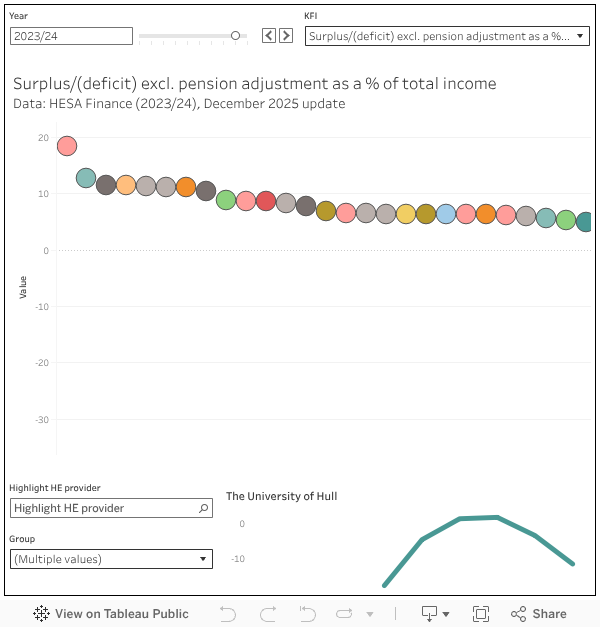
Worth the wait? Well, there are no surprises – not least as the data refers to the 2023-24 academic year (some providers with unorthodox financial years have submitted 2024-25 information but these tend to be very small, very odd, or both). But it is good to have the whole sector in one comparison.
I’ve been using 2023-24 financial data (and student data) to model the impact of the new international student levy (due August 2028). Clearly with near-complete data now available I can update those charts in other articles (I have) but I’ve also put together a comparison between the new approach to the levy (a flat fee of £925 charged on every international student above 220) and the one we all initially modelled because it was used in the immigration white paper (6 per cent of international fee income).
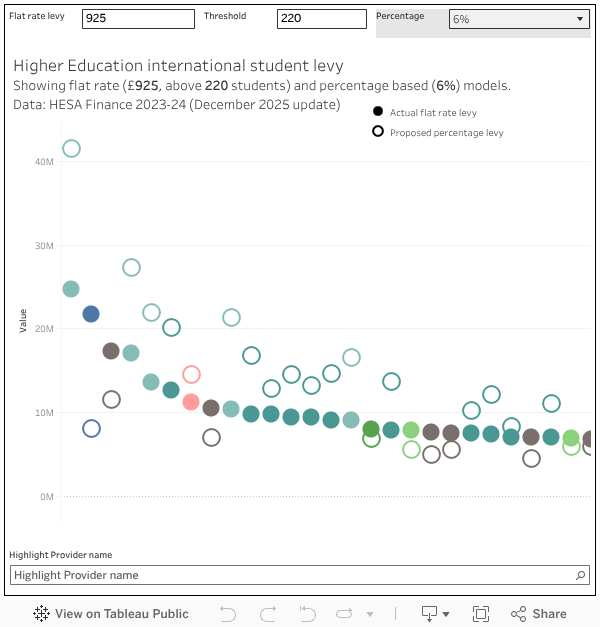
What this illustrates to me is that the DfE’s “specialisation” agenda does, in fact, have teeth. The change represents a net benefit to the kinds of providers who charge international students very high fees, and a net cost to those with more modest financial entry requirements. That this split also quietly duplicates the one between the kinds of provider who have been expanding home student recruitment, and the ones who have failed to recruit well as a result of this behaviour is probably something DfE officials should have an eye on.
For all the concern in the consultation about the number of international students who may be discouraged by the passing on of this levy via fee hikes, I have seen less concern about the number of home students for whom a £1,000 grant is the help they need to make the potentially life-changing decision to access higher education at their local provider – but this is most likely the more important number for the financial health of a large number of our institutions.
Thank you.
As I suspected, UCL had a big problem with the levy. I can safely declare the government policy for a levy is nothing to do with me and I agree with prioritising and funding the technical subjects identified by the government including maintenance grants. I could not care less what the UCL Council, their Academic Board, and its University Management Committee think about the levy. I will not forget their names and conduct of business towards me, led by a clueless statistician.