Wonk Corner|1/04/26 · 17:25
Wales. So close, and yet so far away
Just for a minute (well, five or so years), I thought one bit of the UK wouldn’t be a laughing stock in Europe on student participation. Alas, it wasn’t to be.
Jim is an Associate Editor (SUs) at Wonkhe
Every two or three years, the higher education ministers of the 49 countries in the European Higher Education Area (EHEA) (the Bologna Process club we stayed in despite Brexit) get together to assess progress and make commitments.
We sign communiqués, and promise to do things. And then, when the implementation reports come out, we show up in red on maps alongside Kazakhstan.
The latest of these shindigs was in Tirana, Albania, in May 2024. Among the things ministers adopted were six “fundamental value” statements – covering academic freedom, academic integrity, institutional autonomy, student and staff participation in governance, and public responsibility for and of higher education.
And it’s all going to be monitored. A working group has been developing a framework that will assess both de jure (what’s in law) and de facto (what actually happens) compliance. A public consultation on the monitoring is live right now, and the first full report will land at the 2027 Ministerial Conference in Chișinău.
Red on the map
I doubt you’ve seen the maps from the 2024 Bologna Process implementation report, but I’d encourage a look.
The UK (other than Scotland) is one of the few countries with no legal requirements for student or staff representation on governing bodies, while most of Europe mandates both. We don’t look great on the social dimension or mobility either.
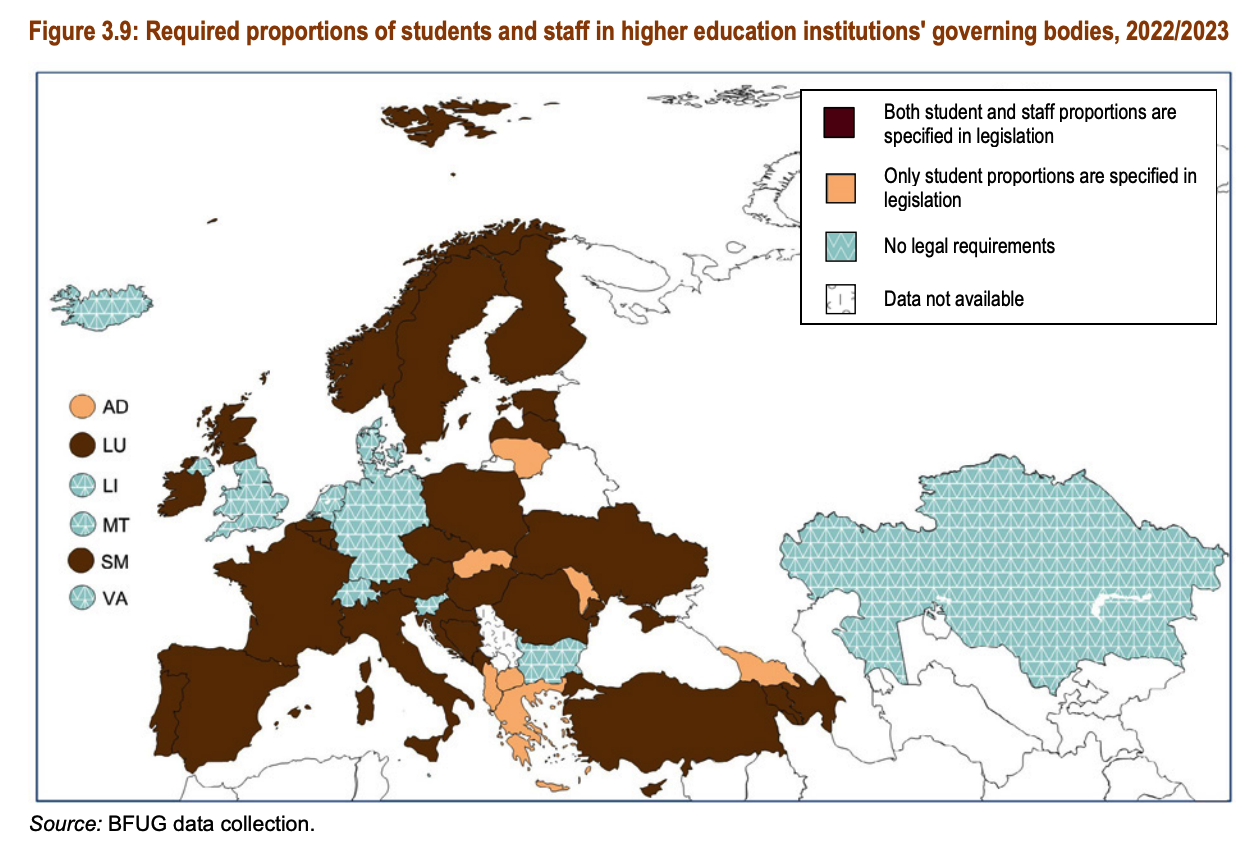
The UK is reported in these exercises as “United Kingdom (England, Wales and Northern Ireland)” – a single bloc, with Scotland treated separately because it has its own qualifications framework.
Wales’s own regulatory and funding arrangements, fee regime, approach to widening access, its own tertiary reform – none of it shows up.
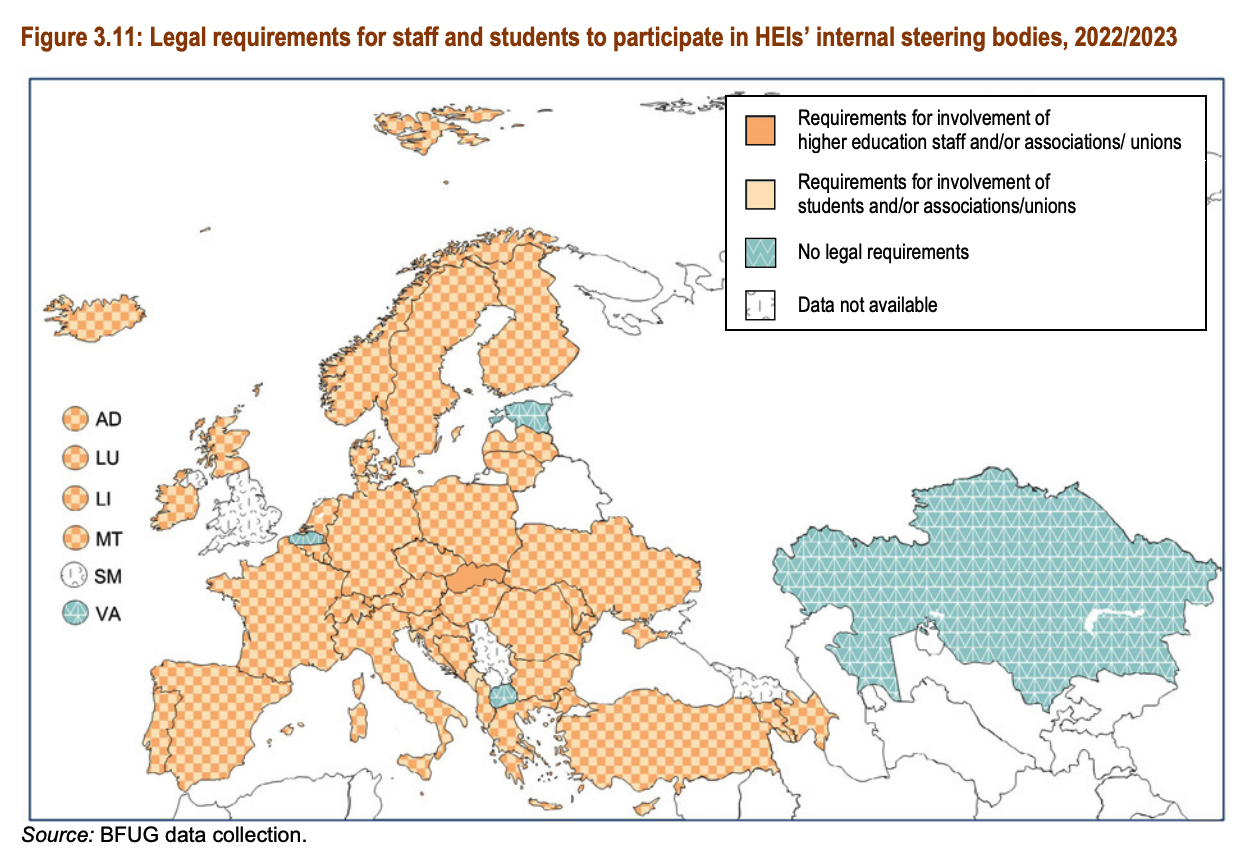
When the UK’s National Action Plan commits to “continue promotion of education exports” rather than supporting UK students to study elsewhere, it’s an England-centric Department for Education (DfE) priority being presented as the Welsh position too.
Luke Hall was the Westminster minister with responsibility for higher education during the Tirana conference, Robert Halfon having resigned a few weeks prior. Don’t worry about remembering who Luke was. He didn’t go.
Enter the Code
Which is why the Tertiary Education and Research (Wales) Act 2022 (TERA) mattered – or should have mattered.
Section 129 places a statutory duty on Medr to prepare and publish a Learner Engagement Code about the involvement of learners in providers’ decision-making. The Act specifies that learner engagement in decision-making includes opportunities for learners to participate in the making of relevant decisions, have their voices effectively represented, and give their views on their education and matters of concern to them. Medr has to monitor compliance.
This was, on paper, a real opportunity for Wales to distinguish itself from the rest of the UK in Bologna terms – to go further than England, which is a bar you can trip over – and to meet the EHEA’s expectations on student participation in a way that could be credibly presented in international forums.
Today we got the Code.
And as we set out elsewhere, the final version – published following two rounds of consultation – takes a deliberately non-prescriptive, principles-based approach.
Nine principles are written from the learner perspective – embedded, valued, understood, inclusive, bilingual, individual and collective, impactful, resourced, and evaluated. Providers must publish a commitment to “embedding and supporting impactful learner engagement in decision-making.” They must demonstrate impact, and must involve learners in reviewing the commitment annually.
What they don’t have to do is give students any procedural governance rights at all.
The Tirana test
Let’s take a stroll through the EHEA statement and test the Welsh position against it.
It starts with:
…implementing a partnership model of higher education governance is necessary to ensure that all stakeholders are accountable and responsible.
It describes students as co-governors of their institutions – able to initiate debates, set agendas, participate in all governing bodies. The Code describes an engagement model where providers invite students to contribute to provider-led processes. The Code does use the word “partnership” – but only for the relationship between providers and learner representative bodies over the commitment document itself. The EHEA means partnership as a governance model. The Code means partnership as a drafting arrangement.
The statement says students have the right to participate in all [academic and corporate] governing bodies and “elect and be elected in open, free and fair elections” to them. Wales has no legal requirement for student membership on governing bodies of any sort at any level. The Medr Governance and Management condition requires an “appropriate balance of knowledge, skills, background, experience, diversity and independence” – competence-based composition, not democratic representation. Most Welsh universities do have student governors, but that’s institutional convention, not law.
The EHEA statement also says representatives must be “accountable to the people who elected them” through elections that are “organised freely and autonomously.” The Code itself doesn’t create any fresh requirements for student representatives to be elected – it defers to existing legislation, referencing the Education Act 1994’s requirements for democratic SU structures. But the 1994 Act covers SU constitutions, not governing body composition, so the gap between what the EHEA expects and what Welsh law requires remains wide.
On procedural rights, the EHEA gives students rights on “setting agendas, drafting decisions, voting and veto, implementation and monitoring.” The Learner Engagement Code merely requires providers to demonstrate “impactful engagement in decision-making.” You can comply with the Code provided you can show that something changed as a result of listening to them.
The EHEA says students should be able to initiate and participate in all debates in all governing bodies. The Code says the provider picks which decisions are relevant. There is a safeguard – providers have to explain the exclusion to learners, and the Code’s guidance says learners should have “an opportunity to appeal that rationale.” But the appeal is to the provider, not to the regulator, and the whole exercise still starts from the premise that it’s the provider’s call which decisions learners get to be part of.
The EHEA describes what students should be consulted about before we even get to board or committee specific topics – equitable access, curriculum design, quality assurance, strategic objectives and financial matters. The Code says engagement should cover “all decisions that impact me, my peers and future learners” – but it’s providers that decide.
The EHEA is also clear that the freedom to express views without fear of reprisal “is an inseparable element of academic freedom.” The Code’s guidance says the learning environment should enable learners to “feel confident that their feedback will be considered sensitively” and that “providing feedback will have no impact on their grades, assessment, or academic standing” – and it’s framed as a culture aspiration rather than a student right with protections. There’s no explicit protection against retaliation for SU officers or course reps who challenge institutional decisions, no whistleblower-style route to raise concerns about reprisal with Medr. When SU funding depends on the provider’s goodwill and you’re being graded by the staff at your SSLC, the power dynamics write themselves.
The EHEA says participation must occur at every level of governance – including faculty and department – and specifically cites the Bologna Follow-Up Group’s (BFUG) inclusion of student organisations as the model. The Code’s guidance describes engagement at course, subject area, and institutional levels, without requiring any participation at all. It does say independent students’ unions “must be central to the university’s implementation of The Code” – but centrality to implementing an engagement framework is not the same as having governance rights within the institution’s decision-making structures.
Staff?
Ironically, Wales already has a stronger statutory framework for staff participation, in theory.
The Social Partnership and Public Procurement (Wales) Act 2023 imposes a duty on public bodies to engage with recognised trade unions when setting well-being objectives and taking strategic decisions. The duty isn’t just to consult – it’s to “seek consensus or compromise.”
If agreement can’t be reached, the body has to document the disagreement and justify its position. There’s an annual compliance report subject to ministerial scrutiny. There’s a Social Partnership Council that gives trade unions a statutory seat at the system-level table. And the Act amends the Well-being of Future Generations framework to include “fair work” in the definition of a prosperous Wales, directly linking working conditions to governance obligations.
“Seek consensus or compromise” is a much stronger obligation than “demonstrate impactful engagement.” Trade unions have independent legal personality, statutory recognition procedures, and legal protections that don’t depend on institutional goodwill.
The duty requires a partnership model – “seek consensus or compromise” – where the obligation is on the institution to try to reach agreement, and where failure to agree requires documented justification.
But guess what. It doesn’t apply to universities.
Sigh. Nothing in TERA prevented Medr from hitting a standard that the rest of Europe manages. A choice has been made – one that will continue to guarantee we’re a laughing stock when the maps get done.