

Under LLE, some full-time students will have their maintenance loan cut by 58 per cent
Jim is an Associate Editor (SUs) at Wonkhe
Tags
Given that the student finance system (at least for the time being, pending the LLE) affords access to maximum maintenance loans to those on one, you’d think that there would be a clear definition of what one was.
Not so much. It’s long been a fairly confusing area – so confusing, in fact, that what has been a long-standing set of regs in the The Education (Student Support) Regulations 2011 has apparently caught out a whole bunch of providers/provision who were only expecting physical attendance at the weekend.
On that, whoever thought this would get round those regs, sorry no. You’re confusing test one (a course is “distance learning” if students aren’t “required to be in attendance”, and required attendance “on a weekend” doesn’t count for this test. Only physical attendance during the week does) with whether enrolled students are “attending” for the purposes of continued funding – and this one can include online participation.
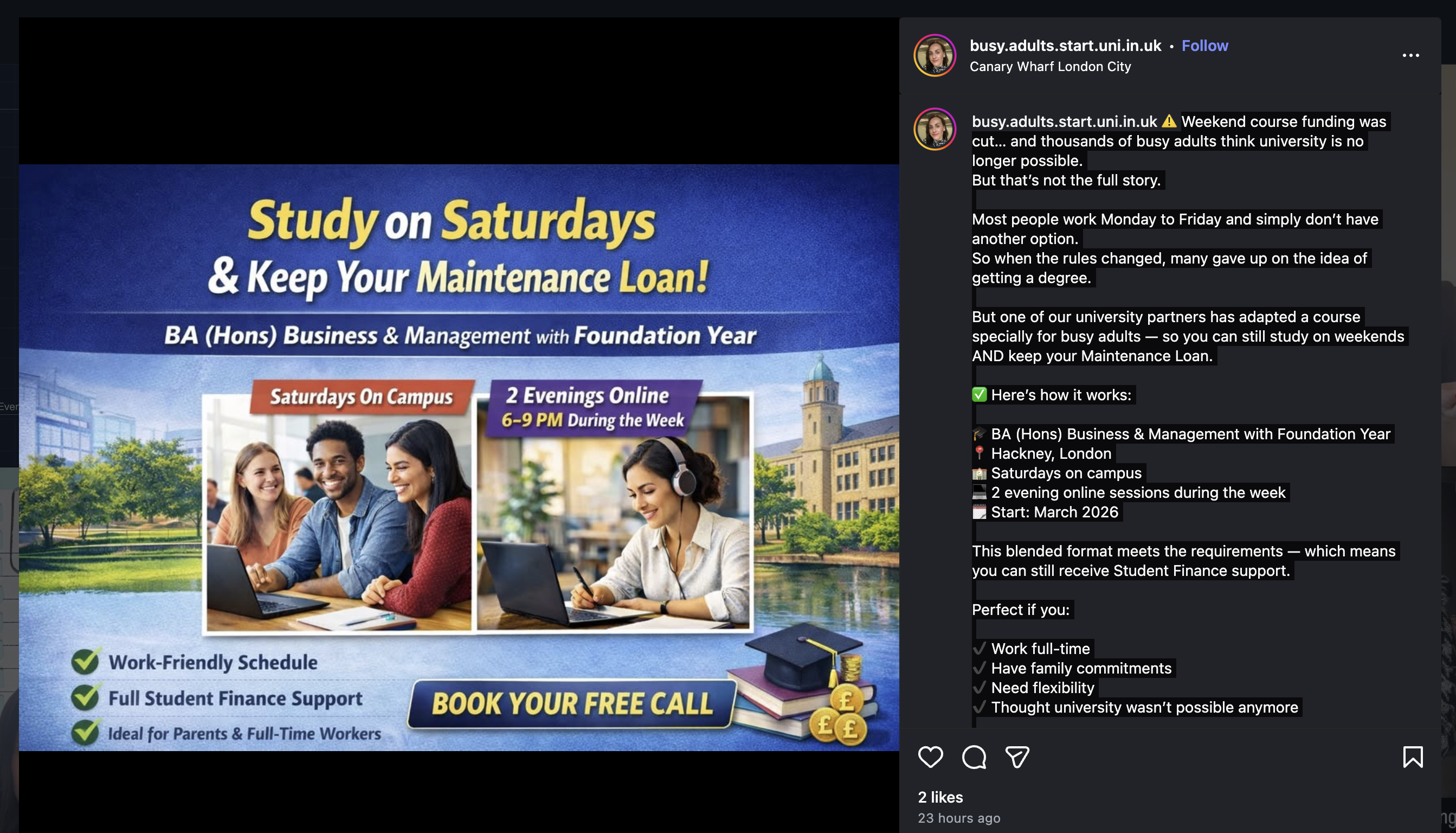
But when that popped up on my feed yesterday (along with the usual range of astonishing ads from domestic agents) I was reminded about the definition of full-time problem in the LLE.
As it stands, a “full time” course is subject to the above rule(s). But there’s another aspect where SLC has set an additional definition effectively on behalf of the Secretary of State:
Students on a full-time undergraduate course will normally attend the university, college or other teaching location for at least 24 weeks of the year.
During that time, we expect them to undertake periods of study, tuition, learning in the workplace and/or a sandwich work placement that does not meet the sandwich year out criteria. These should amount to at least 21 hours per week on average.
It’s both used in the finance regs and often quoted by other departments. Here’s Stephen Timms (Minister for Social Security and Disability) on the potential merits of extending eligibility for Carer’s Allowance to carers in full-time education:
It is right that people in full-time education should be supported by the educational maintenance system, rather than the social security benefit system. That is why, as a general principle, full-time students are usually precluded from entitlement to income-related and income-maintenance benefits, including Carer’s Allowance. Part-time students may be able to claim Carer’s Allowance though. This reflects long-standing principles of the benefit system, and we have no plans to change these rules.
The SLC text is basically a remix of the definition that makes up credit. And 21 hours a week x 24 weeks of the year, under the UK credit system, is 50.4 credits. Which is weird, because in Bologna, “full time” means 120 UK credits (60 ECTS).
That’s the course design rather than the “study hours/effort” thing in reality. But still – it’s a whopping distance from the Bologna agreed definition of “full time”.
Some would ask why we’re running a system that sees a student putting in 21 hours of study graft a week for 24 weeks a year (accruing 50.4 credits in the process) get the same value maintenance loan as one who is putting in 40 hours of graft a week for 30 weeks a year (accruing 120 credits in the process).
Actually, I can make an argument that you very much should be able to still access “full time” support for a reduced credit load – but it’s rare a course is actually designed this way, and nigh-on impossible to flex up and down during a degree.
Which swings us around to the LLE. Under the LLE credit is explicitly attached to time. There, 1 UK credit is 10 hours of notional effort.
Under LLE, if a student now is on a programme which involves 21 hours a week x 24 weeks of the year, accruing 50.4 credits in the process, they’ll only be entitled to 42 per cent of the maximum maintenance loan – a whopping cut.
It would be lovely if someone from the DWP could go for a coffee with someone from the LLE team and set out clearly how these new definitions of “full-trime” work, and how they interact with the statutory benefits system, and then tell the rest of us – especially because the more I notice, the more it seems that the LLE makes things worse for students who need flexibility.
Given her dual ministry status, Jacqui Smith could even meet herself!
Students on many PT courses can access maintenance loans currently though?
Out of interest, how does “required to be in attendance” fit with attendance policies (and their enforcement)? Could our weekend/distance course provider nominally schedule 21 hours (or 40 hours or any other number) of on campus teaching during the week, but publicise a policy that provided a student accesses one session a fortnight (which could be at a weekend or online), attendance won’t otherwise be addressed?
A published attendance policy that expects they won’t attend?!
I suppose it depends what you mean by ‘expect’. I can think of published attendance policies for home students that, when you cut out the fluff (and/or know where thresholds are set in practice), basically say ‘Attendance is very important. The way we enforce this is that if you do not attend any teaching or go to the library or log in online for 7/10/14 consecutive days, we will send you an email.’ As far as I can see, a student who over a sustained period of time logs in twice a week for online learning and goes onto campus most Saturdays wouldn’t even be flagged under that kind of policy.
If the LLE is likely to further heighten pressures for universities to appeal to (non-traditional?) students by simultaneously trying to show they are eligible for as much loan as possible, while also being as flexible as possible re physical attendance, then it seems to be there’s likely to be growing tension between what is ‘expected’ (in terms of what is in the timetable) and what is ‘expected’ (in terms of what anyone will actually do anything to meaningfully enforce).