

The voter consensus forming around Burnham’s education agenda has little time for universities
Luca Lombardo is a Policy Analyst in the Public First education practice
Tags
There is much to welcome in Andy Burnham’s insistence on a “parity of esteem” between technical and academic routes.
That a young person who chooses technical education should not be treated as having settled for less is hardly a controversial proposition.
The problem is that the intense popularity around this messaging rests on a more troubling consensus to do with the role of universities in the education system.
New research from Public First on voter attitudes towards education, based on two national polls of more than 2,000 adults and six focus groups with voters from each major party (one with non-voters), demonstrates a deeply worrying trend for the university sector. Voters across every party think that failures in the education system are largely down to an outdated focus on academic pathways. And they believe the current government’s technical-oriented agenda is making all the right moves to address these concerns.
Education for what?
Voters across the spectrum think the purpose of education should be to prepare young people for adult working life, allowing them to “stand on their own two feet once they get into the real world” (Reform Voter). They think that the education system, as it stands, is failing to fulfil that goal.
The particularly troubling bit for the university sector is that the key reason voters gave for this failure is that the education system adopts a one-size-fits-all approach, where people are too readily “pushed into the university lane” (Green Voter), leaving others by the wayside.
Voters believed that the basic promise of the education system was broken yet still being perpetuated by a university-first narrative: “When I was in school, we were told that the correct formula is to get good grades, go to a good uni, and you’re basically guaranteed a job at the end of it. But that’s just not the case now” (Conservative Voter). Graduates themselves were in fact some of the harshest in pushing this narrative, with one person claiming, “kills me to see my student loan coming out every single month. If I had my time again, wouldn’t go to university, would do something like an apprenticeship” (Labour Voter).
Perhaps most worryingly though, the perceived failure of this university-first system was deeply associated with the NEETs crisis. Some of the voters we spoke to thought that, for example the “mass unemployment of young people [was] simply because [young people] hadn’t received the advice they needed” (Reform). Universities were never pla as a potential solution to this crisis, only as a misaligned actor exacerbating the situation.
The reason the higher education sector should therefore be worried by these findings is because people don’t just think the education system is failing; they think an overemphasis on universities is specifically why.
Universities are at the very bottom of the pack
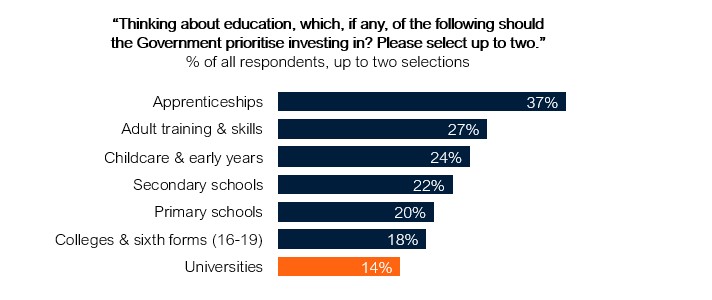
The political outlook for universities only becomes more concerning when you ask people to rank where universities fit in their overall education priorities. Universities finished bottom in the two key voter-rationale metrics we tested. And technical routes finished top.
For example, when we asked voters which stages of education the government should prioritise for funding, university came last:
And when we made voters choose which policies they liked and disliked most, university policy came last:
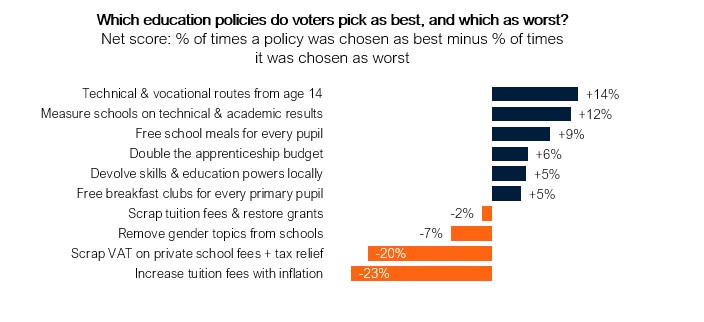
All this indicates that the overall picture for how voters think about education is pretty grim for the university sector. It doesn’t mean that voters on balance think universities have nothing positive about them, or even that they are a net negative, but it does mean that most government action the sector would like to see lacks political buy-in.
Burnham has the public behind him
Bring Andy Burnham into the equation, and this political future looks even more set in stone, particularly with regards to an emphasis on placing technical routes over academic ones.
When blind-testing his education platform in focus groups, voters were consistently drawn to the ideas of giving technical and academic routes equal status, introducing an MBacc-style scheme across the country, vocational pathways for 14-to-16-year-olds, and devolving education power locally.
Our polling shows that education is in fact the policy area on which Andy Burnham is most trusted:
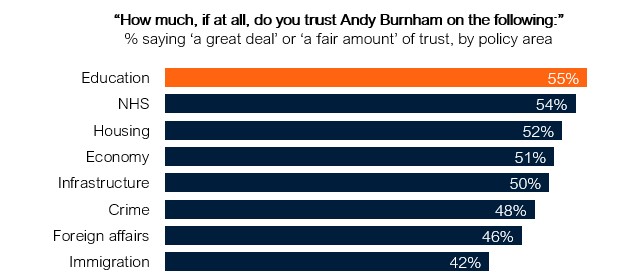
With this combination of high trust and a very popular policy platform, it seems that Andy Burnham’s education agenda is here to stay. And while a greater focus on the “hard hat” as opposed to the “graduation cap” sounds harmless enough in principle, its popularity rests on a voter consensus that places universities bottom of their priority list.
If the university sector is to respond to this political mood, it will need to adapt to these coming changes in wider education policy. And most importantly, it will need to make the case for why the importance of higher education is not mutually exclusive from the importance of technical routes.