Blackbullion’s sixth annual Student Money and Wellbeing survey shows students’ average monthly financial shortfall dropping from £621 to £421.
The trouble is that 88 per cent of students report worrying about money – the highest level the survey has ever recorded.
The explanation isn’t complicated. The shortfall has narrowed not because students have more money, but because they’ve worked harder and expected less – more shifts picked up, more meals skipped, more nights without the heating on.
The gap closes through effort and deprivation, not through improved circumstances – and the cumulative toll of that constant management is what shows up as rising anxiety.
As the report puts it:
It is no longer a cost of living crisis. Rather, a high cost of living is the ‘new normal’ and people have adjusted their attitude accordingly.
The adjustment looks like this – 47 per cent say money worries affect their ability to focus and study, 49 per cent report that hunger has affected their ability to study, and 41 per cent have been too cold to concentrate because they couldn’t afford heating.
One student told researchers:
It’s constant anxiety and worry. I feel totally constrained and I can’t even comfortably eat when hungry, I have to limit my meals and it just makes me feel insecure overall and it distracts me from studying.
The work displacement
The Sutton Trust’s Nick Harrison notes in the report:
…about half of all undergraduates say they have missed classes… so they can do paid work to make ends meet… just under a quarter have missed a deadline or asked for an extension for the same reason.
Ten per cent of Blackbullion’s respondents are working more than 30 hours a week alongside what is nominally full-time study. One student put it as follows:
I constantly feel like I need to pick up every shift available at work to make sure I can pay rent and eat food but then I find I don’t have time to study/revise/do my coursework.
In either words, the instinct is to assume students have closed the gap by picking up more shifts. But the employment data tells a more complicated story.
In this survey at least, in 2023 78 per cent of students were in paid work. By 2025, that had flipped – for the first time, a majority (55 per cent) reported having no paid employment at all. This year it’s back up to 61 per cent in work, but still well below pre-pandemic norms.
The report tentatively suggests two explanations – either students have decided not to work, or they can’t find appropriate work. The latter, it notes:
…makes intuitive sense… as it is a reflection of what is happening more broadly [in the economy].
Students themselves describe a tight market:
I’m struggling right now to get entry level part time jobs and I’m watching my family and older friends make hundreds of job applications with no response.
So the picture may be bifurcating. Students who can get work are doing more of it – 10 per cent are working 30+ hours alongside nominally full-time study. Students who can’t find work are left with no buffer at all. Two different forms of precarity are running in parallel.
Trust without access
When Blackbullion asked students how much they trust various institutions to act in their best interests, universities came out on top – 61 per cent trust or strongly trust. The NHS sits at 57 per cent, employers manage 34 per cent, and the UK government limps in at 23 per cent.
Students believe their university is on their side. So why aren’t they accessing help when they need it? The report identifies a set of barriers that sit between need and action:
Shame and self-blame, often minimising their own need (‘others need it more than me’). Fear of being judged or perceived as irresponsible. Uncertainty about eligibility and outcomes. The administrative burden of applications. Exhaustion and reduced capacity to navigate complex processes.
One student captures it as follows:
I know support exists, but the process feels overwhelming when you’re already stressed and tired.
In other words, students know hardship funds exist. It isn’t a trust problem – they trust the institution more than almost anything else. It’s a capacity problem – the cognitive load of proving you’re poor, gathering evidence, completing forms, chasing decisions are all a significant barrier when you’re already running on empty.
Those most in need are often the least likely to access support early. And the most likely to present when difficulties have intensified.
There’s a parallel in there with Disabled Students’ Allowances, where entitlement and access have long been two very different things. Students can be eligible for support in principle while the process of actually obtaining it remains beyond reach in practice.
The big question for universities is whether they’re measuring provision or access. “We have a hardship fund” is not the same as “students in hardship are helped.” The report really asks institutions to track conversion rates from need to application to award, time from application to decision, and crucially – who doesn’t apply despite apparent eligibility, and why?
Blackbullion’s framing – “design for exhausted users” – makes sense. If the support system requires energy, confidence and administrative competence to navigate, it’s a system that selects for students who are least in need of it.
Worth it?
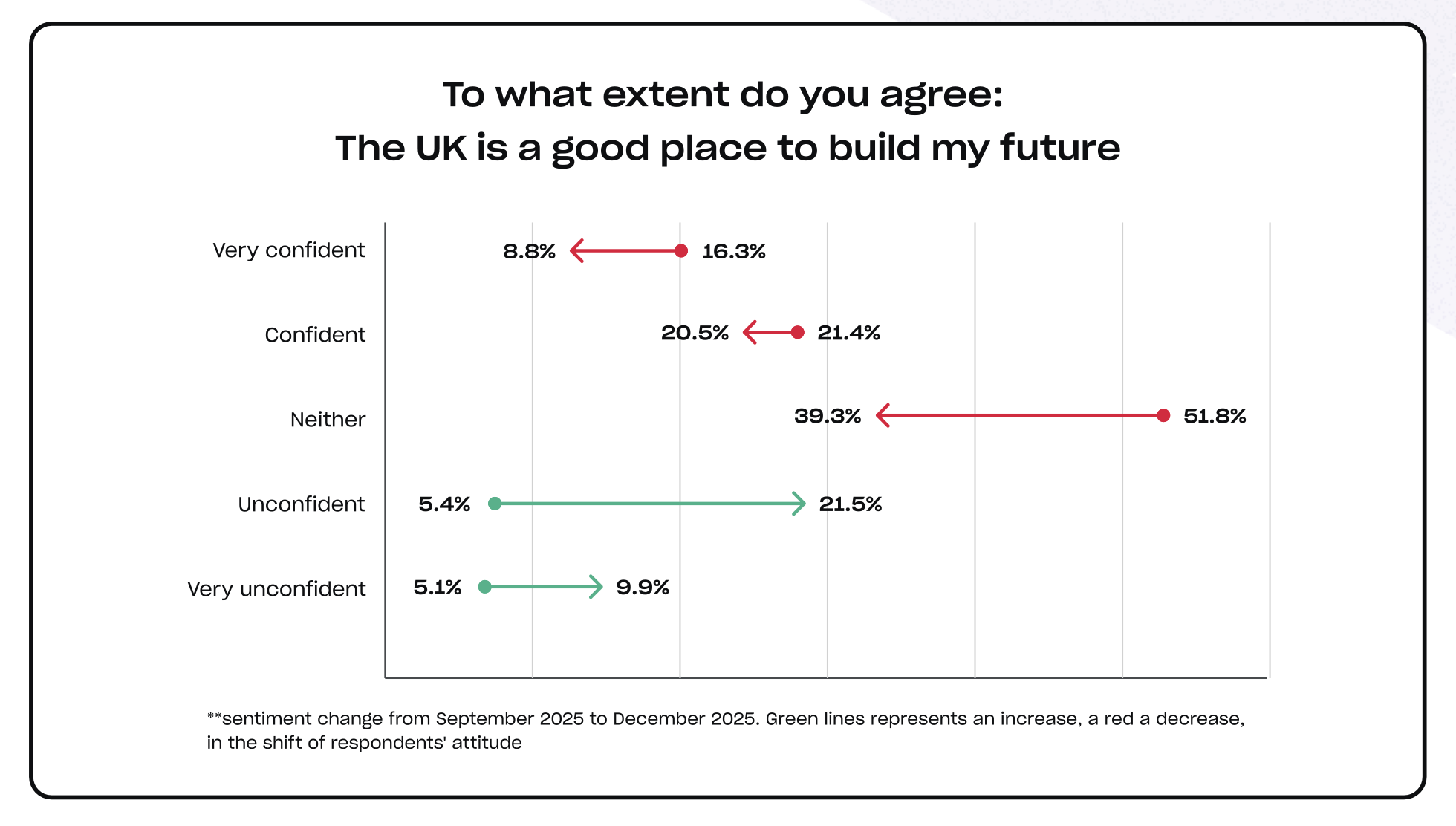
The deeper problem may be what students believe higher education will actually deliver, and whether the struggle will be worth it. Asked about their financial futures, 64 per cent say they have no confidence in their ability to ever own a home, 77 per cent are worried they won’t be able to retire comfortably and 82 per cent are anxious about their earning potential.
This is not the mindset of people who believe they’re making a sound investment. One student puts it like this:
I will spend a lot of money to earn a degree, and it will take years to earn this money.
Another highlights the intergenerational issue:
My parents cannot afford to retire, I am worried about earning enough to be stable enough to get my own house let alone start a family.
Lee Elliot Major, in his foreword to the report, draws that generational contrast sharply. He recalls Monty Don (the gardening presenter) appearing in 1978 BBC footage talking about not being able to afford Cambridge’s May Ball:
Yet Monty Don belonged to a very different generation of students… a cohort who enjoyed full maintenance grants, a burgeoning graduate jobs market, rising real wages, and affordable housing.
For today’s students, Major argues:
…financial insecurity is no longer a temporary hardship on the path to a better life. It has become a structural feature of student life.
The whole sector runs on the premise that a degree is worth the debt. What happens when students stop believing that?
The limits of institutional action
Not that the only solution is “universities need to try harder”. An average shortfall of £421 a month is roughly £5,000 a year per student. If 63 per cent of a cohort reports a shortfall – as Blackbullion’s data suggests – that’s a deficit no hardship fund fills at scale.
UUK’s Vivienne Stern, in her contribution to the report, says:
…there is a limit on what universities can do, given that they are also under financial strain.
In the main, maintenance adequacy is a question for the state. The parental contribution assumptions baked into means-testing are a question for the state. The failure to uprate thresholds in line with wages or inflation is a question for the state. Universities can sand down the edges – subsidised transport, emergency payments, food banks – but they’re bailing water while the hull is breached.
Universities can’t fix a funding settlement they didn’t design. But they can stop building support systems that require students to prove their poverty through bureaucratic obstacle courses, can track not just how much money goes out the door, but who it reaches and who it doesn’t, and can recognise that the students with the greatest need are the students with the least capacity to advocate for themselves – and design accordingly.
The report notes that 71 per cent of students say a lack of money has negatively affected their university experience. That’s not a hardship fund problem – that’s a structural problem. But within that structural failure, there’s a narrower question about whether the support that does exist actually reaches the people it’s meant for.