Wonk Corner|2/04/26 · 16:56
The 22,000 weekend delivery students need information
One of the more unseemly aspects of the weekend delivery loans crisis is the ongoing antics of agents.
Jim is an Associate Editor (SUs) at Wonkhe
On TikTok and Insta, plenty are playing the poaching game – suggesting that students searching for, say, a weekend + weekday evening option can transfer to one of the providers they are working with.
But there’s an only slightly less unseemly set of factors happening via lead (and direct delivery) providers, and their franchised-to partners.
Pretty much the consistent message going out to the 22,000 impacted students that we’ve seen is along the lines of “you have X days to tell us whether you’d like to”…
a) stay on your current mode (guaranteed no maintenance loan after Easter) or
b) switch to an (often as-yet undefined) weekend+weekday mode (you may get a maintenance loan after Easter, but that depends on you agreeing with SLC you’re in hardship, and they may allow suspension of what’s now ordinary debt so that the maintenance can be paid, they may not).
Set aside for a minute the ongoing puzzle of how on earth SLC is going to process what are likely to be the majority of the 22k putting in a hardship claim at an already busy time of the year through a process designed for the odd overpayment.
Let’s assume that some of the students involved are primarily motivated by the maintenance, and that some are primarily motivated by the course and the flexibility it offered.
In this (pretty artificial I know) split, it may well be that none of the former have done anything wrong. There is though anecdotal and statistical evidence that some of those students disappear quickly, and some only sporadically attend.
To trigger fee payments, SLC requires providers to assure over engagement and attendance. I’ve heard several stories this week from those primarily motivated by the course of what I’ll call “creative” ways of monitoring that attendance by less academically motivated students.
Let’s then assume that some of the students involved are in a position to not get that payment in a few weeks, and that some are depending on it.
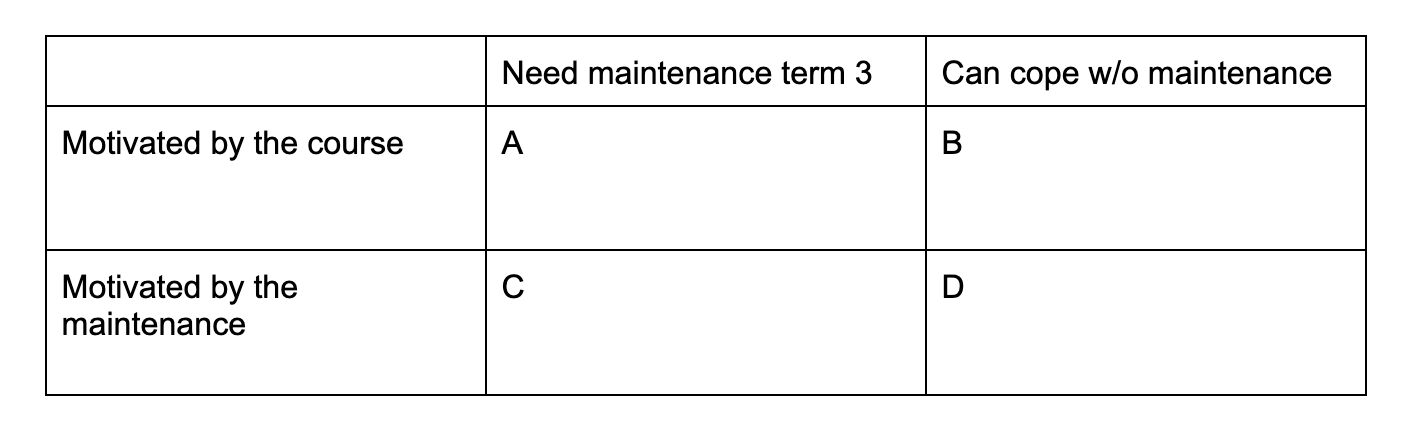
On that four way grid, the perceived volumes in each and your level of sympathy with each may vary. But there’s no doubt that a decent chunk are primarily motivated by the course, in no position to lose next term’s maintenance payment (Box A), and have been royally screwed by the way this is all being handled.
Even if DfE imagines that 21,999 of the impacted students are C or D students (and views the rest as what? collateral damage?) it remains… unclear as to how SLC will be able to assess hardship and debt repayment plans for that volume of students.
Even then, imagine you’re a Box B student in your final year. The prospect of being in “real” debt for 2 maintenance payments is terrifying, and your Box B status means you may not get hardship loans or grants being worked up. And in both Box A and Box B, you’re likely in the middle of preparing for final assessments.
You may well be a student in Box B who wants to pursue staying on as a distance learner. Some of the providers involved charged less for distance learning – do they now hand back the difference, reducing the student’s ICR loan debt accordingly? If you never offered distance learning – are you now charging the same as “in attendance”?
Students may well expect you to not do so. But you’ll need to, partly to provide backup for any argument with SLC over returning part of the fees. Students meanwhile will want to know how much that distance learning offer costs, and whether they’ll be able to not attend, before making a call.
You may be a student primarily motivated by the course who has lost trust in your provider, and/or the lead provider where it’s franchised. You may be a student also experiencing poor delivery – staff that don’t turn up, staff that can’t teach, classes where you’re walked through exactly how to pass. I’ve heard plenty of that this week too.
Either way, you may be desperate to get out. What you’re not necessarily being told are the implications of the pressure you’re under now.
There is also the question of whether any exit award – a CertHE, for example – might be available, and whether providers are making that clear as part of the options being presented. If it is available, it changes the calculus considerably. If it isn’t, or if providers aren’t telling students about it, that’s material information they need to make a decision.
Half measures
Crucially, nothing I’ve seen makes clear to those students that if they started in September/October, if they walk away now, they’ll only have half the year’s tuition fee added to their income contingent loan balance.
The tuition fee loan is paid by SLC directly to the provider – in a franchise situation, the lead university, not the delivery partner – in three instalments across the academic year. The split is 25 per cent, 25 per cent, and 50 per cent.
Those payments are triggered by the provider confirming to SLC, through its Student Information Service, that a student is in:
…active and ongoing engagement with the activities and learning opportunities on a course.
The provider has to do this at three liability points – one per term – which correspond to the term start dates the provider itself registered with SLC when it set the course up.
For a standard September or October start, the floors set by SLC’s Course Management Service mean those liability points fall no earlier than 1 August (term 1), 1 January (term 2), and 1 April (term 3). In practice, most providers will have set term 3 start dates over the next few weeks.
Once the provider confirms a student’s attendance at a liability point, SLC pays the corresponding instalment – and the student becomes liable for that chunk of the tuition fee on their income-contingent loan balance. The provider then gets 25 per cent on the third Wednesday in October, 25 per cent on the first Wednesday in February, and 50 per cent on the first Wednesday in May.
Correspondingly, the student is confirmed as attending at liability point one, they’re liable for 25 per cent. If they’re still there at liability point two, that goes up to 50 per cent. And if the provider confirms them at liability point three, they’re liable for the full amount.
If they withdraw or are withdrawn before the provider confirms attendance at the third liability point, the tuition fee loan liability stays at 50 per cent of the annual fee.
For a winter-start course, SLC’s Course Management Service sets different floor dates for the three liability points – no earlier than 1 January (term 1), 1 April (term 2), and 1 July (term 3).
This time the provider gets 25 per cent after the first Wednesday in February, 25 per cent after the first Wednesday in May, and the remaining 50 per cent after the third Wednesday in October.
Right now – the first week of April – most affected students are sitting in the very narrow window between those second and third liability points. Providers may not yet have confirmed attendance for term 3. The clock hasn’t ticked over.
So on the one hand, for students desperate for the post-Easter maintenance payment to materialise, on the basis that a later hardship claim may unblock it, or at least (via netting off) will start to reduce that now-normal debt balance, you can see why the race is on.
But it’s also very much a race is on situation for the providers. Get the student to confirm they’re not jacking it all in, and the SLC can be told the student is still engaging, and so those all-important fees payments come in. Those payments not coming in may well be existential for several providers, whether franchised-to or lead.
I have heard stories this week both of students being begged to stay on and switch (“you’ve come so far”), and yelled at to do so. Sometimes by the same franchised-to provider.
But for the student who may not end up getting next term’s maintenance anyway, and who is looking at options to get out, it may well be that it’s in their interests to not confirm at all – avoiding the accrual of substantially more tuition fee debt as a result.
Sins of omission
Confirming either way appears to be very much what the Digital Markets, Competition and Consumers Act 2024 regards as a “transactional decision” – partly because it’s accepting a revised set of (at least implied) terms – and there are supposed to be rules that protect the student (consumer) in this scenario.
The student not knowing that if they walk away now would mean their tuition fee debt stays at up to half the annual fee rather than the full whack appears to be a textbook misleading omission under the DMCC Act. The test isn’t whether the provider technically lied – it’s whether it left out material information that the average consumer needed in order to make an informed transactional decision.
It’s hard to think of information more material to the decision “should I stay or should I go” than “if you go now, you owe half; if you stay and we confirm you at term 3, you owe the lot” – especially for the students who are taking seriously the idea that they’ll be in the UK for the rest of their lives and paying back through their payslips. Ditto the fees for distance learning.
Then think about who is actually receiving these communications. These are not seasoned consumers weighing up competing broadband deals. Most are first-generation students, many chose weekend delivery precisely because they needed to work during the week. A good number will be parents, carers, or people managing health conditions – the very reason weekend study was attractive in the first place.
Section 247 of DMCC requires that where a group of consumers is particularly vulnerable to a commercial practice, and the trader could reasonably be expected to foresee that vulnerability, the practice must be assessed from the perspective of the average member of that vulnerable group. The Act specifies that vulnerability can arise from age, physical or mental health, credulity, or – critically – “the circumstances they are in.”
It is very hard to argue that providers could not reasonably foresee that students who have just been told their mode of study is being pulled from under them, mid-year, are in vulnerable circumstances. These are people facing the simultaneous prospect of losing their course structure, losing their maintenance income, and accruing debt for a qualification they may never complete. That is not a neutral commercial context. It is a context of acute stress and financial anxiety, and the providers know it because they created it.
The CMA’s guidance (CMA207) spells this out:
“vulnerability can also be context dependent and is not limited to factors that are intrinsic to the person. This may include, among other things, being in mourning, going through a divorce, or losing a job.
It specifically gives the example of advertising training opportunities to the recently redundant. The analogy here is almost exact – students who enrolled in good faith onto a course mode that has now been yanked are, for DMCC purposes, consumers in vulnerable circumstances to whom a heightened standard of fairness applies.
What that means in practice is that every communication from the provider to these students – every “you have X days to decide” email – is assessed by reference to the average member of this group. A group the provider can plainly foresee is stressed, financially precarious, and in many cases unfamiliar with the mechanics of SLC funding.
Coffin up
So what material information does the student need? At a minimum, they need to know that if they withdraw before the provider confirms their attendance at the third liability point, their tuition fee loan liability will stay at 50 per cent of the annual fee – because that final 50 per cent instalment is never triggered. And they need to know the “price” of distance learning – bearing in mind that some other providers of this type offer it, and charge less for it.
That is, straightforwardly, the most financially significant piece of information bearing on the decision. And from what we have seen, providers are consistently not telling students what it is.
As it may well be breach of contract – or at least represent a cessation event – the usual duty in student protection plans is to facilitate the student in potentially finding another provider if they’re not happy with the change being imposed. There’s not a lot of that happening – unless you count those agents. If DfE and OfS are serious about a franchising crackdown, part of the plan ought to include actively facilitating routes for students who simply want out – or who want to carry on but with a different provider – rather than leaving that to the agents and the market.
If the provider’s communication about the student’s options constitutes an “invitation to purchase” – and a message setting out the terms on which a student can continue on a revised mode of study, complete with pricing implications, almost certainly does – then section 230 kicks in.
That provision requires certain material information to be included in any invitation to purchase regardless of whether its omission would affect the consumer’s decision. The total price of the product is among the categories of information that must be included. Telling a student they can switch to a weekend-plus-weekday mode without making clear what days it’ll run on, what that will cost them in total tuition fee liability, whether a distance learning option exists at a different price point, and how that compares to walking away now, looks like a failure to provide both material and pricing information the Act requires to be given clearly and in a timely way.
Section 226 prohibits providing false or misleading information, and separately prohibits an overall presentation that is likely to deceive the average consumer, where either is likely to cause that consumer to take a different transactional decision.
From what we have seen, several provider communications present the choice as essentially binary – stay on your current mode (and lose your maintenance loan), or switch to the new mode (and maybe get it). The framing is designed to steer students towards switching. Walking away is not presented as a realistic option with its own financial logic – it is treated as an absence of decision, a failure to respond. Nor, where distance learning is or could be available, is it presented as a third option – let alone with clarity about what it would cost.
A provider might say “they can’t just walk away” in their Ts and Cs. But now not offering weekend delivery in way that is consistent with maintenance entitlement may well represent either a breach of contract, or the contract was unlawful in the first place.
Current overall presentation may deceive. It can create the impression that the only financially rational course of action is to confirm one of the two options the provider is offering. It obscures the possibility that for some students, the most financially rational thing to do is neither.
Section 228 prohibits commercial practices that use harassment, coercion, or undue influence, where these are likely to cause the average consumer to take a different transactional decision.
Undue influence is defined as exploiting a position of power in relation to a consumer so as to apply pressure in a way which significantly limits the consumer’s ability to make an informed decision.
The provider holds the student’s registration, controls the SLC engagement confirmation that triggers both fee and maintenance payments, and is the gatekeeper for the student’s continuation on the course. And it is potentially using that position to demand a decision – within a tight, provider-imposed (albeit inherited from SLC) deadline – on terms the provider has set, potentially without giving the student the information they need to evaluate the alternative.
The Act lists specific factors to be considered (section 228(2)) – the timing of the practice, whether it exploits any vulnerability of the consumer (including their circumstances), and whether it requires the consumer to take onerous or disproportionate action to exercise their rights.
The timing could hardly be worse. Students are being asked to make decisions with long-term financial consequences at pace, mid-term, at a point designed to coincide with the narrow window before the third liability point. It is set by the provider, and it aligns with the provider’s commercial interest in confirming students before a fee instalment is triggered.
As for exploiting vulnerability – the provider knows these students are anxious about their maintenance payments. It knows many are financially dependent on that income. And it may be, in effect, framing the decision to stay as the route to getting that payment – while framing the alternative as walking away from both the course and the money. That looks like leveraging the student’s financial precariousness to secure a confirmation that serves the provider’s revenue interest.
The CMA’s own guidance example is almost on point:
Staff working in a funeral director put pressure on a recently bereaved relative, who is deciding on a coffin, to buy a more expensive coffin to avoid bringing ‘shame’ on the family. (Exploitation of a consumer’s vulnerability).
Substitute the bereaved relative for a financially stressed student and the more expensive coffin for a full-year tuition fee liability, and the structure of the practice is notably similar.
Last straw
Even if one were to argue that the individual prohibitions above are each borderline, section 229 operates as a safety net. It prohibits any commercial practice that falls short of the standard of skill and care a trader may reasonably be expected to exercise towards consumers, commensurate with honest market practice or good faith, where the practice is likely to cause the average consumer to take a different decision.
The CMA guidance notes that professional diligence includes:
…having regard to the consumer’s legitimate interests or expectations and taking steps to protect”
…those interests. It is an objective standard.
A provider that communicates with students about a fundamental change to their course, imposes a deadline for response, withholds information about liability for that change, withholds the financial consequences of withdrawal, frames the options in a way that steers students towards the outcome most beneficial to the provider, and does all of this in circumstances where it can plainly foresee that the students are in vulnerable circumstances – that provider runs the risk of being judged to have not exercised the standard of skill and care that honest market practice demands.
The regulator in this space – the Competition and Markets Authority – is nowhere to be seen, as usual. OfS merely regulates whether (lead or direct delivery) providers have paid due regard to CMA’s advice. It is preparing to consult after Easter on a version of its own dedicated regulation on treating students fairly (C5), which is currently in force when judging new providers to the register.
Let’s imagine that a) what comes out will be similar to C5, and b) the new DfE/OfS franchising “crackdown” means many of the franchised-to providers caught in the mess will have to register and be subject to C5.
It requires registered providers to treat each student fairly and is accompanied by a prohibited behaviours list that specifies terms and conduct OfS considers always unfair, a detriment test, and a starting presumption that providers with adverse findings under consumer protection law do not treat students fairly. Much of it mirrors CMA’s consumer protection law guidance.
One of the reasons OfS built C5 and is imposing it on new providers is presumably because it recognised that the old regime was insufficient to protect students in franchise arrangements. These were responses to exactly the kind of information asymmetry and misaligned incentives that are playing out right now.
Today OfS has at least issued guidance to accountable officers that requires that material changes to course delivery receive express student consent, that compensation be offered where students are adversely affected, and that any alternative must comply with consumer protection law. For now, the letter frames this as institutional best practice (“we expect you to…”) rather than as the minimum legal requirement.
It does not spell out that failing to provide material information about liability, or using financial distress to secure a decision the provider needs, may constitute breach of the Digital Markets, Competition and Consumers Act. It does not invoke its own regulation. And it does not clarify what “compensation in compliance with consumer protection law” actually means – whether that includes refunding the difference for distance learning, or unwinding the tuition fee liability where students withdraw before liability point three.
It does say that if students do not agree to a change, then OfS’ expectation is that providers will allow them to continue on the weekend course – but sets no expectation on telling those students how much that course (now distance learning) costs!
Without those specifics, it is a necessary but pretty insufficient response from a student’s POV. And the timing very much suggests that OfS was blindsided here – it’s hard to believe that the key players had thought through any of this in advance of students getting the emails from SLC.
Medium-term, the danger is either that what’s happening now causes regulatory concern (the franchised-to providers don’t make it onto the register, the lead providers are immediately found in breach) or that this becomes another example of OfS regulation failing to do what it says on the tin. All while being led by two new joint CEOs who will likely have had a hand in designing the regulatory framework and the failing student protection regime in the first place when they were at DfE.
None of which is to ignore or set aside the significant risks to providers, and therefore to other students, of the financial difficulties that could yet manifest. They may well also have a case.
But taken together, this is just another reason why this whole situation needs a plan – one that includes facilitating students who want to transfer to another provider, and giving those who want out a clear, informed route to do so – rather than what it looks like, which is a hastily implemented straw-pull from the Kerplunk of HE’s current financial predicament.