

Students have priced in bad jobs. They haven’t priced in bad managers
Jim is an Associate Editor (SUs) at Wonkhe
Tags
In that work, students working over 20 hours a week were 20 per cent less likely to get good honours. Attendance dropped from 64 per cent for those working under 10 hours to 54 per cent for those over 20. And 40 per cent of students working 20-plus hours had considered withdrawing from their course.
But the report’s most important contribution was showing that it isn’t just about hours – students with managers who provide good direction were 10 per cent more likely to be on track for good grades, and those in “achievable” roles nine per cent more likely, regardless of how many hours they were clocking.
Now a new paper from the team behind part of that work has appeared in Education + Training – and regression analysis fills out the findings.
Where Student Working Lives used relative risk ratios across multiple institutions, the authors drill into 271 Business School students at the University of Lancashire to isolate exactly which employment conditions predict mental well-being – and by how much. It’s the same research programme, potentially overlapping data, but a different question asked with greater statistical precision.
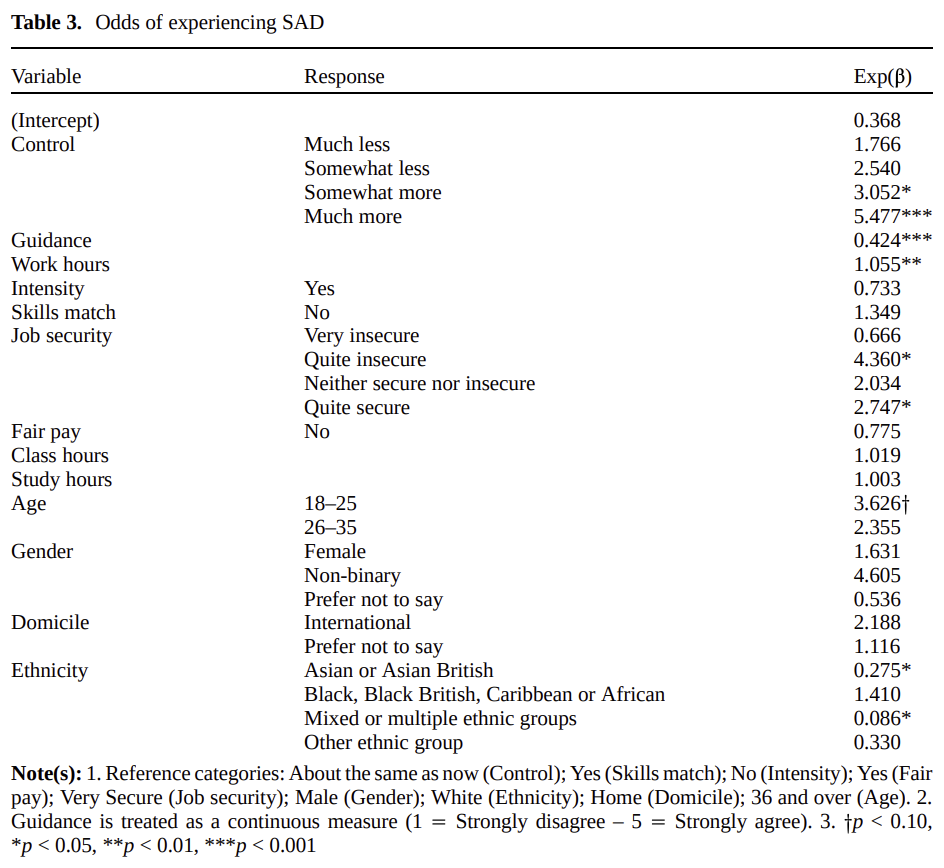
The answer should worry the sector. Control, guidance, working hours and job security all make statistically significant contributions to the odds of experiencing stress, anxiety and depression (SAD). Intensity and skills match – two things you’d intuitively expect to matter – don’t reach significance.
Students aren’t being ground down by how hard or how pointless the work is. They’re being ground down by how they’re managed.
It’s the management, stupid
The standout finding is on control. Students who want “much more” independence and control over their work have odds of experiencing SAD more than five times those of students content with their current level of autonomy – a huge effect size for a single variable.
And for every additional point on the five-point guidance scale – meaning better direction and support from managers – the odds of experiencing SAD fall by a factor of 2.358.
Give a student worker a decent line manager who communicates clearly, trusts them with a bit of responsibility, and doesn’t micromanage every task – it’ll do more for their mental well-being than any number of institutional well-being strategies.
There’s a subtlety that the paper’s own descriptive statistics hint at but the authors don’t fully interrogate. Students who want somewhat less control – that is, those who feel they’ve been given more autonomy or responsibility than they actually want – had the highest raw SAD prevalence of any control category at 47.62 per cent.
The regression doesn’t pick this up as significant in the full model, but the raw number is telling. These aren’t students chafing under micromanagement – they’re students who’ve been set adrift, handed responsibility without adequate support and left to figure things out alone.
It’s the flipside of the guidance finding – what harms students isn’t simply too much control or too little, it’s incompetent management in either direction. The paper’s own theoretical framework – Friedman’s distinction between “direct control” and “responsible autonomy” – should have led the authors to dig into this more.
Working hours matter too – each additional hour worked per week increases the odds of SAD by a factor of 1.055. Over the average 18.58 hours these students are working (well above the 13.5 hours reported in the Student Academic Experience Survey), that compounds. But the effect is modest compared to control and guidance. A student working 20 hours under a decent manager is in better shape than one working 12 hours under a bad one.
It’s also worth noting that guidance and job security are moderately correlated in the study (0.588 on the correlation matrix) – the strongest inter-variable relationship in the dataset. Students with good managers also feel more secure, and vice versa.
It doesn’t hit the 0.8 collinearity threshold – but it does mean interventions targeting line management quality may pay off twice – better guidance and improved perceived security from the same investment. One lever has two outcomes.
Priced in
Almost as notable as what predicts SAD is what doesn’t. 69 per cent of students said their job doesn’t match their experience, training and skills – a huge proportion – but skills mismatch had no significant relationship with SAD.
Students have already priced in that they’ll be doing work beneath their capabilities – they expect it. What they haven’t priced in is being poorly managed while doing it. The problem isn’t that students are stacking shelves, it’s how they’re treated while stacking shelves.
Similarly, 55 per cent of students said they’re not fairly paid – yet fair pay wasn’t a significant predictor of SAD once you control for management quality and security. That doesn’t mean pay is irrelevant – it clearly matters for financial stress, for study impact, for whether students need to work in the first place – but it suggests that the experience of work matters more for mental well-being than the reward for work.
Class hours and independent study hours had no significant relationship with work-related SAD at all. Student Working Lives showed that total workload matters for academic outcomes. But this paper suggests it’s not the volume of work-plus-study that drives poor mental well-being – it’s the quality of the employment itself.
Maybe next week
Being “quite insecure” in your job increased the odds of SAD by a factor of 4.36 compared to feeling “very secure.” But being “very insecure” didn’t reach statistical significance. That’s not what you’d expect – the most insecure students should be the worst off.
The likeliest explanation is that ambiguity does the damage. Students who know their position is precarious have adapted to it, but students who aren’t sure whether they’ll have shifts next week, whether their contract will be renewed, or whether their manager is happy with them – they’re the ones suffering.
Both studies found the same thing on precarity. Student Working Lives reported 38 per cent of students on zero-hours or casual contracts, including one who travelled to a warehouse job only to be told on arrival they were “spare” staff and sent home – losing £24 in travel costs without any work.
Yet zero-hours contracts don’t feature in the regression at all. Contract type isn’t included as a variable, despite being central to the insecurity and control dynamics the paper theorises about. An odd omission in an otherwise careful piece of work.
Nowhere to go
63 per cent of the paper’s sample are international students. Their working hours are legally capped at 20 hours per week during term – the sample average of 18.58 hours means many are already pushing up against the ceiling. And their immigration status creates a power imbalance with employers who know they can’t easily walk away or kick up a fuss.
Student Working Lives painted the qualitative picture – international students are less likely to report their work as meaningful (27 per cent versus 38 per cent for home students), productive (35 per cent versus 46 per cent), or achievable (26 per cent versus 47 per cent). They’re less supported by managers and colleagues.
This paper now quantifies what those conditions do – control, guidance and security are the strongest predictors of SAD, and for international students all three are constrained by immigration law as much as by employer behaviour.
You can train line managers until you’re blue in the face, but if a student’s visa conditions mean they can’t work enough hours to meet their costs, can’t access permanent employment, and can’t challenge poor treatment without risking their right to remain, the intervention that would make the biggest difference isn’t employer behaviour – it’s immigration policy. The paper’s recommendations don’t go there, but the logic of its own findings does.
Against the grain
The ethnicity findings cut across the rest of the findings in ways the paper doesn’t dig into. Asian or Asian British students had significantly lower odds of SAD than White students – 3.6 times lower. Students from mixed or multiple ethnic groups had odds 11.6 times lower. These findings run directly counter to the general workplace mental health literature, which consistently reports higher rates of work-related stress among ethnic minorities.
Given the heavy overlap between the Asian or Asian British and international student categories in this sample, it’s possible that different cultural reference points for acceptable working conditions, or under-reporting driven by visa-related anxiety about being perceived as struggling, explain the pattern.
But the paper doesn’t test this, and it’s a question that needs answering before anyone draws policy conclusions about which groups to target.
Students aged 18–25 had 3.6 times the odds of SAD compared to those aged 36 and over – consistent with the broader literature on young workers. But gender, perhaps surprisingly, wasn’t significant, nor was domicile status once other variables were controlled for.
Small print
A few caveats. The survey was conducted in August and September 2023 – largely outside term-time. Students were reflecting on the past 12 months, but their state of mind when completing the questionnaire may have been quite different from the most pressured periods.
They were paid £5 shopping vouchers – not a huge sum, but the authors acknowledge that engaged students were probably more likely to participate than hard-to-reach students experiencing the worst conditions. The students most damaged by poor working conditions may be exactly the ones who didn’t complete the survey.
The study doesn’t test employment sector as a variable, despite 32 per cent of the sample working in health and social care – far higher than in previous studies and consistent with the Student Working Lives finding that almost one in five international students work in the sector.
Health and social care has very specific control dynamics – shift patterns, hierarchical management, emotional labour, safeguarding requirements. We can’t tell whether the control and guidance effects are being driven disproportionately by students in care work – and given the government’s simultaneous reliance on international students to fill gaps in the care workforce, someone should be looking hard at that intersection.
Read Table 3
Put the two outputs together and the direction is clear. Student Working Lives showed that job quality associates with academic outcomes. This paper shows that specific employment conditions – control, guidance, security – predict mental well-being, and that hours, pay, academic workload and skills match are secondary once you control for management quality.
The policy conversation about student employment – visible in the APPG inquiry, the Black Bullion report, and the SAES commentary – is still overwhelmingly framed around hours. The evidence says the frame is at best only a part of the story.
Student Working Lives recommended that OfS recognise paid work as a risk factor in its Equality of Opportunity Risk Register. These findings would give that risk register something concrete to point at – not just “students are working too many hours” but “students are being managed in ways that damage their mental health, and here are the variables.”
That means the Good Student Employment Charter needs to extend well beyond hospitality into the sectors where students actually work. And the next time a university drafts a well-being strategy that treats student employment as a study-balance problem rather than an employment-conditions problem, someone should hand them this paper and ask them to read Table 3.
Should differentiate for sectors by sort of work.
The researchers should articulate their causal model, which is how they selected the risk factors. If it is all the same, they can get their sample sizes.
The principle issue is supervision. Some organizations just need to fill a shift without any training or oversight: there may be no managers. If you accept the work on that basis, what is there to complain about? Without supervision you do not know if you do know the risks of error, how to avoid the risks, and their consequences, so the uncertainty is likely to cause fear of being reprimanded and no more work.
I am not happy about these sort of statistical studies without qualitative interviews. The concerns may continue or be ephemeral, so setting in train recommendations may not produce a response from employers and could be superceded by the new Employment Rights Act 2025.