The Migration Advisory Committee’s report on the factors that influence how long skilled migrants stay in the UK – Who stays, who leaves? – looks at a decade of data from holders of the skilled worker visa. The MAC is interested to see how propensity to stay in the UK varies across a number of variables, such as age, salary, region, nationality, and gender.
For higher education, there’s one notable finding: those working in the education sector (wherein almost all large sponsoring employers are universities) show “considerably lower stay rates than those working in other industries.” Which is to say that the proportion who remain in the UK after a certain number of years is significantly lower than the other industries the committee looked at (finance, IT, health and social work, professional and technical, and other).
The overall picture is neatly illustrated by this graph:
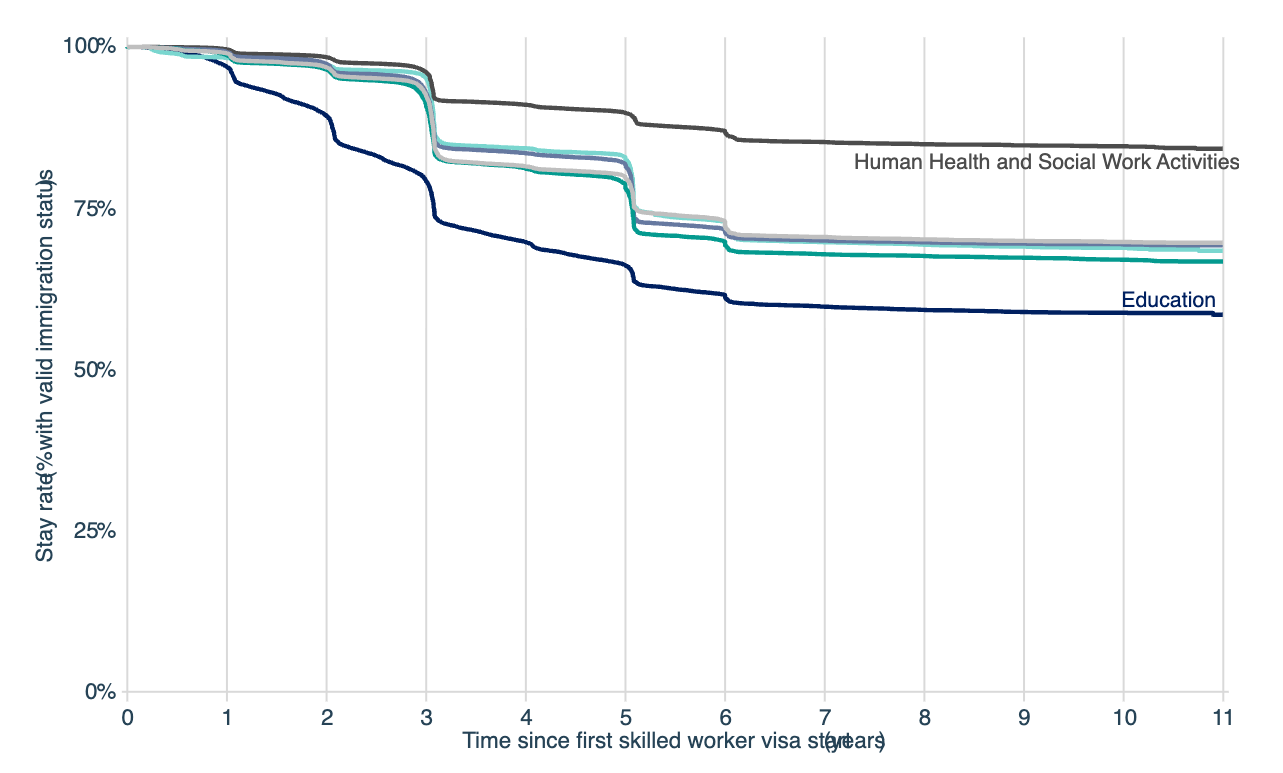
The committee suggests that this
may be a result of typical working practices within the higher education sector where short-term contracts are common for academic staff and workers themselves may be more internationally mobile than those working in other sectors.
It also digs a little further into the data using the SOC codes for a selection of specific occupations, finding that those classed as natural and social science professionals have the lowest stay rates among common occupations:
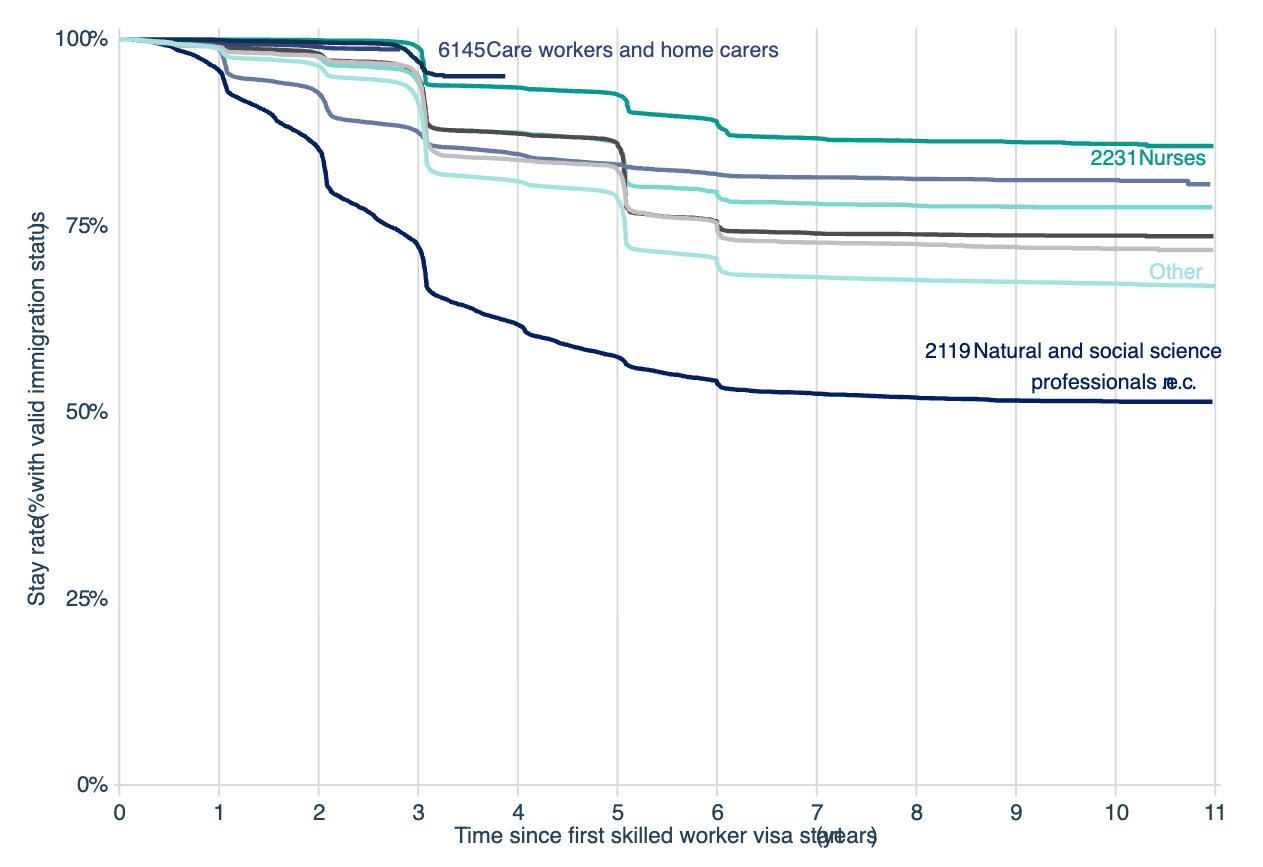
The reasons here, it suggests, are similar (given that all employers sponsoring more than 100 visas in this occupation group were universities). The committee’s logic – that a fair proportion of academic staff will come to the UK on a fixed multi-year basis, and that they are more able to relocate afterwards than many in other occupations – feels reasonably persuasive.
The more interesting thing going on here is the fact of the committee making a connection to the government’s own plans to reform the UK’s system of indefinite leave to remain (which I went over at great length a couple of months ago).
As the MAC puts it (my bolding):
We may speculate that groups with lower stay rates under the current policy – such as higher earners and people working in higher education – could be more susceptible to being deterred by a less generous settlement offer (or may be more likely to leave if they are already in the UK and are moved to a longer path to settlement).
Which is to say, that making it harder to qualify for permanent settlement will not only deter skilled worker visa holders from remaining in the UK – an unsurprising observation in itself, given that this essentially seems to be why the Home Office is doing it – but that furthermore the effects will be more marked among certain groups, and one of these groups is those working in higher education.
Given that the government response to the consultation is still up in the air, and that there has been enormous pushback from (suddenly more powerful) Labour backbenchers – as well as voters in many areas, with the reforms cited as a particular point of contention of the party’s left flank – this intervention from the MAC is worth paying attention to.
To the extent that there has been much policy coherence here, the Home Office’s framing of the reforms to ILR has been as a coded response to the high post-pandemic levels of net migration, with a focus – as objectionable as this might be – on the large numbers of “lower-skilled” workers such as those in social care who came over as a result of workforce shortages (and purposeful changes to migration policy intended to address such shortages). Changes to visa policy in the last couple of years has greatly restricted who can qualify for a new skilled worker visa, but the department has still taken it upon itself to find ways to drive away those who are already here.
But what the MAC’s analysis shows is that making it harder to permanently settle in the UK will proportionally have less impact on this occupation type, and more on – for example – researchers and scientists who have options elsewhere. It’s clearly relevant evidence for a complete re-think, though as we’ve seen all along this policy has depended more on which groups within Labour and the Home Office have the upper hand, and less on what actually makes sense.
Postscript
On a separate topic, there’s a little wildcard recommendation at the end of the report:
Finally, subject to feasibility and data access, in future the Migrant Journey dataset could be joined to other Home Office administrative datasets to produce additional insights. For example, linking to the Confirmation of Acceptance for Studies (CAS) document could enable analysis of visa outcomes by higher education provider and course, including switching patterns into work routes and longer-term retention.
The MAC is still keen to better link up university study details with subsequent labour market outcomes – readers may remember how the committee’s review of the graduate route called for information on degree classifications for international students to be available for analysis (a recommendation which seems to have hit a brick wall). It’s certainly possible that the Home Office will one day get its data systems in order and be able to publish, or at least scrutinise, labour market outcomes and stay rates at the institutional level.