***Update 27th October***Below assumes that new Scotland Tiers are in place from 2nd Nov; Wales firebreak still in place; and NI circuit break still in place***
Here I’ve had a look at the regulations that I think at the time of writing are going to apply in the middle of the first term.
Obviously not all students/ universities/courses have a reading week, and lots of students "go home" for other reasons. Consider this to be illustrative of how we're treating students who are studying away from home rather than a formal guide to legal rights.
In England the government's guidance on T3 (very high) mentions students specifically (it's also the same text for T2):
You can move home and travel to go to university but there are some stricter rules in place for very high alert level areas. You must not move back and forward between your permanent home and student home during term time – subject to limited exemptions set out in law. Students living at their university term-time address in a very high alert level area should follow the same guidance on meeting other people and travel as others in that area. Commuter students (those who live at a family home which may not be in the same area as their university and who travel to/from university each day) should be able to continue to travel to and from their university as required, this being for education purposes.
The below chart applies to UK domiciled students who are studying in the UK “away from home”, and I’m assuming that the student has not formed a formal “bubble” with their parent’s household (the rules in each nation stop you from swapping these around at will).
I’ve also not taken into account any special exemptions for health/wellbeing that may apply (these apply in Scotland for example).
What’s going on here is a mixture of restrictions on leaving a place - which of course would apply to a student’s study location - and restrictions on (other) household visits - which kick in at parent homes. I’m also assuming by the way that someone goes home for a weekend or a week for a visit (that includes an indoor overnight stay) and isn’t “forming a new household” in doing so.
If you spot any errors here, do let me know!
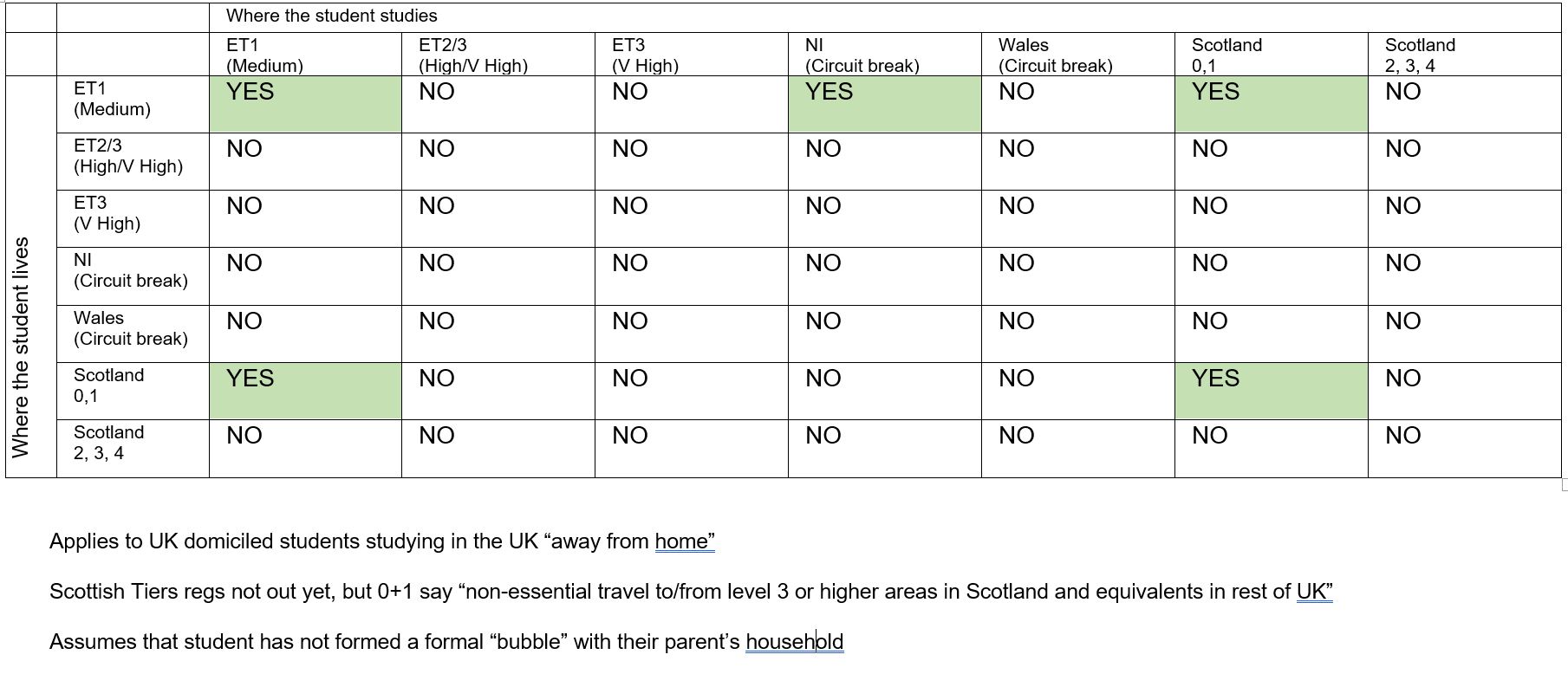
You’ll see that what this does underline is that as things stand for the going home bit (rather than the nonsense around quarantining) it does mean that Christmas requires the creation of some legal exemptions for most students, rather than restrictions.