Higher education quangos: where are they now?
With lots up in the air about sector agencies over the last few months, the White Paper finally give some clarity about direction. At least for now.
This article is more than 10 years old
Policy Watch|

News, analysis and explanation of higher education issues from our leading team of wonks
In recent months we’ve seen an epic battle of the quangos as the agencies have struggled to assert their position in the new landscape. HEFCE, protected by Coalition inactivity after threats emerged with the 2010 government’s spending plans, it is now to be split down the research/teaching divide with the former merging with Research Councils and the latter evolving into the Office for Students (OfS).
“By creating the Office for Students, we will put student choice, teaching quality and social mobility at the top of the agenda in higher education. With UK Research and Innovation we’re creating a strong voice for our world-class knowledge base and ensuring the UK is ready to lead the world in multi-disciplinary research where some of the most exciting breakthroughs are taking place.” Jo Johnson
He’s a run down of the winners and losers.
Adjudication please
There will be a new register of higher education providers, and signing-up to the Office of the Independent Adjudicator (OIA) will be a requirement. This should strengthen the role and level the playing field for student complaints from alternative providers.
Quality street
The Quality Assurance Agency (QAA) will survive, albeit a little bruised, from HEFCE’s recent threats on quality assessment. It should be bolstered by designation from the Secretary of State as the “Quality Body” working under contract to the OfS. The QAA even gets a pat on the back in the White Paper: “The QAA has been at the heart of [international quality recognition], in developing many of the methods, approaches and techniques which have since been adopted across the world.”
R is for reorganisation
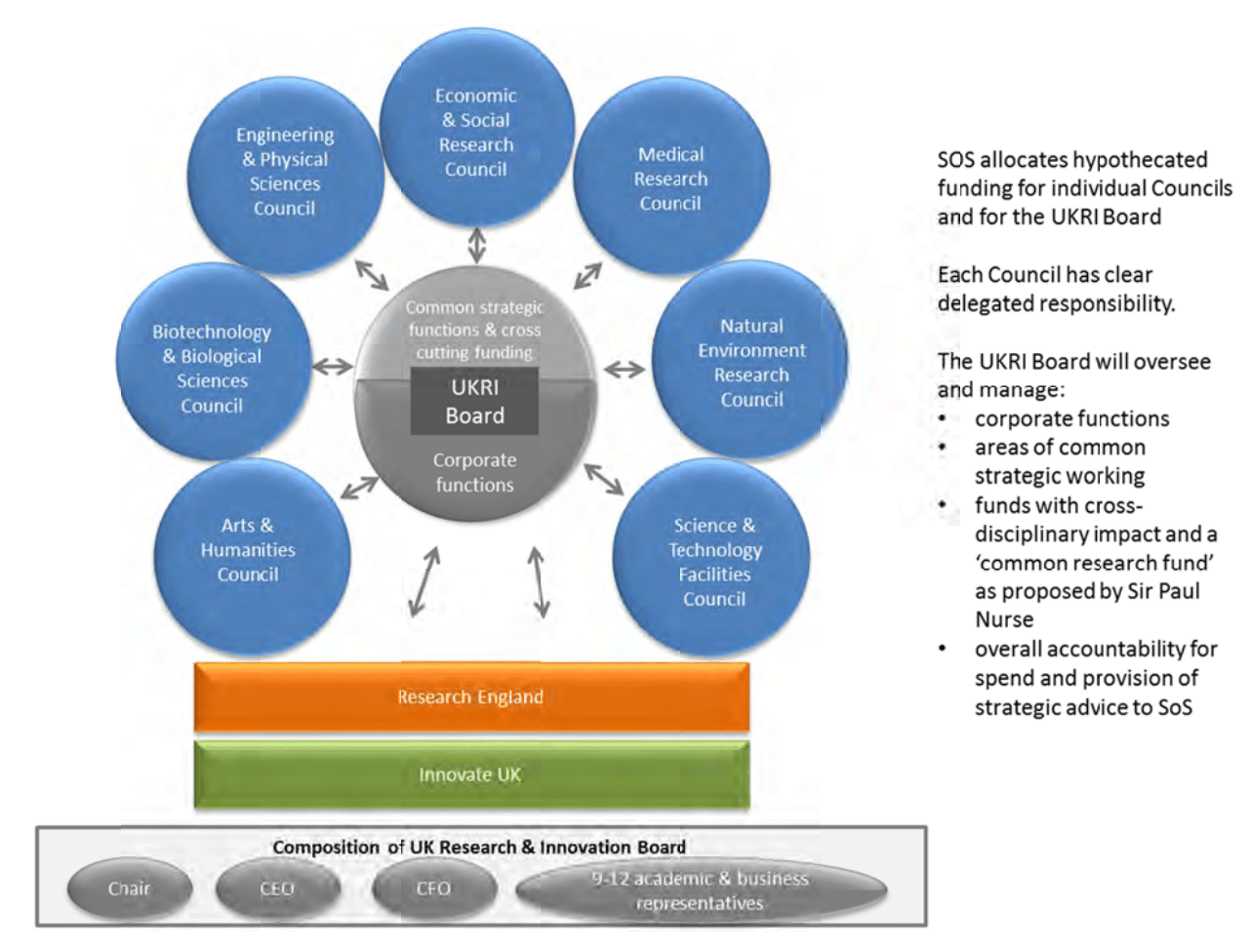
UK Research and Innovation (UKRI) will integrate Innovate UK as well as the seven Research Councils. David Sweeney’s research team at HEFCE is also to join the party with a new organisation – Research England – that will manage QR and the REF. The Haldane principle, that researchers and not politicians should make decisions about research funding, will be protected. The White Paper states that, for the first time, the dual-support principle will be enshrined in legislation.
Below is a diagram of the new system from the White Paper:
 Statistical significance
There’s no planned change for the Higher Education Statistics Agency (HESA), and this is presumed to be the ‘Data publication body’ referenced in the paper.
T time
The non-research HEFCE rump will re-open its doors at the Office for Students on 1 April 2018 and Wonkhe will be ready a sweepstake on the best ‘fools’ joke for the opening day. Staff will be TUPE’d over in what could be an even more unsettling process for the Bristol-based team. It is understood that Tim Melville-Ross will continue to be chair to manage the transition.
OfS will have new powers including some currently held by the Privy Council: granting degree-awarding powers (DAPs) and university title.
The OfS will be funded by subscriptions from providers. In addition to the HEFCE teams, OfS will include the work of the Office for Fair Access (OFFA). The remit will include taking action against wayward providers and operating the Teaching Excellence Framework.
Related articles
Inflation is papering over a £6.4bn hole in the student loan book
Jim Dickinson | Policy Watch | 20/11/26

Phase 2 of Milburn’s NEET report
David Kernohan | Policy Watch | 17/11/26

Continuity and efficiency are UCAS’ watchwords as it confirms no major changes to national admissions process
Debbie McVitty | Policy Watch | 5/11/26