Higher education postcard: Jesus College, Oxford
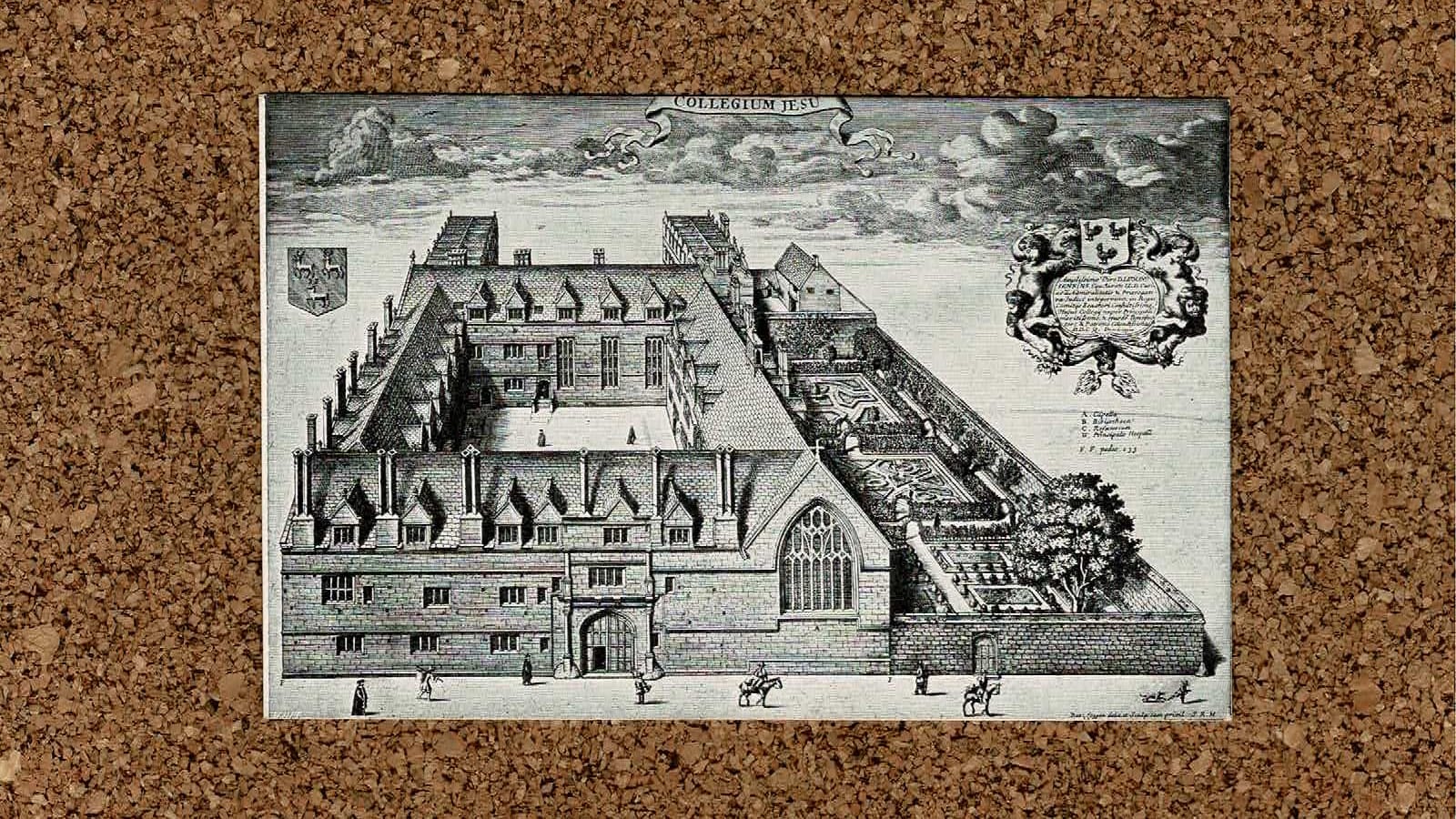
This week’s card from Hugh Jones’ postbag takes us to Oxford’s Welsh College
This article is more than 3 years old
Comment|
Hugh Jones is a freelance HE consultant. You’ll find a daily #HigherEducationPostcard if you follow him on Bluesky
In 1571 Hugh Price, son of Rhys ap Rhys, a butcher of Brecon, persuaded Queen Elizabeth I to establish Jesus College at Oxford.
Price (his anglicized surname derived from Ap Rhys, or son of Rhys) had been educated at Oxford, and was an influential lawyer: being a judge, the treasurer at St David’s cathedral, and prebendary at Rochester cathedral.
The college had some initial objects which might raise an eyebrow today – “to train up the young in true loyalty, to eradicate heresies, to see ‘Sacred Theology’ as the goal of all our scholarship” – but this was a time of intense religious strife. And they don’t do that sort of thing nowadays, anyway. (The quote, by the way, is from the excellent 450th anniversary college history which you can find here.)
The college’s initial focus was on Wales, and it continued this way for centuries. And it depended on some significant philanthropy to survive and thrive. After the Wars of the Three Kingdoms the College’s finances were not good at all. But enter stage left Sir Leoline Jenkins, Principal from 1661, and sometime Secretary of State to Charles II, whose bequest gave financial security. (Leoline, again, is an Anglicization, this time of Llewelyn …)
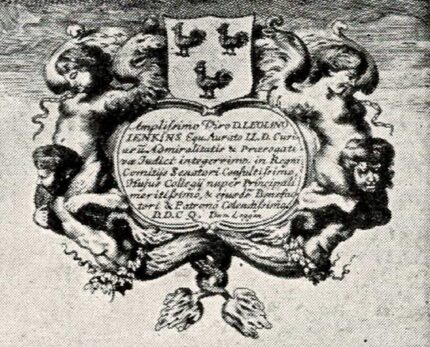
The following century saw the second quadrangle completed. This also gives us an end-date for the image shown on the card – the engraving it reproduces must be from before 1713. If you look very closely, you can make out Leonine’s name inscribed in the legend of the engraving – perhaps the engraving was dedicated to him? Or commissioned by him? (I need better glasses and better Latin to say more than this!)
In the late 19th century the college began to change: some of the scholarships were made open to non-Welsh students.
But there was also the establishment of the first chair in Celtic. Its holder, John Rhŷs, later became principal and Sir. The college’s Welsh connections and culture remained strong.
Consider the career of William Havard. An early graduate of Aberystwyth, he served as a chaplain in WW1, being awarded the Military Cross. He then took up the post as Chaplain of Jesus College, whilst simultaneously studying for a degree in history.
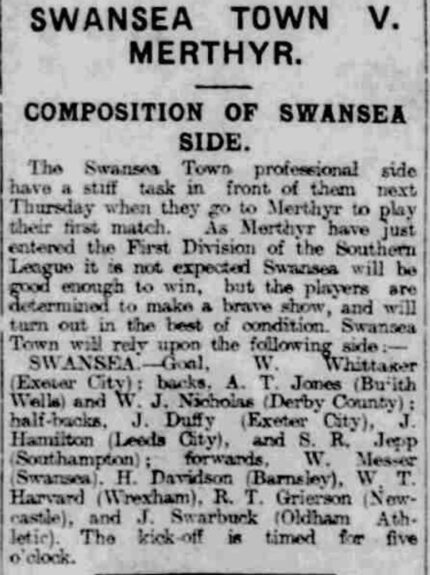
At this time he represented Wales against the New Zealand Army at rugby (Wales lost, naturally). He’d also previously played for Swansea Town at football, scoring its first goal (against Merthyr) in its first competitive season. (The cutting from the South Wales Daily Post of 3 September 1912, which misspells his name, shows the very attacking 2-3-5 formation adopted by Swansea for the game.) And having played for Llanelli Town in the round ball game, he controversially (should he have counted as a professional?) played one game for Llanelli with the oval ball.
The college commemorates St David’s Day and is strongly associated with Cymdeithas Dafydd ap Gwilym, the university’s Welsh language society.
A third quadrangle was added to the college in 1908. Other accommodation has been added elsewhere (the centre of Oxford is a crowded pace). And, significantly, the college admitted women, becoming co-educational, in 1974, one of the first tranche of colleges to do so. It commemorated its 450th anniversary in 2021.
Alumni include T E Lawrence (of Arabia), Harold Wilson, Magnus Magnusson, and my brother Stephen.