Higher education postcard: Christ’s College, Cambridge
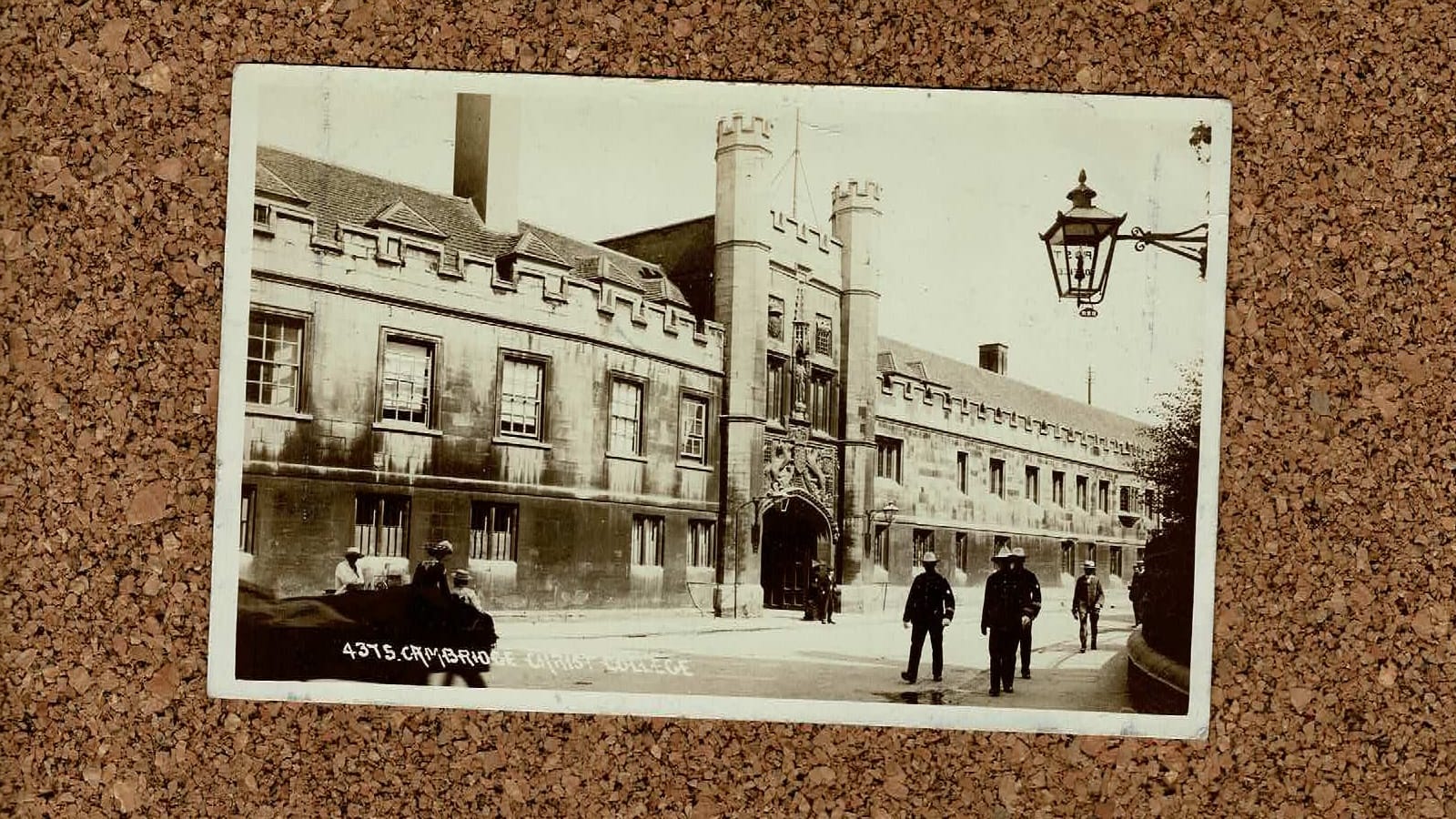
This week’s card from Hugh Jones’s postbag takes us to England’s first training college for secondary school teachers
This article is more than 2 years old
Comment|
Hugh Jones is a freelance HE consultant. You’ll find a daily #HigherEducationPostcard if you follow him on Bluesky
It’s 1437, and the University of Cambridge has eight colleges: Peterhouse, Clare (then called Clare Hall), Pembroke (then called Marie Valence Hall), Gonville and Caius (at the time called the Hall of the Annunciation of the Blessed Virgin Mary), Trinity Hall, Corpus Christi (then known as Bene’t College), and Magdalene (then known as Buckingham College).
A London clergyman – William Byngham, vicar of St John Zachary in the city of London – sought to improve education for children. For which, read boys: we’re even further away from sex equality at this point than we are now. Eventually, with financial help from John Brokley, a former Lord Mayor of London and alderman for Byngham’s ward in the city, he founded God’s House in Cambridge: the ninth foundation in the university. This was aimed at educating masters for grammar schools. And was thus the first training college for secondary teachers.
God’s House received a licence from King Henry VI in 1439; Henry then decided that he wanted to found his own college at Cambridge, and so God’s House was moved from where King’s College now stands. But as a quid pro quo, it gained a charter from the king.
These were turbulent times, the wars of the roses being in full pelt, and the houses of York and Lancaster vying for predominance. By 1485, Henry VII was on the throne, and his mother, Lady Margaret Beaufort, having played a significant role in the power politics of the age, remained a real and vital presence at court. She also undertook charitable works, as was expected of the nobility of the age. This included, in 1505, the re-founding of God’s House as Christ’s College.
More political and religious turmoil arrived in the seventeenth century. By now Christ’s College was recognised as a puritan stronghold. John Milton, poet and, gloriously, Secretary for Foreign Tongues to the Commonwealth Council of State (aka translator of diplomatic Latin) between 1649 and 1660, was a graduate. Milton’s mulberry tree grows in the college’s Fellows’ Garden. Although, to be clear, its connection with Milton appears tenuous at best. It is grown from the root of a tree which was planted in 1609, the year after Milton’s birth. But it seems to be a splendid tree nevertheless.
The college was clearly thriving: an appeal to fellows and alumni in the 1640s raised enough money (£5 million or so in today’s money) to build the Fellows’ Building to enable expansion.
Charles Darwin is another notable alumnus, having studied at Christ’s following his unsuccessful attempt to study medicine in Edinburgh. (The story is that he was traumatised by witnessing surgery, and left the course. Another account is that he was not a diligent student, and his father made him leave and study at Cambridge instead.)
In the twentieth century Christ’s expanded still further, with modernist architect Denys Lasdun designing the New Court, also known as the typewriter.
And one final glorious snippet. The college has what may be the oldest outdoor swimming pool in England, dating from the mid seventeenth century. This is fed by water from Hobson’s Conduit, named for its builder Thomas Hobson. Hobson’s Conduit provided clean water for Cambridge, which would have been revolutionary, and undoubtedly a Good Thing. Even better, Hobson operated an inn with stables, and hired out horses. His practice was to rotate the horse within his stables, and customers could only hire the horse who was next in the rota. This practice – take it or leave it – gave us the phrase Hobson’s choice.
And to complete the circle, here’s an epitaph for Hobson written by John Milton.
Related articles

Boards can’t predict the future, but they can make sure their institution is ready for it
Debbie McVitty | Comment | 19/10/26

What counts as a graduate outcome when the labour market is changing?
Angel Tan | Comment | 16/10/26

Widening participation isn’t finished while background still predicts destination
Hannah Rolley | Comment | 16/10/26