

The mental health taskforce has no budget
Jim is an Associate Editor (SUs) at Wonkhe
Tags
The short answer is that nobody has said.
Its last publication was a report on partnerships between universities and the NHS on 29 January 2026, there’s no note of any meeting held this year, the implementation plan promised for February never appeared, the progress report promised for this month has not appeared either, and the gov.uk page still says the taskforce “will meet until May 2026” without anyone having said whether it did.
The longer answer appeared earlier this month in a freedom of information response, along with something the Department for Education (DfE) didn’t mean to send.
Two totals
The request was as basic as they come – what’s the taskforce’s budget, how much has it spent, and how’s that money split between its workstreams. The reply, dated 7 September, is that none of those things exist:
The Department does not hold recorded information of this kind. The Higher Education Mental Health Implementation Taskforce operates as a stakeholder forum and does not have a dedicated programme budget. We have not identified any consolidated budget, expenditure report, funding allocation document or financial plan relating to the Taskforce itself, nor any funding distribution between Taskforce workstreams.
What the department does hold is figures for two “separately funded programmes” that the forum has discussed.
The Student Support Champion role has had £135,000 in grant funding since April 2023, and the national review of student suicide deaths cost £70,000. That’s £205,000 in total, which for a department that spends over £100bn a year wouldn’t even count as a rounding error – and it’s the entire identifiable cost of the government’s answer to a petition signed by 128,292 people calling for a statutory duty of care.
The margin
But there’s more – or rather, less. Somebody hit print on the PDF with the Word review comments still embedded, and in them an official asks a colleague whether the figures should be broken down by financial year:
“My preference is overall amounts (rather than leading to questions about why Steve West didn’t receive any funding in 25/26 and why amounts varied in different years under EP).
The colleague replies that their own instinct “would have been to set out by FY”, but that if a breakdown “is likely to prompt more Qs” then totals it is, “especially as the requestor hasn’t asked for FY breakdowns, although could come back asking for the split”.
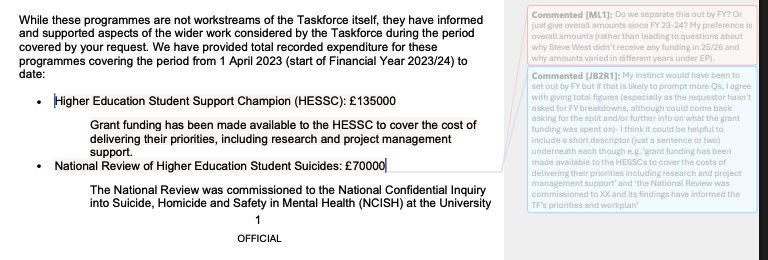
So we now know things that we weren’t supposed to know. The first is that UWE VC Steve West, who took the chair on World Mental Health Day last October and was handed the job of steering the sector’s response to a national review of student suicides, has been doing it for nothing. His budget for getting things done has been nothing as well.
And when officials were asked a straightforward question about money they worked out which version of the truth was least likely to generate another question, and sent that one.
What it says
It’s not really a scandal. No money went missing, because there was barely any money. Nobody lied, because the totals are accurate.
What the margin shows is a culture in which the instinct on receipt of a request is not “what does the requester need to understand this” but “what will stop them coming back” – and, more damningly, an awareness inside the department that the answers to the obvious follow-up questions are embarrassing enough to be worth designing around.
The taskforce was announced in a Westminster Hall debate in June 2023, in front of a public gallery of parents who had each discovered at an inquest that the duty of care they assumed universities owed their children did not exist in law.
They were told that legislation was unnecessary because something better was coming. Three years on, the something better has no budget, no published meetings this year, a terms of reference that says it should meet “at least once every [to be agreed]”, and an official view that the safest way to describe its finances is the one that raises fewest questions.