


There are numerous professions that regularly encounter traumatic narratives and situations. Journalists have to cover conflict, humanitarian workers operate in crisis zones and therapists work with survivors of violence.
These roles differ, but they have one important thing in common: they accept that exposure to distressing material has psychological consequences, and they put support in place.
Academia has been much slower to do so.
For researchers working on sensitive topics, there is rarely any equivalent system of support. Listening to people recount painful experiences is often essential to producing meaningful research, but it comes with real emotional cost. Yet the institutional structures that govern research rarely acknowledge what this can do to the researcher.
Universities are very good at protecting the people we study. They are far less careful when it comes to protecting the people conducting those studies.
Bearing witness has consequences
Qualitative researchers frequently work with individuals who have experienced profound suffering, whether victims of abuse, refugees, veterans, victims of crime or people living through systemic injustice. Many of the accounts gathered are deeply distressing. Exposure to these stories, and the psychological responses they can trigger is known as vicarious trauma.
First identified by psychologists, vicarious trauma can affect a person in profound ways. It can engage emotions, shift worldviews, and negatively affect mental health.
My own research explored the experiences of British military personnel who testified of the atrocities they witnessed during the war in the former Yugoslavia. The original aim was to examine how witnesses experienced giving evidence at war crimes tribunals. But during the interviews something unexpected became clear: the stories themselves carried enormous emotional weight.
One participant described entering a village after a massacre: “Everything was destroyed. On fire. Smashed. Burned. Cows. Dogs. Children. Women… everything, all just shot… all close distance. They had been shot through the head.”
Listening to accounts like this is not just an intellectual exercise. While detaching yourself might seem possible, the reality is that listening to these people recount their experiences comes with a cost. An interview may only last an hour, but the images it creates stay in the mind far longer.
After those interviews I experienced effects I had not anticipated. Insomnia, intrusive memories and emotional reactions, none of which were visible within the formal structures of the project.
My experience is not unusual. A growing body of research shows that sensitive topics can lead to emotional exhaustion, anxiety, disrupted sleep and intrusive thoughts. Yet many researchers are not prepared for these experiences when they embark upon trauma-facing work or adequately supported while they’re doing it.
A blind spot in the ethics system
Most university ethics processes focus, rightly, on protecting participants. Researchers must demonstrate how they will minimise harm, maintain confidentiality and ensure informed consent.
But there is a crucial question missing: how will the researcher be protected? In many cases, they will not be.
Few doctoral training programmes include preparation for trauma-informed interviewing. Structured debriefing after emotionally demanding research is uncommon. Institutional conversations about emotional risk are rare.
Academic culture reinforces this silence. Researchers often feel pressured to appear resilient and professional. Emotional difficulty may be interpreted as weakness rather than a predictable response to distressing material. This is especially true for early-career researchers, who may worry that any sign of vulnerability will damage their career prospects.
Ironically, these are the very people most exposed. Postgraduate and early-career researchers often conduct interviews, transcribe recordings and code data. They spend hours immersed in traumatic narratives, often without the experience or support needed to manage the psychological impact. Many simply carry on, dealing with the consequences alone.
This needs to change. If universities are serious about research integrity, then researcher wellbeing must become an explicit part of research ethics instead of an informal afterthought.
A framework for recognising trauma
One practical tool emerging from my own research is a model called the Vicarious Trauma Reflexive Sequence (VTRS).
The model shows how researchers absorb and work through exposure to traumatic material, from initial emotional impact, through disruption and intrusive responses, to reflection, integration and longer-term resilience
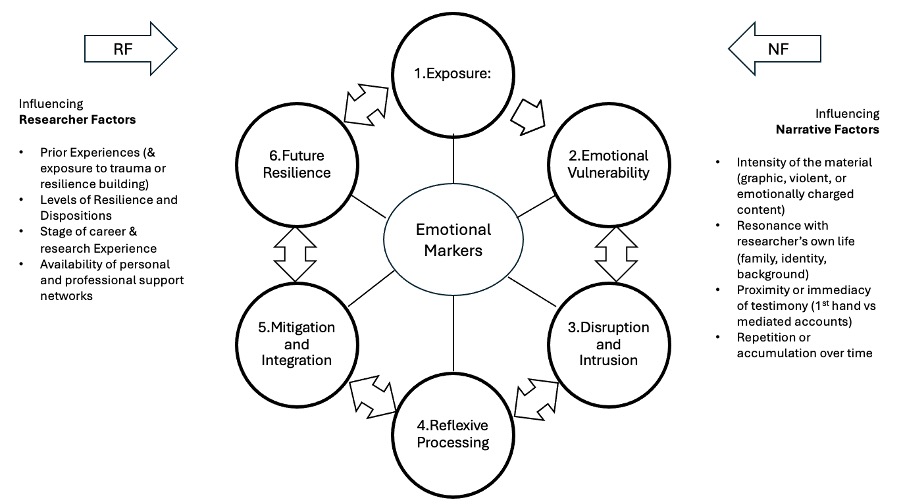
The Vicarious Trauma Reflexive Sequence (VTRS), a model illustrating how researchers process exposure to traumatic narratives.
This model is not intended to be diagnostic. It offers a language for recognising what researchers may be experiencing when working with traumatic material.
Frameworks like this can support supervision, training programmes and research ethics discussions. They also legitimise something academia has historically struggled to acknowledge: research is not purely intellectual work, it’s also emotional labour.
It’s time to re-think researcher care
Higher education has been slow to respond, but the solutions are not difficult:
- training researchers to recognise emotional risk when studying traumatic topics
- structured supervision and debriefing after difficult interviews
- peer support networks that consider researcher wellbeing alongside participant protection
- ethics processes that explicitly address researcher wellbeing
- Institutional cultures that normalise conversations about emotional labour.
None of these will remove the difficulty of this work. But they would create a system of care, so researchers are not left to manage the consequences on their own.
Listening to painful experiences is often necessary to produce knowledge that matters. But if universities expect researchers to undertake such difficult yet socially important work, they must make sure those individuals are properly supported. Otherwise, the consequences become predictable: burnout, long-term emotional harm, and withdrawal from an important area of research.
Research ethics must evolve to protect everyone involved, including the researcher.







I am not personally involved with this but I’m aware of the excellent peer support work ongoing in Scotland on this topic for many years now: https://emotionalresearch.wordpress.com/ = this isn’t mentioned here but hopefully Professor Allen is engaging with this ongoing work too? This has been cross-institutional, led by ECRs and has been the topic of a Wellcome funded project this year for further development.
Sam – thank you for this. I was not aware.
I really appreciate this article as it reinforces something I have directly witnessed while working within research ethics. I was discussing the ethical considerations in a focus group project with a PhD student. The student was very switched onto how a focus group on the sensitive topic of their research could impact participants but when I asked them about their plans for their own wellbeing, they were surprised. They actually contacted me later to say they had reflected on my query and they realised that in a previous focus group they ran on a different (but still sensitive) topic, they were impacted by what they heard but they thought they just had to get on with it. We explicitly ask questions on this in our ethics application, but this needs to be embedded more deeply in research culture as you say.
Tegan, thank you so much for sharing this and for your kind words. It’s wonderful that the student felt they could talk to you about it. It speaks to your skill, professionalism, and the relationship you have built.