South Africa tuition fee u-turn after protests
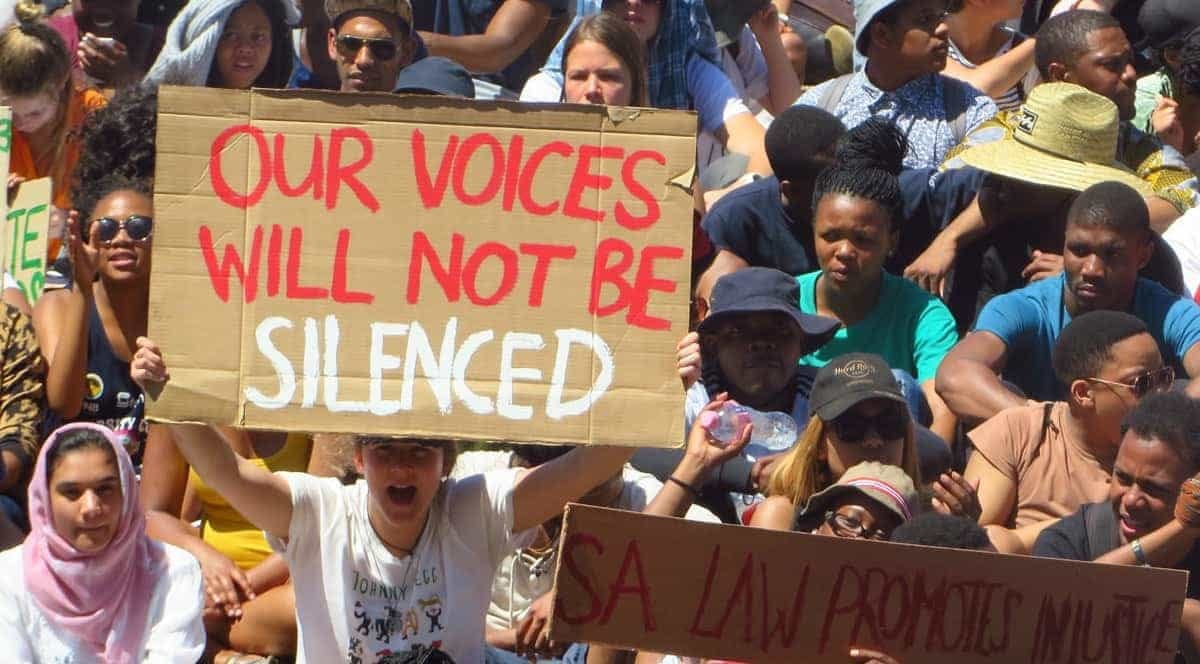
Student protests have caused the South African government to cancel a planned tuition fee increase, with thousands of young people across the country organising demonstrations and clashing with police, but activists are unsatisfied with President Zuma’s response and are calling for free education.
This article is more than 10 years old
Policy Watch|
Zaki is a reporter at Wonkhe.
The South African government has ditched plans to raise university tuition fees after the largest student protests in the country since apartheid.
President and African National Congress (ANC) leader Jacob Zuma announced the volte-face after South African police repeatedly clashed with students as they marched to parliament, railing against proposed fee rises of up to 11.5%.
Marches took place in most major cities, with the most significant demonstration outside the government’s headquarters in Pretoria attracting over 10,000 students.
Police responses, which many considered excessive, involved rubber bullets, teargas and stun grenades after a small minority of protesters damaged vehicles and hurled rocks.
Protests also caused university blockades and led to exams being cancelled and classes being suspended in both the University of Cape Town (UCT) and Rhode University.
Along with the level of fees and the planned increase, protesters have cited a lack of transparency in the fee process, extra charges tabled by some universities and the requirement, in many cases, to pay fees upfront as motivators for the demonstrations.
Students claim that, with South Africa still riven by race inequality, the hike meant discriminating against black families, the average earnings for which are much lower. On average, white households’ income is six times that of black households.
Indeed, protests have at times focussed on colonial statues, such as the one of British imperialist Cecil Rhodes at UCT. Younger generations feel let down by the government and claim free tuition was promised by the ANC when it took power in 1994. Many believe the country has not made the progress expected, including in tackling racial and educational inequality.
Dissent was also voiced in parliament as MPs from the left-wing Economic Freedom Fighters (EFF) party interrupted a speech by the ANC Finance Minister with shouts of “Fees must fall”, one of the protesters’ main slogans, which has been used in a loud social media campaign.
The EFF, which support free education and free primary healthcare for all, are the third biggest force in parliament and were founded by Julius Malema, who was expelled from the ANC in 2012.
Having won 62% of the vote in last year’s general election, the ANC still have a comfortable parliamentary majority, but appear to have felt rattled by the multi-racial coalition of support, which has also crossed class lines, that the protest movement has attracted.
Martin Hall, emeritus professor at UCT (where he was previously deputy vice-chancellor) and until recently vice-chancellor of the University of Salford, wrote on his blog:
“While the cost of higher education is a real and pressing issue, South Africa’s universities are also a barometer of widespread discontent with the pace and direction of change 20 years after the end of apartheid.”
Indeed, many think the protests have tapped into widespread frustration among young people not just at HE policy but at what they perceive to be corruption on the part of the Zuma government.
Hall also says that many students struggle to afford food and housing under the current fee regime and will find it extremely difficult to remain in HE if the cost of tuition goes up again.
Universities originally claimed a fee raise would maintain academic standards in the wake of a shortfall in government funding. But it seems that a number sector leaders place lots of blame on the government for the situation that has unfolded, and some have joined calls for change. A proportion of academics joined marches in solidarity with their students, and University of Witwatersrand vice-chancellor Adam Habib has lauded the protesters for putting HE on the national agenda.
While the u-turn marks a historic moment, student leaders were unimpressed with the President’s failure to address them directly; when Zuma chose to announce the reversal of the fee rises in a press conference instead, many labelled him “a coward”. Some hope to use momentum generated to push for a ban on further increases or, in particular, for free education. Despite what is an unprecedented about-face, there appears to be little prospect of students’ anger dying down overnight.
Comments
New comments will come back with sign-in later this year.
Related articles
Ministers dodge the question of candour in universities
Jim Dickinson | Policy Watch | 12/10/26

Counting the cost of teaching higher education in England
David Kernohan | Policy Watch | 18/09/26
The tone has changed on free speech, but the architecture hasn’t
Jim Dickinson | Policy Watch | 17/09/26
Student loans are still broken and unfair
Jim Dickinson | Policy Watch | 13/09/26

We’re very sorry, and we won’t do it again
David Kernohan | Policy Watch | 4/09/26
Assessing Scotland’s sector finances
David Kernohan | Policy Watch | 28/08/26