LGBTQ+ students mental health: What we’ve found and what the sector needs to do
Equality Improvement Officer Dom Smithies introduces a Student Minds report into the mental health issues faced by LGBTQ+ students.
This article is more than 8 years old
Comment|
Dom Smithies is the Equality Improvement Officer at Student Minds, the UK's student mental health charity.
Over the past year at Student Minds – the UK’s student mental health charity – I have been exploring LGBTQ+ students’ involvement in the local and university LGBTQ+ community; experiences of mental health difficulties; perceptions of peer support and mental health services; and attitudes towards help-seeking. We have now launched a report to share our findings.
Why is this study needed?
There are many instances to highlight the different experiences of LGBTQ+ and non-LGBTQ+ students. The vitriolic free speech debates are one example. I’ll resist the urge to weigh in on that debate here, as it is a complicated discussion on which many have already commented on Wonkhe. I understand why many trans students feel unsafe at their universities, considering that they act as both academic institutions as well as homes to their students. Regardless of whether that fear is legitimate or not, their perception is their reality and it impacts on their experience. Universities, under the 2010 Equality Act, have an obligation to prevent the “creation of an intimidating, hostile, degrading, humiliating or offensive environment” for their students, particularly those with protected characteristics.
Conversely, universities have been identified as being uniquely positive, empowering and liberating spaces for many LGBTQ+ people, and they should be commended for that. They’re a brilliant opportunity for students to learn about a lot of different cultures and identities. They often act as a melting pot where diversity is celebrated. But not always.
Looking at research and policy across the sector, we can see this is an issue that needs attention. The government recently published the findings of their national LGBT survey that asked over 108,000 LGBTQ+ people about their experiences of living in the UK and accessing public services. The study identified a prevalence of mental health difficulties in the LGBTQ+ population and recommended that services be made more inclusive.
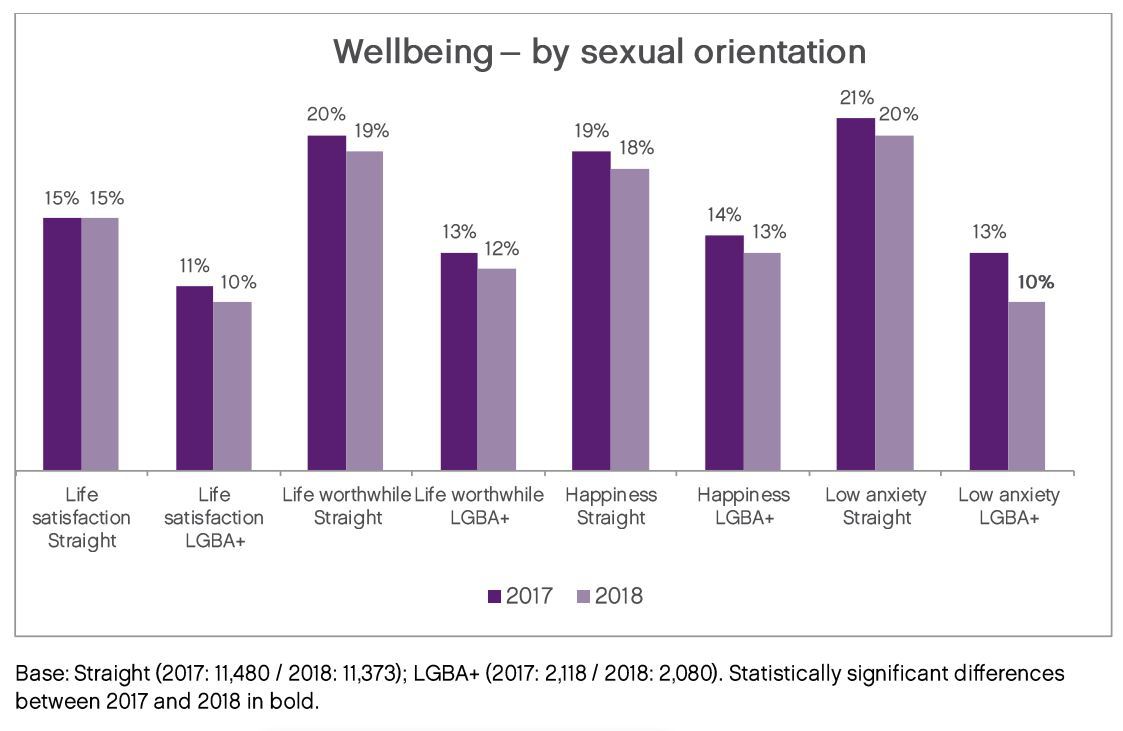
The 2018 Student Academic Experience Survey report by HEPI and the Higher Education Academy noted lower wellbeing scores among the LGBTQ+ population.
Stonewall’s 2018 university report also found that LGBTQ+ students experience difficulties within the university setting, including not feeling able to report bullying, feeling excluded and receiving negative comments about their sexual orientation from peers.
We know LGBTQ+ students’ experiences are different to their peers. Students’ unions have flagged this by engaging students and it is consistently reaffirmed through research. Universities are failing students by not responding to this difference.
What did we find?
We were able to really explore LGBTQ+ students’ experiences of various topics that relate to mental health – engaging in their communities, providing or receiving support from their peers and accessing support services. Headline findings include:
- The majority of respondents (79%) feel that there is a need for further support for LGBTQ+ students.
- Over a quarter (28%) of students do not feel engaged in their university’s LGBTQ+ community and over half (54%) do not feel engaged with the local LGBTQ+ community.
- The majority of students (89%) believe a peer support programme for LGBTQ+ students would be beneficial and most (77%) would engage with such a programme.
- LGBTQ+ students are most likely to seek help or advice for emotional problems from their friends (93%), professionals (75%) or their parents (75%) and least likely to seek help from a telephone helpline (30%).
- When rating the helpfulness of support (from 1 (very unhelpful) to 5 (very helpful)) parents were found to be the least helpful (average of 3.05), while friends (4.15) and professionals (3.69) were rated as more helpful.
- Respondents suggested that their LGBTQ+ societies and representatives were not always warm, friendly or welcoming; they were often perceived to be “cliquey” and exclusive. Where societies are seen as focused on drinking and partying, they were felt to be shutting out those students who sought a supportive space.
- When asking students what could be done to improve LGBTQ+ student mental health, the most common responses were “raising awareness of the challenges facing LGBTQ+ students”, “improving support services” and “wider policy work – to improve universities’ and ‘society’s inclusivity”.
What needs doing?
There is no silver bullet to tackling these challenges. Nor should there be. There are solutions, but a strategic and collaborative approach is required to ensure that the problems are being approached from as many angles as possible. Universities need to lead on this and think strategically about how to support students’ mental health. They need to work with students as partners to ensure services and activities are as good as they can be. Instead of putting all of our effort into trying to boost everyone’s wellbeing, it may be more impactful to prioritise the wellbeing of those who face more challenges and have more needs, and to bring them up to the same level as their peers.
Cultural competence in student services and wider healthcare provision has been an issue and a priority campaign area for many students’ union officers in recent years. Student support services need to hire and train their staff so they are equipped to deal with the needs of their students as well as engaging LGBTQ+ students so they feel comfortable accessing the services. Students’ unions need to continue lobbying for these changes. Organisations that offer specialist training and advice need to be used to provide support.
Inclusivity – or at least perceived inclusivity – of LGBTQ+ societies, sports clubs and wider students’ union activities needs to be acknowledged as an issue. Students’ unions have a long and proud history of being at the forefront of campaigning on issues affecting minorities and marginalised people in society, celebrating diversity and building strong communities. But they need to be sure to also reflect on their own activities and groups to ensure that they are being as inclusive as possible.
The role of parents
Parents have recently become a point of discussion across the sector with regards to student mental health. Nicola Barden recently explored the role of parents in supporting students on Wonkhe. Our research found parents to be the least helpful source of support and advice, with significant variations between students. But this shouldn’t be ammunition to argue against including parents in supporting students. Our research also found that parents are one of the most commonly accessed sources of support and advice. There is a gap here that needs addressing – if students are going to their parents for help, then we need to work with parents to ensure that they are equipped to support their children.
The LGBTQ+ community can, and does, support its members, but greater societal acceptance of LGBTQ+ individuals may go a long way in reducing the need for additional support. I believe that universities and students’ unions have always led the way for wider society to be more inclusive and accepting – they must continue to now, more than ever.
Comments
New comments will come back with sign-in later this year.
Related articles

The civic university agenda has a geography problem
David Clelland | Comment | 14/10/26

Universities are overlooking their established researchers
Steve Joy | Comment | 14/10/26

Educational needs are a higher education issue
David Kernohan | Comment | 14/10/26

Student transition into university shouldn’t be a handover
Katharina De Vita | Comment | 13/10/26

Creating a space and a voice for widening participation professional practice
Tara Webster-Deakin | Comment | 13/10/26

During times of transformation emerging leaders need to be inside the leadership tent
Alistair Jarvis | Comment | 12/10/26