Higher education postcard: Oxford Brookes University
This week’s card from Hugh Jones’ postbag reminds us that it’s shortly the 160th birthday of one of our universities
This article is more than 1 year old
Comment|
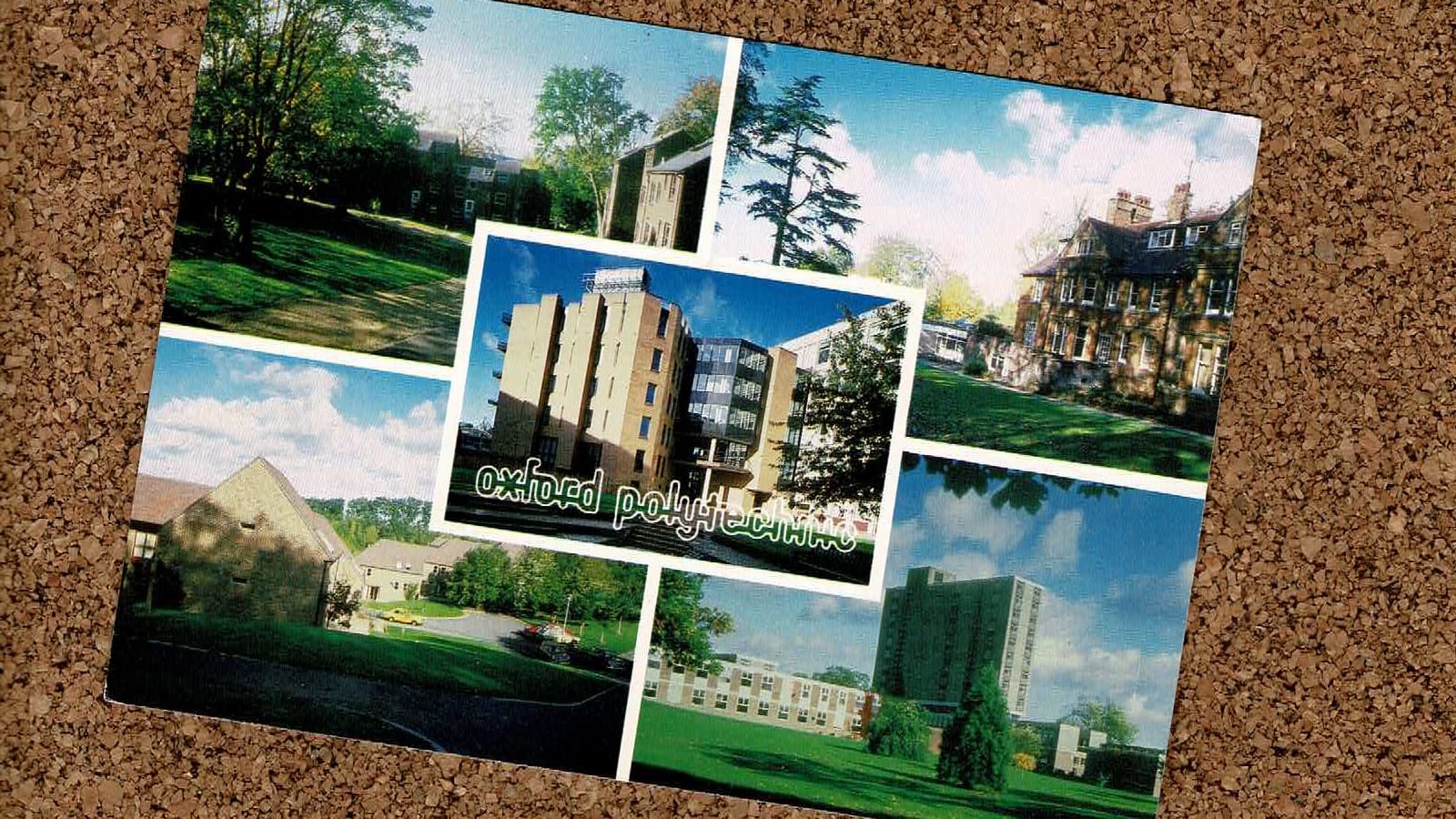
Hugh Jones is a freelance HE consultant. You’ll find a daily #HigherEducationPostcard if you follow him on Bluesky
Greetings from Oxford!
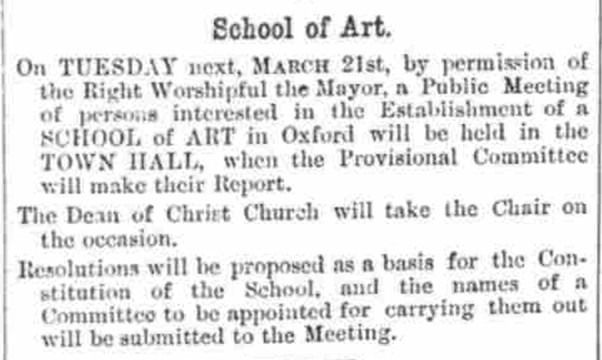
As reported in the Oxford Times, on 21 March 1865 – which by my count is very nearly 160 years ago – a meeting was held in Oxford. This led to the establishment of the Oxford School of Art, which opened its doors to students on 22 May that year.
The initial curriculum included freehand drawing, shading in chalk, perspective and model drawing, figure drawing and anatomy, and painting in oil and watercolour. There were separate classes for men, women, and children under 15. Men and children paid two shillings a month (with discounts for larger periods paid up front); women paid four shillings per month. It isn’t clear to me why the fees were different, but as L P Hartley says, “the past is a foreign country; they do things differently there.”
The school was initially housed on the ground floor of the Taylor Institute, a library for European languages within the University of Oxford. In 1868 or 1870 (sources differ) a school of science was added. But trouble was brewing. John Ruskin, who had recently been appointed as the Slade Professor of Fine Art at the university, did not approve of the way drawing was taught at the Oxford School of Art, and established the Ruskin School of Drawing to address this. The Ruskin School needed space, and so the School of Art and Science was moved to the basement of the Taylor Institute. The Ruskin School of Drawing is now, by the way, the Ruskin School of Art, and is the University of Oxford’s department of fine art. This tells you who won that argument in the long run!
The move to the basement proved short lived. In 1888 chemistry labs in the Wesleyan school, Witney, were used by the school of science. In 1891 the school was taken over by the city council, following legislative changes enabling local authorities to fund education and to act as trustees, and was renamed the Oxford City Technical School. And in 1894 a new site, at St Ebbe’s in Oxford, was acquired for the school.
The new site enabled growth in activities – so rapid that in 1899 the government Department of Art and Science declared it inadequate. Needless to say, the school remained on that site for another fifty years, albeit it also occupied other sites across the city.
We now need to fast forward to 1928 and introduce a new character: John Henry Brookes.
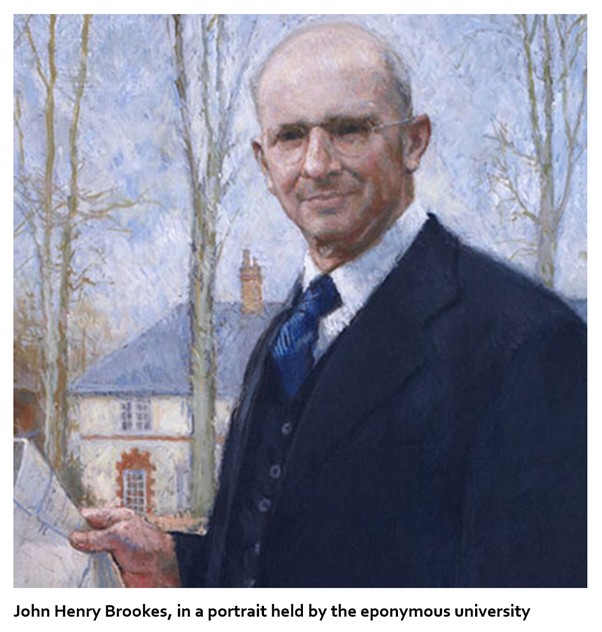
Brookes had trained as a silversmith, and was a part-time teacher of sculpture at the school. In 1928 he was appointed vice principal of the school of art (the schools of art and science were technically separate organisations); and in 1934 when the schools of art and science were formally merged to form the Schools of Technology, Art and Commerce, Brookes was appointed its first principal, and was to remain in that post until 1956.
A pressing issue was accommodation, and in 1949 a 25 acre site in Headington was secured for the school. Planning permission was not granted until 1952, having been initially rejected in 1950, and it wasn’t until 1955 that the foundation stone for the new suite was laid. In 1952 a new name was also given: the school became the College of Technology, Art and Commerce. The Headington site was not formally opened until 1963, fourteen years after the site was acquired.
In 1956 Brookes retired. His impact on the institution was clearly great. The college was once again renamed as the Oxford College of Technology; this and Brookes’ retirement were not, I believe, related events.
In 1970 the college became Oxford Polytechnic and, in line with national policy which encouraged the amalgamation of smaller specialist colleges into more generalist institutions, it started to expand by incorporation. First came the Lady Spencer-Churchill College – this had been an emergency teacher training college, established in 1947. The Oxford School of Nursing joined in 1988; and in 1992 the Dorset House School of Occupational Therapy also joined the polytechnic. And also in 1992, the polytechnic became a university.
Oxford Brookes University was the chosen name, in honour of John Henry Brookes. A few of the polytechnics had chosen names to commemorate local people – for example, Liverpool John Moores, Lanchester Polytechnic in Coventry – but I think Oxford Brookes is the only one named for a former principal. If you know different, please do say!
In 1993 the university acquired Headington Hill Hall, formerly owned by Robert Maxwell, enabling an expansion of the Headington site. And in 2000 Westminster College, a methodist teacher training college, merged with the university.
Being a university sharing a city with the University of Oxford can’t be easy: comparisons will mostly be tiresome. But here’s a surprising one: Oxford Brookes is arguably the best university in the UK at which to row (as in, propel a boat by oars, not argue) – see, for example, this report on the Henley regatta, 2023. Bet you didn’t know that!
And here’s a jigsaw of the postcard, which I found more challenging than I expected.
Happy 160th birthday, Oxford Brookes University!
Related articles

Boards can’t predict the future, but they can make sure their institution is ready for it
Debbie McVitty | Comment | 19/10/26

What counts as a graduate outcome when the labour market is changing?
Angel Tan | Comment | 16/10/26

Widening participation isn’t finished while background still predicts destination
Hannah Rolley | Comment | 16/10/26

Higher education postcard: The Warburg Institute
Hugh Jones | Comment | 16/10/26

If not university then what?
David Kernohan | Comment | 15/10/26

John Healey’s drive for a resilient economy could further squeeze universities
James Coe | Comment | 15/10/26