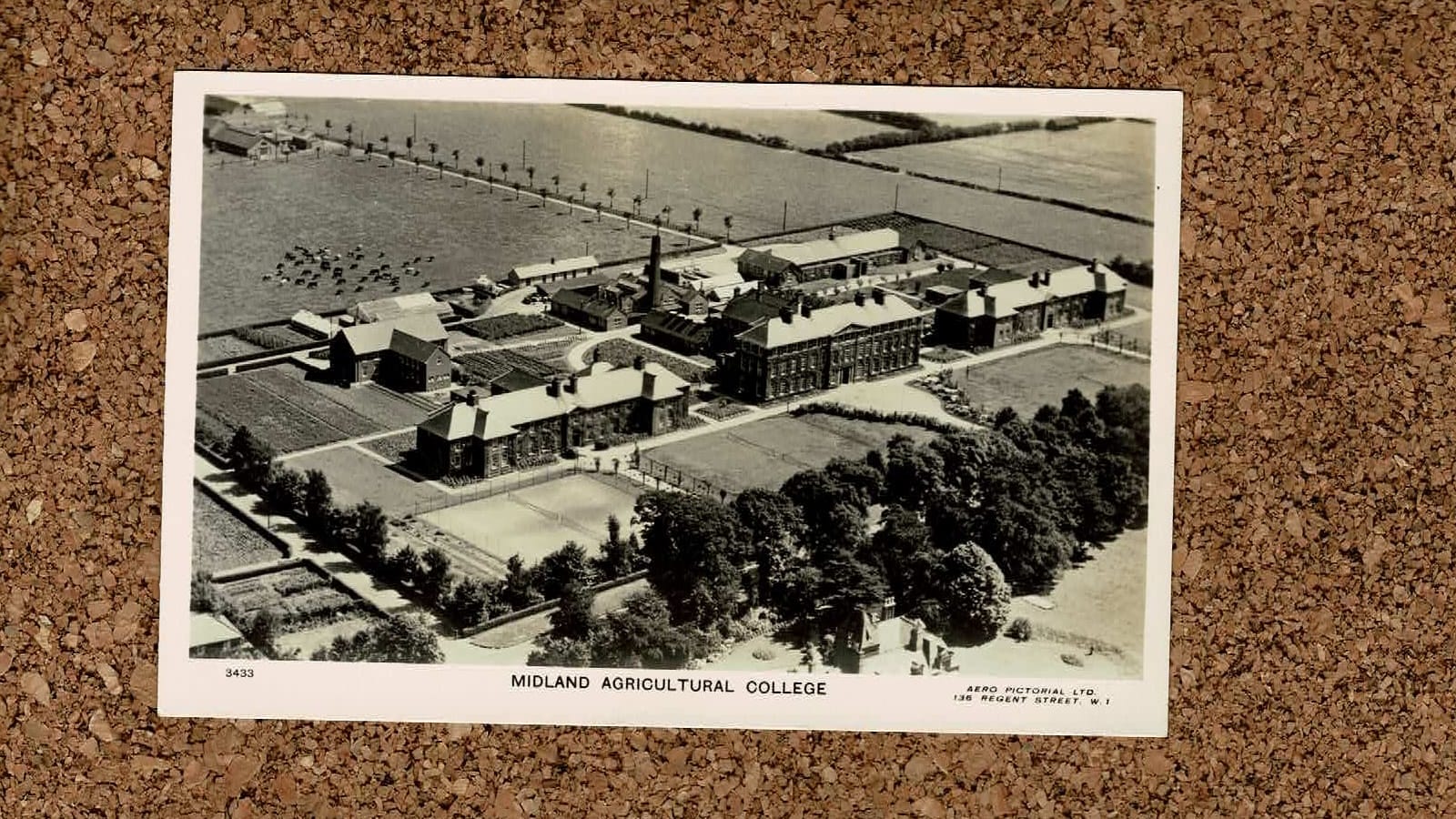
Higher education postcard: Midland Agricultural College
This week’s card from Hugh Jones’ postbag shows the site of a great escape
This article is more than 2 years old
Comment|
Hugh Jones is a freelance HE consultant. You’ll find a daily #HigherEducationPostcard if you follow him on Bluesky
In 1893, University College Nottingham had been admitting students for 12 years. Students could read for a University of London degree, although most simply attended evening classes, and courses were offered in arts and science subjects, in teacher training and in engineering disciplines.
And the college also decided to form an agriculture department which, two years later and in conjunction with a joint agricultural education committee made up of representatives of the various local authorities in the region, led to the formation of the Midland Dairy Institute, in Kingston on Soar – affiliated to the university, but not part of it.
In 1900 the university’s agriculture department did something which many a head of department must, from time to time, have dreamed of. It moved to Kingston on Soar, amalgamated with the Midland Dairy Institute, and formed a new college: the Midland Dairy and Agricultural College. This was independent from the university, and offered theoretical and practical training in everything you’d need to know about running a successful farm: agriculture and horticulture, dairy, and poultry keeping.
It seems that the new college was also the base for the governmental Board of Agriculture’s regional agriculture correspondent – the board being the forerunner of today’s Department of Environment, Food and Rural Affairs (DEFRA). The Board of Agriculture correspondents were honorary posts, with a brief to liaise with the board in London, and to advise farmers.
By 1911 a new site was needed, and 100 acres at Sutton Bonington, a couple of miles further south, was purchased. Building work started but was delayed by the first world war and the site being used as a prisoner of war camp. (The camp, incidentally, witnessed the largest escape by prisoners in Britain of the first world war – 22 German officers crawling through a tunnel. All were, it seems, recaptured.)
In 1919 the agriculture department moved to Sutton Bonington, and in 1928 further building work – presumably to house the dairy and poultry activities – meant that the Kingston on Soar site could be closed.
At some time the college also changed its name, to become simply the Midland Agricultural College. My guess is that this was in 1919 when agriculture was separated, spatially, from dairy and poultry, but this is speculation on my part.
In 1943 the college again became associated with University College Nottingham. A joint faculty of agriculture and horticulture was established, with members from the college and the university college. The principal of the agricultural college, Henry Goland Robinson (see here for his obituary), became professor of agriculture and the first dean of the new faculty.
In 1946 the buildings and grounds were transferred from the county councils to the university college. The money paid by the university college to the councils was used to fund basic agricultural education elsewhere; the work of the Midland Agricultural College focused now on university education and research. In April 1947 the college became the faculty of agriculture and its independence was no more. Here’s the write-up in Nature.
The Board of Agriculture staff moved to the National Agricultural Advisory Service at Shardlow Hall, Derbyshire. This is now an at-risk listed building, its use by the Ministry of Agriculture, Fisheries and Food having ceased in 1986. The Sutton Bonington site is still part of the University of Nottingham, home to veterinary and biosciences courses.
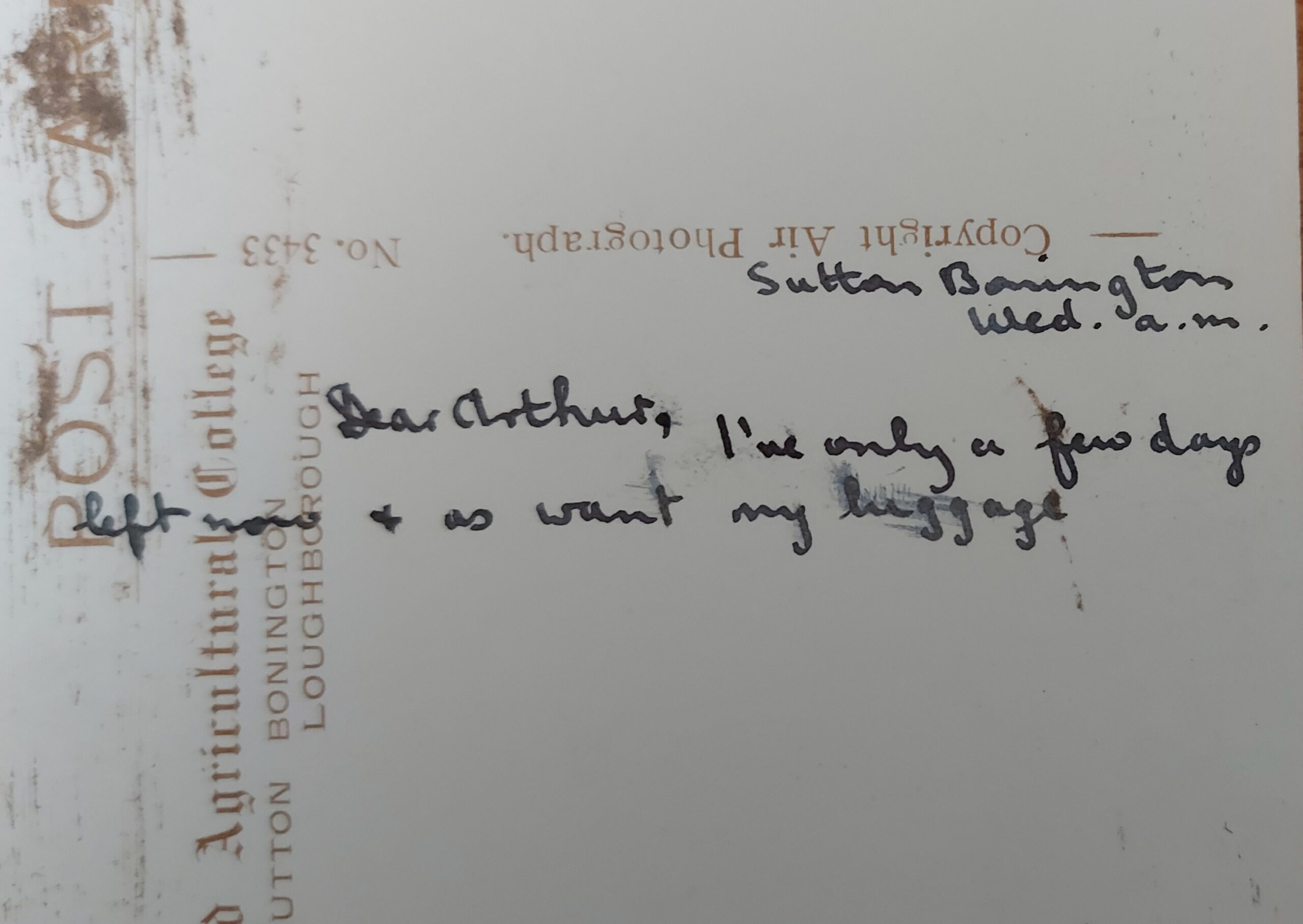
The card itself is enigmatic. Undated, but I would guess from the 1930s. It was never posted, but a start was made at writing a message:
Sutton Bonington, Wed am, Dear Arthur, I’ve only a few days left now and as want my luggage.
And then no more words…
Comments · 5
New comments will come back with sign-in later this year.
Jonathan Woodhead · 1 Dec 2023
I think 1919 is correct. My Gt Uncle studied Agriculture there during that period. No further records survive sadly!
David Kernohan · 1 Dec 2023
This story explains why the University of Nottingham is one of only seven providers where undergraduate students can rent accommodation for a horse.
A small prize for anyone who can name the other six (current and former Wonkhe staff are not eligible).
Hugh Jones · 2 Dec 2023
Six, eh? How about:
Loughborough (equestrian sports)
Aberystwyth
Harper Adams
Royal Agricultural
SRUC
Exeter (because)
Dave Roberts · 5 Jan 2024
I know that Royal Holloway offered stabling at one time as I remember it when mystery shoppong an open day 30 years ago. Very popular feature as I recall.
Steve Rimell · 4 Dec 2023
I’m intrigued by the mystery of the message on the post card itself …
Related articles

Boards can’t predict the future, but they can make sure their institution is ready for it
Debbie McVitty | Comment | 19/10/26

What counts as a graduate outcome when the labour market is changing?
Angel Tan | Comment | 16/10/26

Widening participation isn’t finished while background still predicts destination
Hannah Rolley | Comment | 16/10/26

Higher education postcard: The Warburg Institute
Hugh Jones | Comment | 16/10/26

If not university then what?
David Kernohan | Comment | 15/10/26

John Healey’s drive for a resilient economy could further squeeze universities
James Coe | Comment | 15/10/26