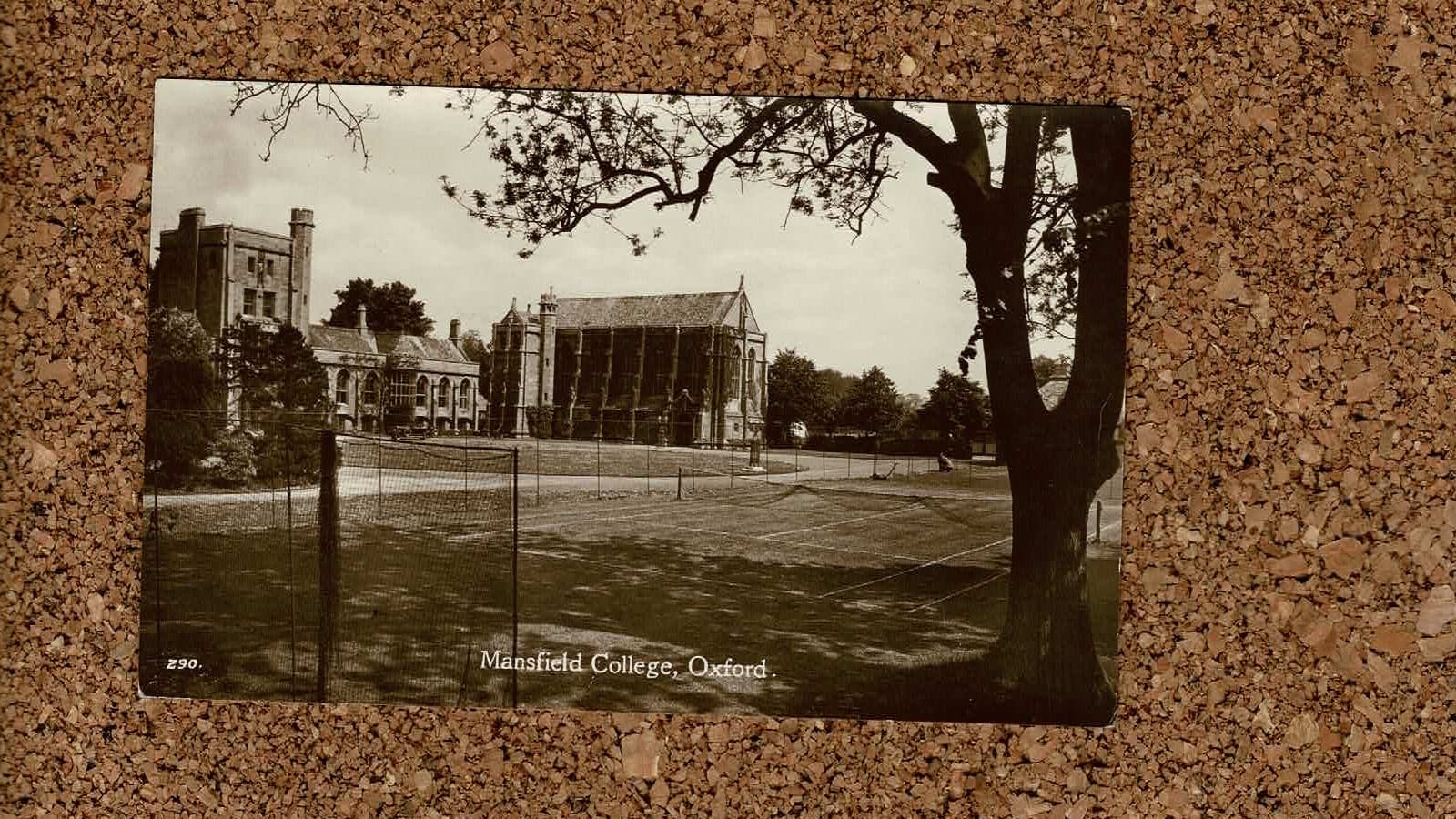
Higher education postcard: Mansfield College, Oxford
This week’s card from Hugh Jones’ postbag takes us to Oxford via Birmingham
This article is more than 2 years old
Comment|
Hugh Jones is a freelance HE consultant. You’ll find a daily #HigherEducationPostcard if you follow him on Bluesky
In 1838 a college was established at Spring Hill in Birmingham, for the education of nonconformists.
At that time in England, you could only graduate at Oxford, Cambridge or Durham if you adhered to the articles of the Church of England. London did not have this test but the options were UCL, which was absolutely without religion, or King’s College London, which was very Anglican. So, if you were religious but not CofE, you faced a quandary. And Spring Hill College addressed this, in part.
The college was founded by three siblings – George, Sarah and Elizabeth Mansfield. It was aimed at congregationalist students, congregationalism being a variety of protestant Christianity. (The name derives from its governance arrangement – each congregation had the power to decide its own forms of worship and confessional statements. The most famous congregationalist was probably Oliver Cromwell.)
The college clearly thrived, expanding its premises to include several private houses, and in 1857 – after all of the Mansfield siblings had died – it relocated to a splendid new building in Moseley, some miles south of the city of Birmingham, but now very much part of that city.
 (The Moseley building for Spring Hill College. Image by Oosoom at English Wikipedia, CC BY-SA 3.0)
But wheels were turning in the wider world. In particular, the requirement to conform to the Anglican faith to graduate in some universities was being relaxed. The Oxford University Act 1854 abolished religious tests for admission to the Bachelor of Arts degree. The Cambridge University Act 1856 did much the same for Cambridge. Durham changed its regulations in 1865 to remove the test; and finally the Universities Tests Acts 1871 removed all vestiges of tests at Oxford, Cambridge and Durham except for theology degrees.
This had the effect of making Oxford more viable as a location, and in 1886 Spring Hill College moved to Oxford, renaming itself as Mansfield College in honour of its founders. (Or apparently, in honour of George and Elizabeth. Why Sarah was not so included I have not been able to find out.) And in 1889 it moved to the buildings shown on the postcard, on land which had been bought from Merton College.
Mansfield was not yet a college of the University of Oxford, and its students matriculated through other colleges of the university, or studied as external students at the University of London. It was for men only – as most colleges were at that time – although in 1913 Constance Coltman was admitted to study for a University of London bachelor of theology. Coltman had previously studied at Somerville College, and was one of the first women in the UK to be ordained as a church minister. The college became co-educational in 1979.
Mansfield College was admitted as a permanent private hall – something like a probationary status – in 1955. Full collegiate status was granted in 1995.
In 2011 the college adopted two formal Latin graces to be said pre-supper. One is religious – Benedictus benedicat – “may the blessed one bless”. The other is secular – nullius boni sine socio iucunda possessio est – “no good thing is worth having unless it is shared”.
Related articles

Boards can’t predict the future, but they can make sure their institution is ready for it
Debbie McVitty | Comment | 19/10/26

What counts as a graduate outcome when the labour market is changing?
Angel Tan | Comment | 16/10/26

Widening participation isn’t finished while background still predicts destination
Hannah Rolley | Comment | 16/10/26