Higher education postcard: Churchill College, Cambridge
This week’s card from Hugh Jones’ postbag comes to you straight from the 1960s culture wars
This article is more than 1 year old
Comment|
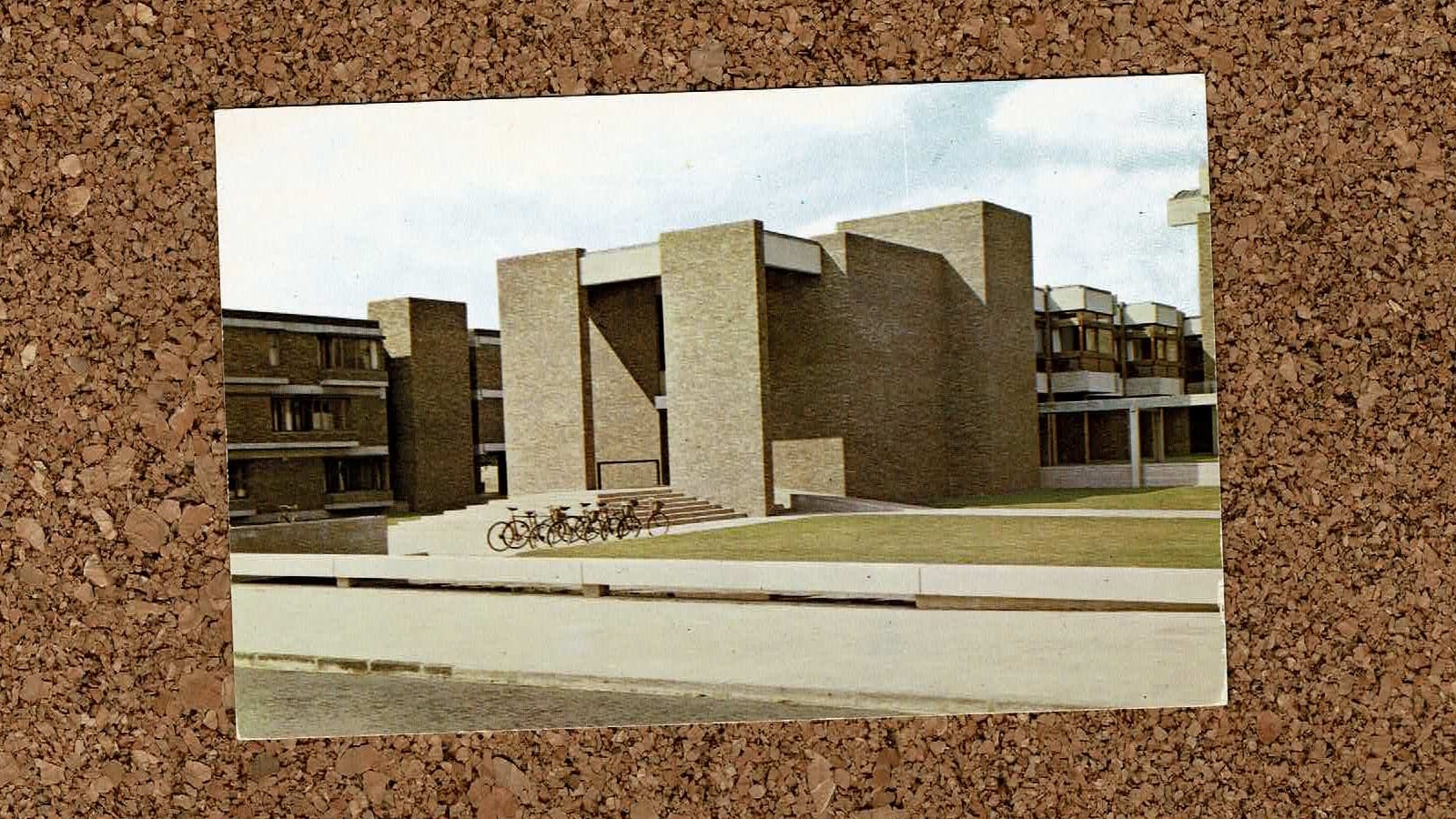
Hugh Jones is a freelance HE consultant. You’ll find a daily #HigherEducationPostcard if you follow him on Bluesky
It’s 31 March 1949, and Winston Churchill, now Leader of the Opposition, was visiting the Massachusetts Institute of Technology.
He was impressed by what he saw, and thought that the UK should have its own version, a postgraduate university focusing on science and technology. Fast forward six years, and Churchill had retired after his second spell as Prime Minister. His private secretary, John Colville, sought to progress the idea, but could not make as much progress as he had hoped.
Parallel with, and unconnected to, Churchill’s idea, Shell Petroleum had since the early 1950s been hosting meetings at which leading British industrialists identified a need for a specialist institute to train people for the science and engineering industries. Again, this came to nothing.
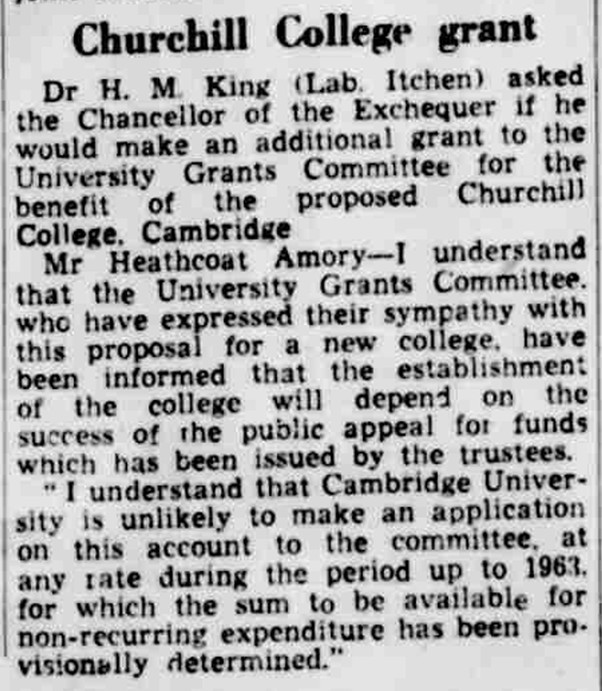
But then in 1957 the two schemes were revivified and brought together. Alexander Todd, Nobel Prize-winning chemist, worked with Carl Gilbert, chairman of Gillette and sometime US trade representative, to make the case for a Cambridge college which would focus on science and technology. And one which would stand as a memorial to Churchill. And so in 1958 an appeal for funds was made (as can be seen from the Scotsman of 21 May 1958, no public funds would be available at first), with some £3.5 million being raised to finance the college and its initial activities.
The money was raised, with contributions from industry and also from the Transport and General Workers Union (which all confirms L P Hartley’s motto in The Go-Between: “the past is a foreign country; they do things differently there”). And it was a period of industrial largesse to higher education: in researching this piece I came across a wonderful article – in the Brechin Advertiser (29 July 1958) but no doubt syndicated more generally – by Richard Martin, on the donations to Churchill College, St Catherine’s Oxford, and for new buildings fore engineering at UCL. “The universities have been given the financial tools, and they will not fail to finish the job.”
Very deliberately, although the college was intended to focus on science and technology, it would not exclude the humanities. This was the period of C P Snow versus F R Leavis, two cultures versus one. Snow – scientist, civil servant, novelist – argued in The Two Cultures and the Scientific Revolution that the problems of society were exacerbated by the failure of many who would be considered well educated (ie in the humanities and classics) to know anything about science:
A good many times I have been present at gatherings of people who, by the standards of the traditional culture, are thought highly educated and who have with considerable gusto been expressing their incredulity at the illiteracy of scientists. Once or twice I have been provoked and have asked the company how many of them could describe the Second Law of Thermodynamics. The response was cold: it was also negative. Yet I was asking something which is about the scientific equivalent of: ‘Have you read a work of Shakespeare’s?’
(To avoid embarrassment at this point, I will remind you that the second law of thermodynamics states that the entropy or disorder of a closed system is always increasing. Which you already knew.)
Snow’s view was attacked (there is no better word) by critic F R Leavis in 1962: Snow was a philistine; his vision soulless technocratic utilitarianism. Viewed as an attack which played the man not the ball (but note here a defence of Leavis from 2013), the row did not do much to damage Snow’s view.
The founders of Churchill College clearly thought there was merit in Snow’s views; hence the requirement that only 70 per cent of the entry be for students of science and technology.
The college was given a Royal Charter in 1960, and admitted a few postgraduate students in that year. The first undergraduates arrived the following year. By 1966 Churchill had been admitted as a full college of the university and by 1968 all of the original buildings had been completed and opened.
Churchill College was amongst the first of Cambridge’s all-male colleges to admit women (in 1972). Its senior tutor – Dick Tizard – sought to broaden admissions to focus on grammar school and comprehensive school students, not focusing on the public schools. He also worked to achieve the admission of students to membership of the college governing body, in 1969.
In 1970 the Churchill College JCR, along with the University of Bristol Students’ Union, persuaded the NUS to take up an appeal by two students – Julian Fox of Bristol, and Hugh Nelson Ricketts of Churchill – against decisions of the local returning officers to disbar them from the electoral register because they were not permanently resident at their term time addresses. The Court of Appeal – with Lords Denning, Widgery and Karminski – on 12 May 1970 granted the students appeal. The OfS now requires universities to assist students in registering to vote: quite some distance has been travelled in this matter!
Winston Churchill is not without controversy. In 2020 the college announced a working party which would organise a year-long programme – on Churchill, race and empire. The university archives hold some recordings from this. Not, perhaps, surprisingly, this attracted a considerable amount of media attention and criticism: Churchill is a revered figure for some in Britain. The college cancelled the series of events in June 2021.
There’s a very readable history of the college on its website (click on “the college’s first decade” in the fuchsia box), by the way, from which I’ve drawn fairly heavily in this account.
And here’s your jigsaw of this week’s card – enjoy!
Comments · 1
New comments will come back with sign-in later this year.
David Kernohan · 14 Feb 2025
I don’t think I could ever let a reference to CP Snow go by without recommending his “Strangers and Brothers” sequence of novels.
In particular, “The Masters” (which is a wonderfully claustrophobic account of the election of the master of a Cambridge college), “The Affair” (which returns to the same college to deal with a charge of academic misconduct), and “The Sleep of Reason” (which deals, in part, with academic governance and student conduct at a thinly disguised University of Leicester)
Related articles

Boards can’t predict the future, but they can make sure their institution is ready for it
Debbie McVitty | Comment | 19/10/26

What counts as a graduate outcome when the labour market is changing?
Angel Tan | Comment | 16/10/26

Widening participation isn’t finished while background still predicts destination
Hannah Rolley | Comment | 16/10/26

Higher education postcard: The Warburg Institute
Hugh Jones | Comment | 16/10/26

If not university then what?
David Kernohan | Comment | 15/10/26

John Healey’s drive for a resilient economy could further squeeze universities
James Coe | Comment | 15/10/26