Death by no higher education
Nora Ann Colton looks at evidence from HE “cold spots” to explore whether there is a link between higher education and life expectancy.
This article is more than 8 years old
Analysis|

Nora Ann Colton
Nora Ann Colton is professor of economics and Education Director at UCL’s Institute for Ophthalmology and Moorfields Eye Hospital.
In 2014, HEFCE published maps that revealed "cold spots" in higher education provision across England.
These maps revealed gaps in subject provision, student mobility, and graduate employment. Though this work was significant in providing useful information for higher education providers and local authorities, there is more to the question of educational "cold spots”. There has always been an understanding that a lack of employment opportunities, poverty, and deprivation lead to higher mortality rates, but recent research suggests a link between a lack of higher education provision and high rates of mortality.
Learning and life
In recent years, the government has starting pushing for universities to account for the outcomes of their students, with these outcomes defined broadly in graduate earnings metrics. There is some merit in understanding the employment outcomes of graduates, particularly given that students borrow to finance their education, but this approach does not take a holistic view of life or of the true impact of higher education on it. It does not take note of the mission of different higher education providers, nor of the countless reasons why a student goes to university. And, importantly, it misses the link between a person’s health and their educational attainment.
Princeton economists Anne Case and Angus Deaton have identified a marked difference in American mortality rates by race and education, with white males and females without university degrees displaying worse health than those with degrees. Case and Deaton assume that cumulative disadvantage from one birth cohort to the next is triggering progressively worsening labour market opportunities at the time of entry into the labour market, due to low levels of education.
Last resort
A case in point of such “death by no higher education” in England is found in Blackpool. The city stands out on a number of markers. Demographically, Blackpool is predominantly white with 96.7% of its population classified as white compared to the nationwide average of 86%. According to the Lancashire Area Review of August 2017, only 21.9% of the population of Blackpool has a higher education qualification - far lower than the average of 37.1% across the country. Blackpool also has high levels of benefits claims with 16.9 percent compared to 8.7 percent in England. This is also from Lancashire Area Review document.
Blackpool also stands above the nationwide average in terms of suicide rates. At 27.1%, the rate of male deaths from suicide and injury of undetermined intent was significantly worse in Blackpool than it was across England as a whole (15.3%) in 2016. In the same year, Blackpool was the local authority in England with the highest overall mortality rate (1,288 per 100,000), according to the Office for National Statistics (ONS). What we can see in Blackpool is an example of cumulative disadvantage. The average male in Blackpool can expect to have 18.9 fewer years of healthy life expectancy than those from the least deprived areas of the country. In fact, nearly half (47.2%) of the economically inactive people in Blackpool aged 25 to 64 were recorded as such because of long-term sickness or disability.
Trend in Mortality from Suicide and Injury Undetermined 2001-2013 (Persons aged over 15)
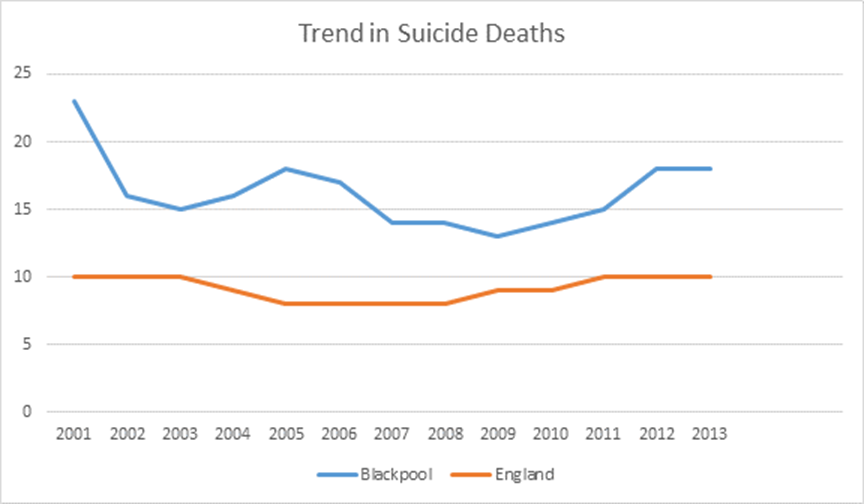
Source: JSNA Blackpool: Joint Strategic Needs Assessment
Could higher education be the “disease” marker for Blackpool? Demand for higher education is increasing in the city, like the rest of the UK, and the number of jobs available for lower-skilled workers is falling. Future jobs demand for Lancashire will be in the professional occupations. As a result, getting a degree matters more now than it ever has.
Figure 2: Future job demand for Level 4+ qualifications
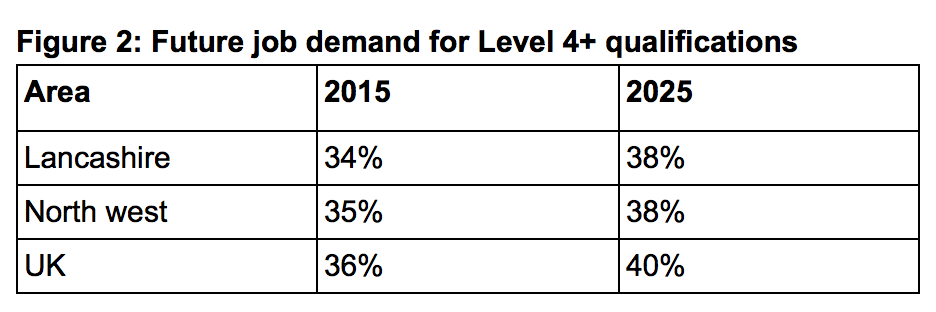
Source: Lancashire Area Review, August 2017
HE dividend
Research shows that better-educated people live in less-polluted areas, tend to be less obese, are more physically active, are less likely to smoke, and do not as frequently engage in risky behaviours. In her 2017 book The Sum of Small Things, Elizabeth Currid-Halkett looks at the consumption patterns of the aspiring elite. She notes that, with mass production, the wealthy no longer distinguish themselves from the rest of the population solely on conspicuous consumption. In fact, what we are seeing is that the wealthy now spend more on inconspicuous consumption. They are focused on healthy living which often involves healthier food choices, exercise, travel, and a focus on lifestyle - while those on lower incomes spend a higher proportion of their incomes on housing, cars, and the like. She notes that, income aside, education is the biggest predictor of conspicuous vs inconspicuous spending. Education expenditure in the US has increased by 60% since 1996, with the top 1%, 5%, and 10% income fractiles having increased their share of education expenditures by almost 300% during the same period. The children from these households benefit from this increased investment in education and go on to obtain the highest paying jobs.
In October 2017, then-education secretary Justine Greening announced that Blackpool would be one of the first six social mobility “cold spots” to be receiving extra funding and support. As one of the government’s opportunity areas, it should see more joined-up DfE programmes, as well as local partnerships formed of schools, local authorities, universities, and others - in order to improve attainment at school, as well as education and employment opportunities for school leavers. All this could be good news as long as this scheme is ageless. Otherwise, Blackpool could continue to lose many of its sons and daughters before it sees the longer-term benefits of investing in young people.
Health outcomes through HE
We all want to see the economic returns to a university education, most often through a graduate job and higher earnings, but we also need to recognise that higher education is about nurturing and educating people. A reductionist approach to higher education, its mission, and its impact fails to recognise the profound effect that it can have on an individual in terms of shaping their quality of life, health and life expectancy. If everyone in England had the same death rates as the most advantaged people, we could enjoy between 1.3 to 2.5 million extra years of life, according to Stephen Armstrong.
If a university education is the best signifier of future good health and high earnings, the higher education sector needs to get its messaging right. This approach requires that we recognise that higher education and the missions of universities are more than simply getting a student a job. Institutions must work with the government and the health sector to ensure these life changing outcomes. The higher education sector needs to start adopting this approach to fulfil its role in ensuring that we not only have a better-educated working population, but a healthier one as well.
Related articles

Whose universities are they anyway?
Jim Dickinson | Analysis | 4/09/26
We say we value diverse research, but can we assess it?
Ola Thomson | Analysis | 27/08/26

Accommodation matters, for foundation year students too
Wendy Ashall | Analysis | 26/08/26

Going deeper: Student loans, public expenditure and the devolution funding gap
Jim Dickinson | Analysis | 25/08/26