A decade on the bus – some of our fave moments from Wonkhe SUs study tours
Jim Dickinson goes back through ten years of study tour blogs – and finds that the best lessons were rarely about other countries having more money
SU Blogs|
Jim is an Associate Editor (SUs) at Wonkhe
Ten years ago, a group of SU officers and managers met on the fringe of the SUs 2017 conference to dream up a study tour of students’ unions in Scandinavia.
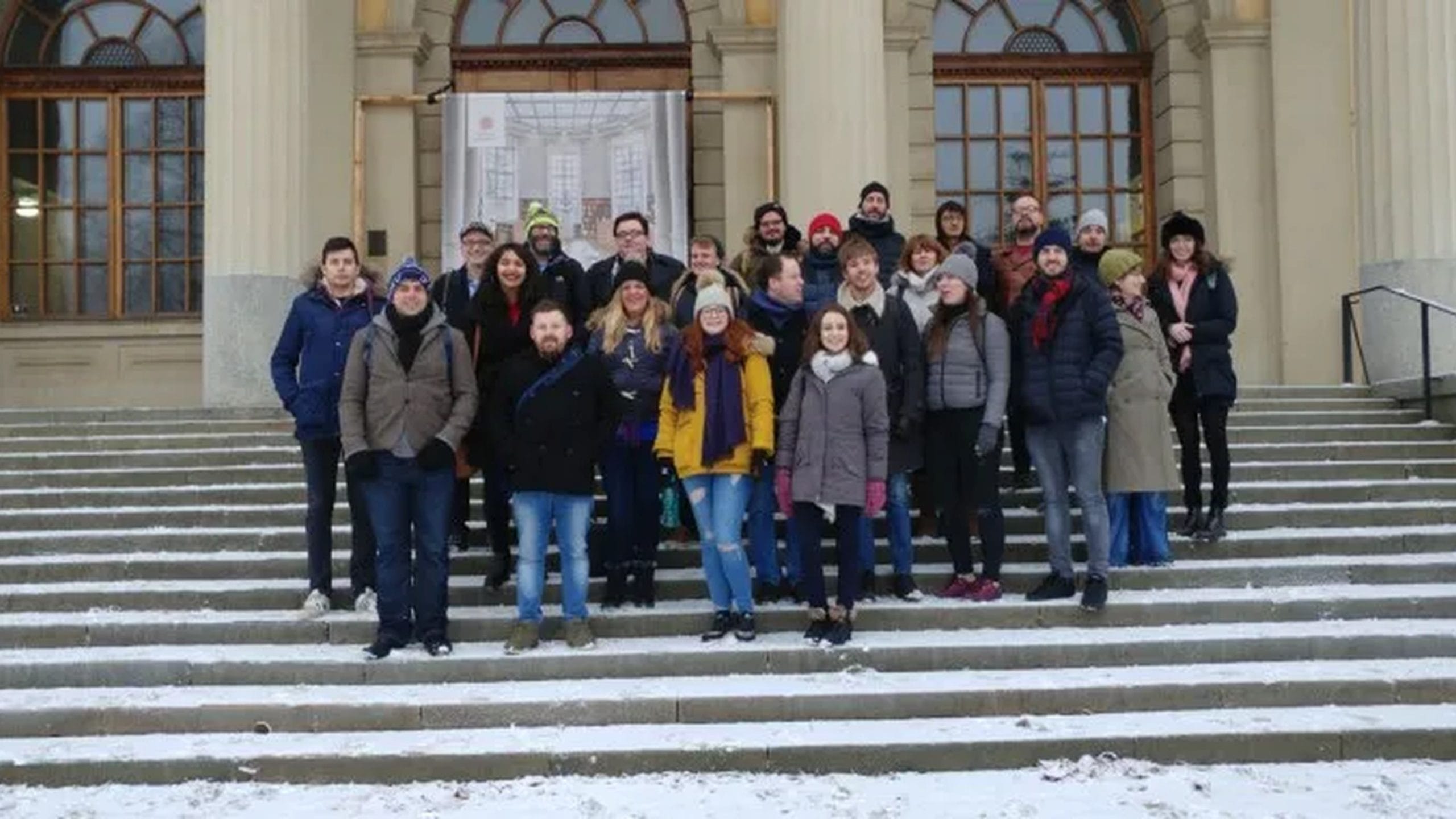
Six months later thirty of us gathered in a meeting room in Copenhagen to begin an extraordinary and magical five day journey, taking in fifteen student organisations, three countries, twelve nations and a bizarre motorway service area.
Since then the Wonkhe SUs study tours have taken groups of officers and staff to the Baltics and Finland, back to Scandinavia, the Low Countries, Dublin, the Balkans and Austria, the Visegrád countries, Stockholm, Portugal, the Rhineland, and Iceland.
And so as we get ready to head back north in January, I’ve been back through the blogs we wrote along the way to pick out some of my favourite moments.
They’re not necessarily the biggest ideas we came across, but each one shifted how at least some of us thought about what an SU could be for, and between them they cover pretty much every corner of what SUs do.
The welfare co-op that students run
The final leg of that first trip was where, as I put it at the time, “things got very interesting” – because in Oslo we met SiO, a regional student welfare co-operative “run like a company but with a student dominated board” that handled housing, sport, counselling, GP services, 40 cafes, careers, and nurseries for 67,000 students, all funded through a semester fee of about £55 a term.
A Welfare Council of 37 student representatives chose half of the board, including a chair with a double vote, and the whole thing even rented out skis, poles, and boots for the snow – leaving us wondering what would happen if universities were only allowed to charge for education and everything else was spun off in the same way.
You do have to pass a test
We’d been in Lithuania for less than a day when we discovered that at Vytautas Magnus University in Kaunas, becoming a student rep or committee member meant passing a test – and that if you failed the resit the following week, you’d have to wait six months before trying again.
The test covered student rights, university history and procedures, the union’s current policy, and even its own governance and strategy, which meant that over 10 per cent of the student body knew about as much about the university as the average UK sabb does by the end of the summer – a sobering thought for anyone who has ever squeezed rep training into a single October afternoon.
We take out extra student debt to do it
On the Low Countries tour we piled into the University of Twente’s design lab to hear Tom from Twente Students’ Union describe how hundreds of students carry out roles that we would concentrate into a tiny, centralised handful back home – and when one of our lot asked how they afforded to do what they do, he replied “We take out extra student debt to do it”.
Access to the Dutch maintenance system while in post is what makes that possible, but it was his colleague Bram’s answer, when we asked what the government thought of all that volunteering and often risky activity, that stayed with us on the walk back to the bus. “They don’t like everything about higher education, but they are so proud of us.”
€4,000 handed out €20 at a time
Back in the Baltics in 2024, we learned how the SU at the University of Tartu had taken a €4,000 award from the university and given the whole lot away to students who lined up for €20 each, so that they could explain to journalists just how little €20 covers once rent, food, study, and travel costs are taken into account.
Needs-based study support had been frozen at €220 a month for a decade, the stunt almost certainly contributed to its increase, and it was a perfect example of the creative campaigning we saw everywhere on that trip – proof that a campaign needs a good picture for the cameras far more than it needs a big budget.
Pass the songbook
Viewed from the UK, the Baltic student corporations feel really quite alien – and so it was with some trepidation that we spent an evening in Tartu with Korporatsioon Revelia, a male-only fraternity whose uniforms, caps, and symbols come with demands for cohesion, a sense of duty, dignified behaviour, and a serious attitude towards studies.
But the activities make more sense once you’re doing them, and once the songbooks had been passed out and we’d all had a run at singing one, the feeling of belonging with students whose politics we might usually be suspicious of was visceral – a reminder of how new these nations are, and how much their student leaders want for the future of their society.
Soup with your Big Mac
On the Balkans and Austria tour, the typical lunch in one of the University of Zagreb’s twelve student canteens turned out to be soup, meatballs in tomato sauce, mashed potatoes, fresh cabbage salad, cheese pie, and three slices of bread – a €3 meal that students pay €0.86 for, with the state covering the rest.
Crossing into Slovenia, we found the national student organisation running a student-led tender for any restaurant that wants to deliver the subsidised meal scheme, with a fixed maximum price and standards on nutrition, ethical purchasing, and menu diversity – a market so big that McDonald’s takes part, making Slovenia one of the few countries in the world where you can buy a bowl of soup to go with your Big Mac.
A whole team elected in an eight-hour debate
Down in a basement facility in the centre of Krakow designed especially for student volunteers, Magdalena Herman, President of the SU at Poland’s oldest university, introduced her impressive and unpaid team of lead officers – and then revealed that the council of reps had elected them as a single team over the course of an eight-hour debate.
To stand a chance, she had to recruit both the most talented students she could find and a team with the broadest possible appeal across the faculties, with primaries out in the faculties to get “ordinary” students involved – the kind of moment that really challenges your thinking on what is and isn’t democratic, and on whether cross-campus ballots for individual sabbs really are the only way to do it.
A committee just for keeping the room clean
At KTH Royal Institute of Technology, every student on every programme belongs to a “chapter” that you can spot on campus by its coloured overalls, and we met the volunteers from Datasektionen, the computer science chapter, in their own chapter room – a space that felt like it was theirs rather than a page from a furniture catalogue.
As they presented, I tried counting their roles on the website and soon gave up, not least because there’s even a whole committee for keeping the chapter room clean, since it’s their home after all – and across the city at the Stockholm School of Economics, around 700 of roughly 1,800 students held a position of responsibility in the student association.
Capes, a giant spoon, and a festival run by students
Walking onto NOVA’s science and technology campus at Caparica, half an hour south of central Lisbon, we were greeted by two students in black capes looking like extras from Harry Potter, one of them carrying a giant wooden spoon – Portugal’s traditional academic dress, which JK Rowling is said to have spotted on holiday and borrowed for the books.
Back in the city at Iscte, the SU puts on the Festival do Caloiro at the end of freshers, “a 2 day, 17 hour, 18 artist, five stage, four bar, 20 partnership shindig” planned by around 25 volunteers and run by about 200 former and postgraduate students, with every society and academic association playing a part. School plays, as we often say, sell out.
The more colourful the better
A little group of us snuck in a day in Munich before the Rhineland tour, and the thing that has stuck with me is the Olympic Village, where the 1,052 bungalows rebuilt for students come with free paint from the Studierendenwerk and an official position, as per a former spokesperson, of “Je bunter, desto besser” – the more colourful, the better.
The result is an open-air gallery of Van Gogh, Homer Simpson, and one contrarian’s “A Heart for Exposed Concrete”, while the residents’ association that runs the pub and the disco lets students extend their tenancy by up to three years by volunteering – a neat reminder that students look after the places they’re allowed to make their own.
A start week that counts for credit
The Rhineland tour proper began in St Gallen, where the university’s Start Week takes approximately 1,800 incoming students each September, divides them into 72 groups of roughly 25, and hands each group two trained student tutors and an interdisciplinary case study to crack – a one week, one credit challenge project run by students.
The 180 or so tutors prepare through a two-semester course in the university’s contextual studies programme, a Start Week office with just 1.75 paid posts coordinates over 20,000 working hours, and the whole thing ends with shortlisted teams pitching their solutions to the entire cohort in the city’s OLMA exhibition hall – a long way from a societies fair and a foam party.
Studying criminal law at the police station
In Antwerp, Steven Van Goethem walked us through STAN, a city-wide student platform that isn’t a students’ union at all but a facilitation layer between students, the city, and the universities, with nine permanent staff, 45 student workers, a student-made map of where you can make out in Antwerp, and a very simple goal. “We want to keep those brains.”
Its big student survey found that students needed places to study together, and so Study 360 was born – ten years on it offers a record 700 exam-season seats in venues ranging from the cathedral to IKEA, one offer of three free pizzas meant “students all went there”, and law students particularly enjoy studying criminal law at the police station.
Credit literally where it’s due
On the first afternoon of our Iceland tour in the spring, we crossed the University of Iceland campus to meet Juan Camilo, the university’s intercultural officer, who runs Sprettur – a free programme of mentored study groups, language support, and workshops for students from immigrant and refugee backgrounds whose families have little or no experience of university.
Its student mentors earn a five-ECTS module, the equivalent of ten UK credits, for doing the work – “the students go from, oh, I’m helping someone, to I also deserve a credit, because I’m being evaluated”, as Juan put it – and the boundaries are deliberate too. “If you have a problem with a landlord, I’m not your person… But I can support you in your study.”
Back to where it started
Reading back across ten years, what strikes me is how rarely the lesson was that other countries simply have more money – far more often it was that they trust students with more, give them the time and the credit to do it, and build the structures that let students run things for each other.
In January we’re heading back to Scandinavia, travelling from Oslo to Hamburg via Gothenburg, a ferry across the Kattegat, Aalborg, and Aarhus – and if you’d like to be part of the next ten years of stories, you can find out more about joining us on the tour.