Why do students take their rights problems to Reddit?
Jim Dickinson and Sharanya Sivarajah examine why so few students turn to their students’ union when something goes wrong – and launch a new tool to close the gap
SU Blogs|

Jim is an Associate Editor (SUs) at Wonkhe
Sharanya is Wonkhe’s SUs Community and Policy Officer
Every week across multiple subreddits, students from across the country (and sometimes prospective students from around the world) post about their dissatisfaction with some aspect of their student experience.
This past week, one student said that their course had promised loads and loads of guest speakers – but in reality, they’d had one, and they were rubbish.
Another said their handbook promised three dissertation supervision meetings – most students got one, and they got none because their supervisor went on holiday.
One reported that their faculty wants to scrap anonymous marking. Another posted that they think their placements are unsafe and want something done. Another described a field trip that can’t be made accessible for two students.
And 30 students on one module have had no teaching at all thanks to strikes.
The problems are bad enough. The advice underneath tends to be worse.
The guest speakers student was told that’s every uni, keep your head down and focus on the degree. The supervision student was told to go to the Competition and Markets Authority (CMA) – which doesn’t handle complaints from individuals.
The anonymous marking thread confidently asserted that removing it is “illegal”. The placement students were advised not to make enemies before they qualify. The field trip one attracted “sounds like a lawsuit, get a solicitor”.
And the strikes thread turned into a support group of people who tried in 2018, 2020, and 2022 and never saw a penny. There’s a heady mix of fatalism, misinformation, and wildly premature escalation – and all too rarely, in lots of these threads, does anyone say “ask your students’ union”.
Slot machine
Let’s suppose these six students did walk in. At most SUs there are two coin slots that the welcome desk might roll a problem down – advice or voice – and it’s much less obvious than it looks which slot each of these belongs in.
You might reach for a distinction between individual and collective problems, except the Office of the Independent Adjudicator (OIA) has a group complaints function, so that can’t be right. You might distinguish between a system failing (advice) and a system that could be improved (voice), except nobody can tell you where the minimum line sits.
Maybe you take the view that in many of the six examples above, the student wouldn’t approach the helpdesk at all. Advice tends to see people once things are already a crisis. Voice tends to work on issues once they’ve survived an election, a priority-setting away day, and a term of committee cycles. Everything else stays on Reddit, getting answered by the fatalists and the amateur solicitors.
And even if they did, no students’ union in the country has the resource to handle everything students are experiencing through either slot.
Rights and wrongs
Last year the Office for Students (OfS) published two pieces of research that relate to all of this. The first found that more than three quarters of students in England said commitments made to them before they arrived weren’t met in full.
The second, polling by Public First, found that only half of students said they understood and could describe their rights and entitlements – and when the survey pressed the confident half on what those rights actually were, plenty of them didn’t know either.
And asked where they’d go looking for information about their rights, only 42 per cent said the students’ union. On the evidence of those Reddit threads, the other 58 per cent are asking strangers on the internet instead – and getting told to lawyer up or give up.
That 42 per cent figure raises two questions. First – what has happened across welcome week, the handbooks, the tote bags, and the freshers’ fair stalls such that most students don’t think of their SU as the place to look?
And then, even if they did go looking, what would they find? Have an honest scroll through your own website and social media and ask whether a student who wanted to know what they’re entitled to on supervision, feedback turnaround, placement safety, or contact hours would actually find it.
In lots of cases it’s far from obvious that they would – which leaves the Reddit thread as both the fallback and the better-indexed option.
Tell us a tragedy
Part of the reason knowledge matters is that the machinery students are given to use runs on a strange asymmetry.
Think about the classic academic appeal. If a student has a bereavement, a mental health crisis, a car crash, or whatever, most universities – deadlines permitting – will let them demonstrate their performance some other way at some other point.
But if what actually went wrong was on the university side of the bargain – the dissertation supervisor was never available, the library didn’t have the resources, there was nowhere to sit, the teaching was poor – most of us know the student is on a hiding to nothing. Someone will say they should have complained at the time. Academic judgment is academic judgment. Bye.
Worryingly, there’s evidence from the benefits system that people in front of processes like this start to recategorise what they’ve been through to fit the boxes that work. We’re not suggesting that students lie – but we are suggesting that a system which only accepts personal misfortune will be told stories of personal misfortune.
Which might explain why, if you read universities’ annual complaints and appeals reports, you’ll learn a lot about the tragedies and complexities of students’ lives, and almost nothing about the failures in provision that sit underneath some of the results.
National Union of Diners
Martin Lewis – the Money Saving Expert – was a sabb at LSE in 1995. Almost 30 years ago, his view was that there’s “too many of them, and not enough of us.”
His point was that the volume of problems that students experience will always outstrip the capacity of the people elected or employed to fix them. His belief was that the systems to help them end up rationing – elections select out issues that aren’t niche, and advice services filter out all but tragedy.
His answer, in the campaigning journalism he went on to build, was to do something else – to engage people in a way that lets them take action and improve their own lives.
When your food arrives cold in a restaurant, you don’t phone the National Union of Diners. If you’re struggling to get a refund on a faulty washing machine, you don’t book an appointment with an adviser.
You might not raise it at all. The research literature is pretty clear on the six things that stop students doing so – opportunity cost (that sounds complicated and I haven’t got the time), conflict aversion (exacerbated by continually high levels of anxiety), and confidence and capital (those who most need help are least likely to present for it).
Then there’s fear of retribution – plenty assume that complaining means deportation or zeroed marks, and while occasionally they’re right, mostly they’re not – futility (they won’t do anything anyway), and plain ignorance of what they’re entitled to.
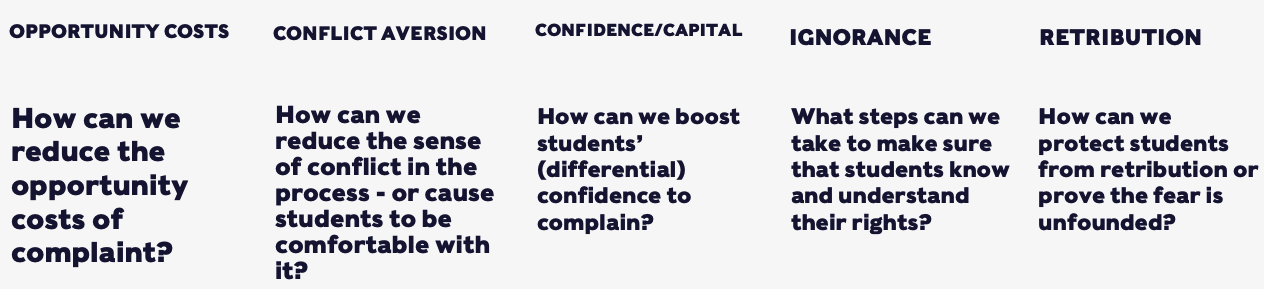
Every one of those is something a students’ union could work on – model letters and template emails that prove raising something takes five minutes, myth-busting on retribution, and communication designed for the anxious.
On that last one, Jim read a paper from a US cosmetics firm the other day on marketing its make-up to anxious consumers. It’s now considering dropping ads featuring beautiful people and is trialling adverts in the US showing ordinary-looking people interacting with its in-store consultants, specifically to lower the anxiety of having the conversation.
If late capitalism gets there faster than the sector that specialises in students does, we’ve got ourselves a problem.
On futility – maybe raising things in this financial environment mostly is futile, individually. But if individual students don’t raise those issues anywhere except Reddit, then nothing ever changes.
The easiest thing in the world for an HE sector short of money to do is cut what students receive rather than go back to government and admit it can’t afford its promises – and the evidence from consumer research is that an active, complaining customer base is exactly what makes that lever harder to pull.
Verbs going undone
So rights matter. Strip away the org chart and what students’ unions do with rights can be extensive.
SUs discover them, on behalf of students who don’t know they exist. SUs establish them – getting things written down so they survive a year in office.
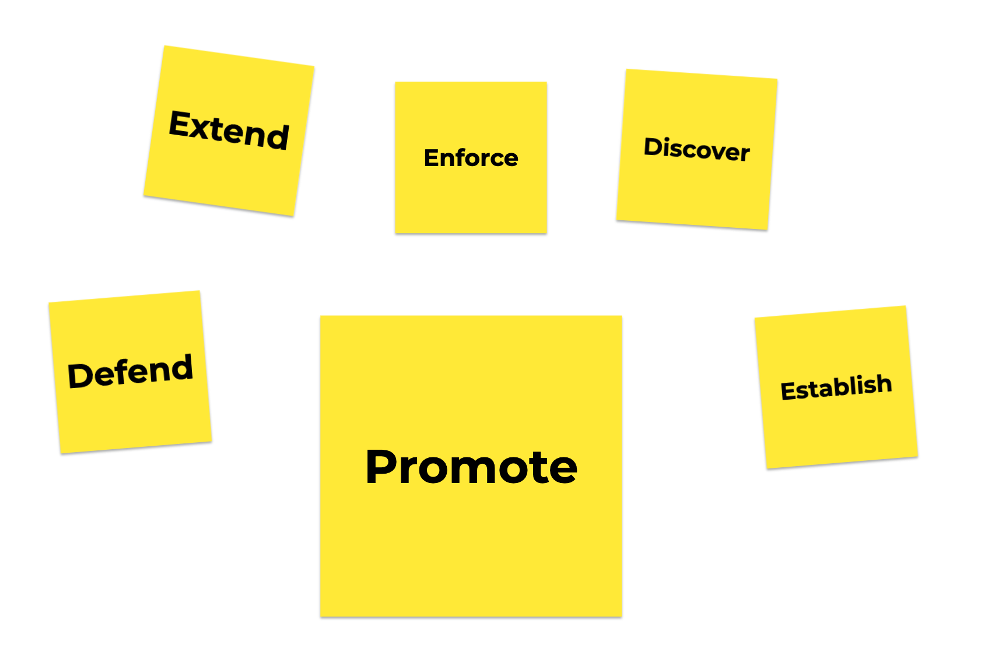
SUs enforce them, usually through the advice centre, which is arguably the bit the sector does well. SUs extend them – turning the 12-hour library into a 24-hour one, though not so much these days.
But oddly, the simplest lever of all is the lever most often not pulled. Promoting them – explaining to students the difference between an improvement suggestion and a right – is a verb most often going conspicuously undone.
Conditions apply
The good news is that in England, the regulatory architecture has already conceded the point. OfS Condition C6 will expect providers to say what they mean and mean what they say, and tell students about their right to complain.
But a single webpage run by the institution against which a right may need to be enforced can’t build the demand side of accountability on its own. Research suggests that C6 needs active education that gets repeated at the moments that matter, is built with students, and is delivered partly in partnership with an independent representative body.
Other systems got there years ago. In Poland, knowledge on student rights has been treated as something to be actively developed – organised and resourced through national programmes and training delivered via student representation, including train-the-trainers work – rather than left as a link at the bottom of a webpage.
So for universities, there’s an opportunity rather than a threat to be tolerated at arm’s length. A serious partnership with the students’ union would map the rights and promises that already apply at course level, test whether students can actually find and understand them, translate core policies into actionable language, and build rights education into induction and course rep activity.
It would audit complaint routes against the barriers above, support safe group complaints where a shared failure hits a cohort, and properly resource independent SU advice. The safeguards matter – the university shouldn’t approve individual advice, shouldn’t know which students have sought it, and shouldn’t use “partnership” to soften public challenge.
Both sides should agree upfront that a rise in well-founded complaints may signal improved access and trust rather than declining standards – the OIA’s own good practice guidance warns that a low complaint number is not in itself evidence of success.
Situation before statute
All of which is why, this September, we’re launching Know Your Student Rights.
We’ve spent the past 9 months building it because of the gap that’s been growing – between something going wrong and a student recognising they’re entitled to challenge it.

Students don’t wake up thinking about consumer law, equality legislation, or regulatory conditions. They think – my course has changed, my result looks wrong, my deposit hasn’t come back, I can’t get the support I was promised.
So the site starts with the situation rather than the statute, and then does five things. It translates legal, regulatory, and institutional rules into plain language, and it calibrates – signalling how strong and how certain a right actually is, rather than pretending every case is a slam dunk.
It points to action – check this, save that, ask this person, meet this deadline – and it shows outcomes, with real cases organised around what happened and what changed, because visible wins are the best answer to learned futility.
And it routes to support – towards independent students’ union advice and the correct external route in each UK nation, because the OIA covers England and Wales, Scotland runs through the Scottish Public Services Ombudsman (SPSO), and Northern Ireland through the Northern Ireland Public Services Ombudsman (NIPSO).
Sometimes students can use the First-tier Tribunal, their accommodation code’s complaints panel, or Student Loans Company (SLC) appeals processes – or even claim their fees back from their credit card company.
It’s a discovery layer – an attempt to make advice, ombuds schemes, and good students’ unions more reachable rather than a substitute for any of them.
And there’s more coming alongside it – a case bank of official ombuds outcomes coded for what students can learn from them, and course rep training modules that turn reps into a peer distribution network for rights literacy.
There are also four-nation source cards covering routes and deadlines, and a rights-agenda guide for SUs with an implementation plan for welcome week and beyond – with pilots planned with students’ unions in each UK nation.
We’ll obsessively seek to keep it up to date and accurate, and we’re also exploring ways to enable SUs to bespoke it with their own universities’ policies and entitlements. It’s up now but not yet being indexed by search engines – give it a try and use the feedback boxes if you spot a problem that needs fixing.
Parcels of power
There are, famously, two models of international development. In one, you go in, you help people, you leave, and they’re no better off than when you started. In the other, you give people the resources and the capability to build for themselves, and they thrive. Students’ unions do their level best to run the charity model – but the empowerment model isn’t nearly as strong.
The behaviours students learn now are the ones they take into the rest of their lives. A student who never raises the small things – the cold food, the missing supervision, the damp flat, the underpaid shift – becomes a citizen who never raises the big ones.
Helping students cope with what is thrown at them remains something that SUs should do with care and skill. But the real gift a students’ union can give a student was never the resolved complaint or the passed policy – it’s a graduate who, faced with something wrong in their own life, knew they were entitled to challenge it, took responsibility for doing so, and found out that it worked.
A September’s worth of welcome weeks is about to happen. A tote bag full of charity is one thing. A parcel of power would be quite another.
Related articles

Jewels in the crown or rough diamonds – what universities miss about their SUs
Nick Smith | SU Blogs | 22/10/26
Climate, Coffee, Crisis – where do SUs fit in?
Krzysztof Mikulski | SU Blogs | 14/10/26

Universities can’t keep demanding diagnoses the NHS is slowing down
Sharanya Sivarajah | SU Blogs | 12/10/26