Franchised HE is getting bigger, owners are getting richer, and more students are dropping out
New OfS data identifies every franchise delivery partner. Jim Dickinson finds the problem providers are larger, more profitable and losing more students than a year ago.
Comment|

Jim is an Associate Editor (SUs) at Wonkhe
A year ago I argued that a specific corner of English higher education had become a get rich quick scheme.
I was talking about privately owned colleges teaching non-specialist business and management degrees on behalf of universities.
Their outcomes were well below the regulator’s minimums and profits were well above anything a university could dream of.
Since then the government has legislated to force the larger franchise partners to register, the OfS has introduced a new condition of registration for the universities that subcontract, and one of the big partners has been through a de-designation and a judicial review.
Now OfS has published a new round of outcomes data, and read alongside the latest company accounts, they show a corner of the sector that carried on growing.
The provision got bigger, the profits got bigger, more students dropped out, and the growth went to the providers whose results were getting worse. It’s now an almost £1bn sub-industry most of whose income comes from state-backed tuition fees.
And a caveat before we get going – OfS publishes a rate and a rounded student number for each partner at each university it teaches for, so to get one figure per provider I’ve weighted each rate by its student numbers and combined them. That makes these estimates – small cells are suppressed, the data follows the methodology in OfS’s current quality consultation rather than B3, and figures cover full-time students only. Every provider discussed in detail was approached for comment before publication.
Who we’re talking about
My definition is deliberately loose – privately owned, mostly for-profit, growing fast in non-specialist business and management, and teaching students who are registered at a university.
I’ve applied the same test this year, combined companies under the same owner, and set a floor of 250 full-time undergraduate entrants in the latest year we have data for.
That produces 22 groups covering around 30 companies. Some are familiar from last year – Global Banking School, St Piran’s, LCA, the London School of Science and Technology, Oxford Business College, Navitas, QAHE, Cecos, Mont Rose, Waltham, and others.
Some are new or newly visible – UK Management College in Manchester, EDA College in Birmingham, Stratford College London, Results Consortium, OLC Europe, and Victoria College of Arts and Design, which despite the name sells business management with a foundation year.
The “get rich quick” label is my view of how this corner of the sector works as a whole, rather than a verdict on any individual company in it – and on our estimates several of the providers named here, among them LSST, Cecos, Mont Rose, Fairfield, Stratford College London, OLC Europe, EDA College, LD Training, and UK Management College, clear the 80 per cent continuation line on their own.
Two groupings matter. Elizabeth School of London’s accounts give its ultimate parent as Planet Education Networks, which also owns Victoria College of Arts and Design, so I’ve treated them as one. And Global University Systems owns the London College of Contemporary Arts, The Language Gallery, and LCCM, so they’re combined too.
UKCAB, which trades as Scholars School System and teaches thousands of Leeds Trinity students, is a registered charity rather than a for-profit. But its accounts show net income of between 30 and 52 per cent of its total income in each of the last four years – surpluses that, as a charity, it has to apply to its charitable purposes rather than distribute – and because its provision looks like the rest of the group’s, I’ve included it.
More students, more drop-outs
The first thing the new data shows is scale. Full-time undergraduate entrants taught by these 22 groups went from 23,850 in 2020–21 to 39,090, then 42,900, then 55,100 in 2023–24 – about 85 per cent of all full-time undergraduates starting subcontracted courses that year with an identified delivery partner.
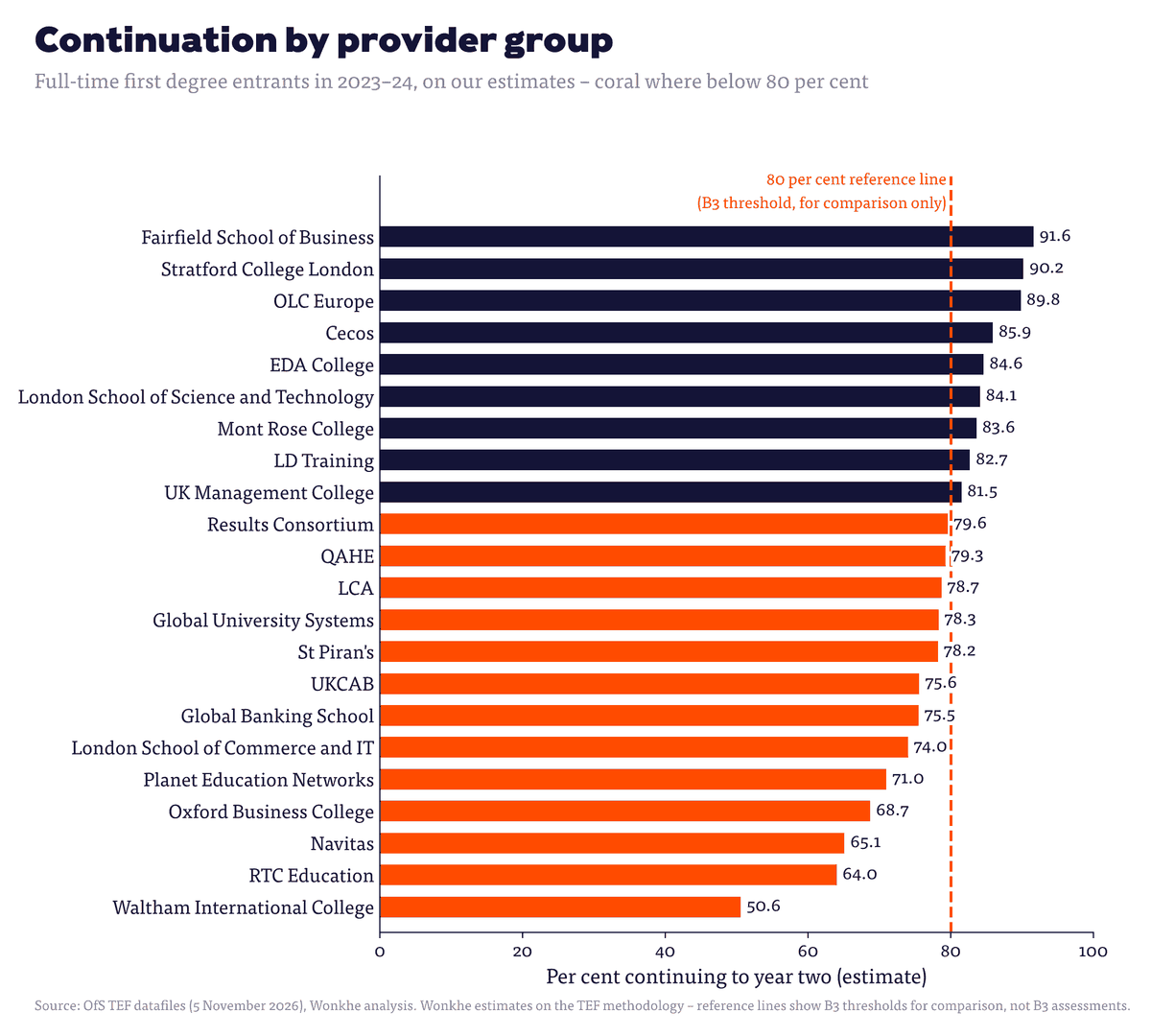
The second is that continuation hasn’t moved. Across those four cohorts the proportion still studying a year on bounced around between 73 and 76 per cent, and was 74.3 per cent for the 2023–24 entrants. A flat rate on a rising intake means a rising number of students who don’t make it – not all of whom will have left higher education for good.
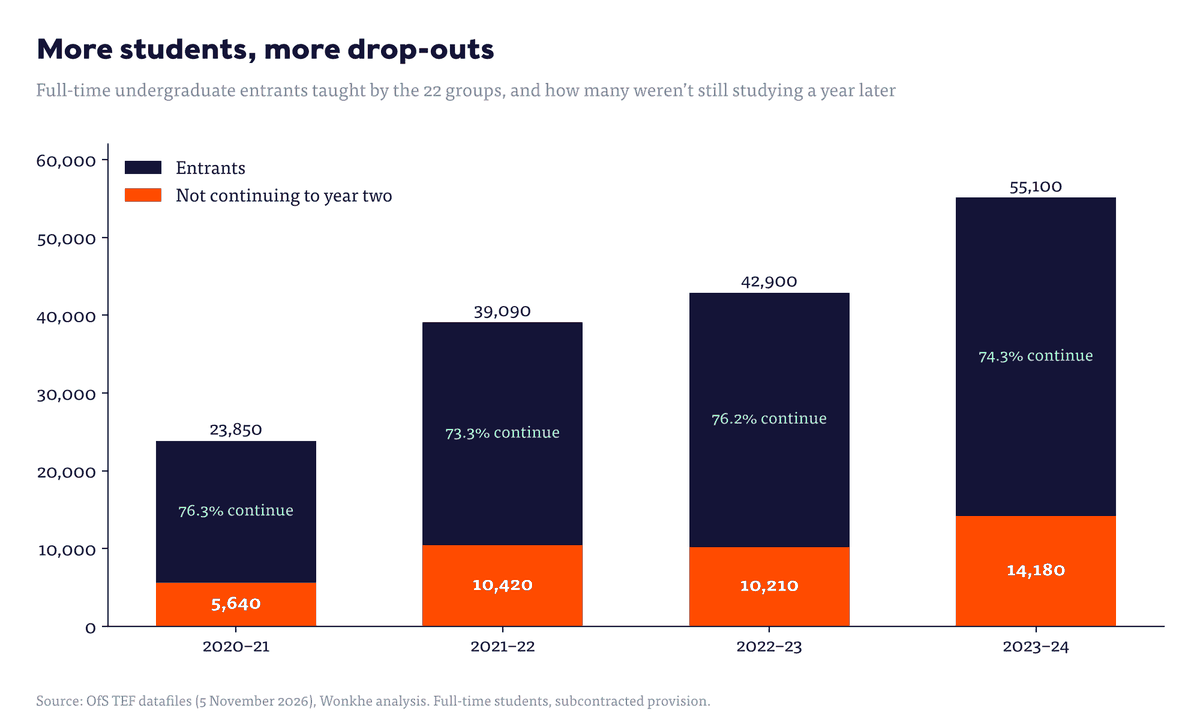
That’s around 40,000 students in four years who started a course with one of these providers and weren’t still studying a year later – and the annual figure is two and a half times what it was.
As a hypothetical ceiling, if each of the 14,180 from the latest cohort had been charged the full first-year fee of £9,250, that would be more than £130m for a single year of non-continuers. It isn’t an estimate of loans actually paid – fee liability for students who withdraw early is charged by term, and not every student borrows – but it gives a sense of the scale.
Completion – whether students have gained a qualification or are still studying four years on – is going the wrong way. For 2019–20 entrants it was 70.5 per cent. For 2020–21 entrants, the first cohort of the boom, it’s 66.3 per cent, and the number not completing has more than doubled from 3,360 to 7,400.
Below every line
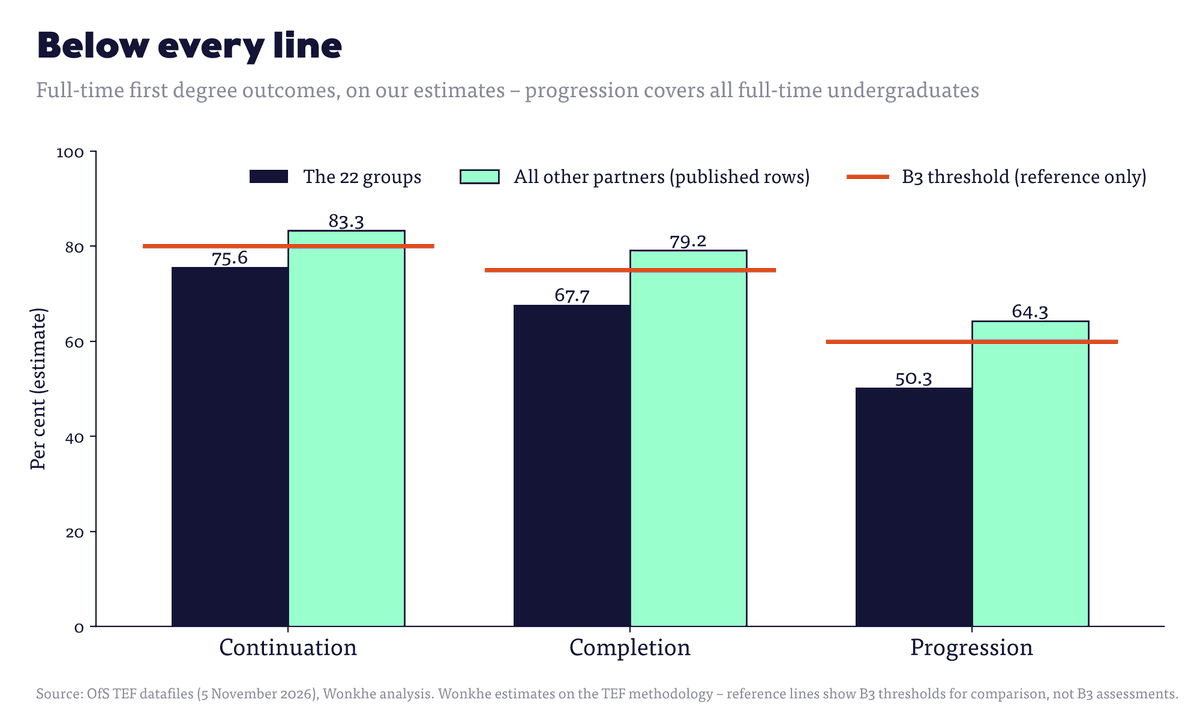
OfS’s minimum thresholds under condition B3 are set by level of study. For full-time first degrees they’re 80 per cent for continuation, 75 per cent for completion, and 60 per cent for progression into professional work or further study.
Taken together, this group’s full-time first degree students sit at 75.6 per cent on continuation, 67.7 per cent on completion, and 50.3 per cent on progression.
Every other subcontracted partner in England – around 240 further education colleges, specialist arts and performing schools, professional bodies, and the rest – comes in at 83.3, 79.2, and 64.3 per cent on the published figures. They clear every threshold, while this group misses them all – as estimates set against the B3 reference thresholds, rather than findings that any university has breached B3.
That matters because as I’ve argued before, subcontracting per se isn’t the problem. Take these 22 groups out and franchised provision in England looks fine. Leave them in and the whole subcontracted population falls below the line.
Where the growth goes
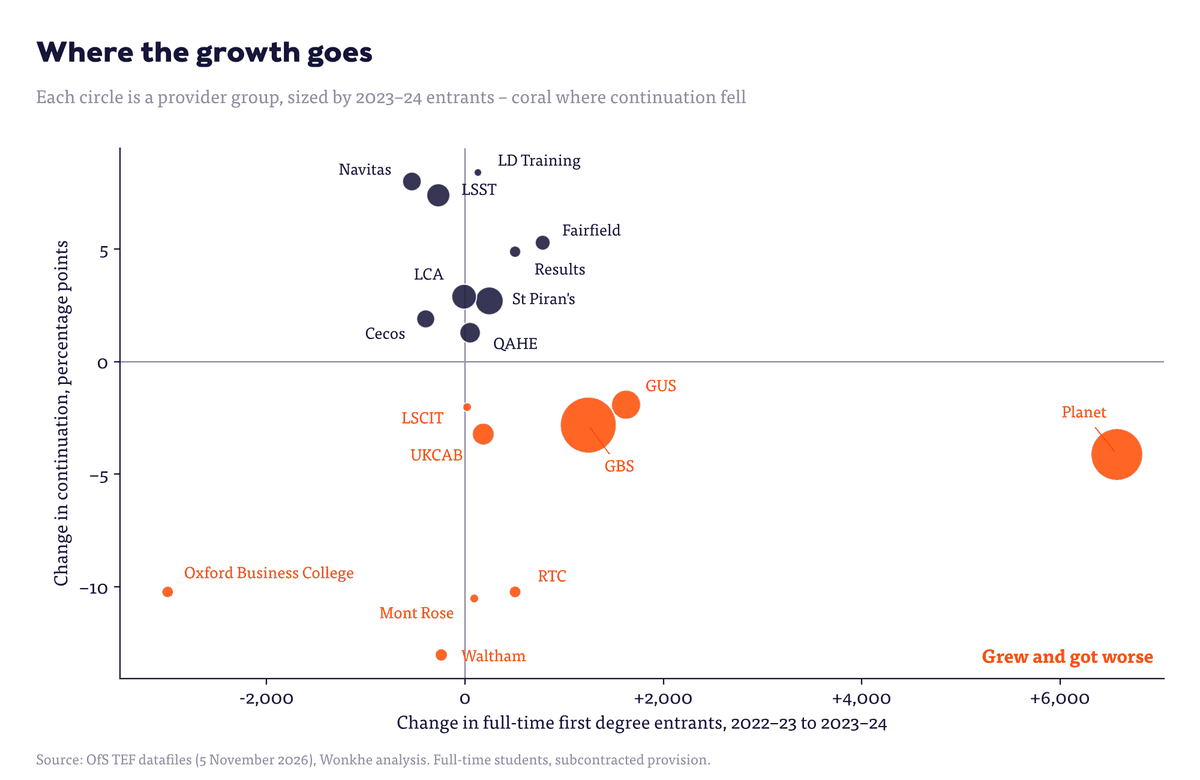
Underneath the flat average, providers are moving in different directions – and the ones getting bigger are mostly getting worse.
Global Banking School took 13,600 full-time first degree entrants in 2023–24, but on our estimates continuation for that cohort fell from 78.3 to 75.5 per cent. GBS told me its outcomes are in line with other providers teaching students from widening participation backgrounds and that it is working to improve them – its median student is 35 at enrolment, and almost three quarters live in the two most deprived fifths of England. Planet Education Networks more than doubled its intake to 11,630 while continuation fell from 75.1 to 71.0 per cent. Between them they account for half the group’s entrants.
Waltham International College, which teaches for Leeds Trinity, went from 73.9 to 63.6 to 50.6 per cent continuation over three cohorts. Its principal told me the fall was largely down to generative AI and academic misconduct among first-year students in a single subject area, and that its current cohorts now exceed the B3 thresholds.
The Language Gallery, part of Global University Systems, put 1,060 students on Cert HE programmes through Lincoln Bishop University and St Mary’s Twickenham in 2023–24 – and 18.9 per cent of them were still studying, or had gained a qualification, a year on.
There are improvers. LCCA’s first degree continuation has recovered from around half to 78 per cent, the London School of Science and Technology is up to 84 per cent, and several of the newcomers start above 80 per cent. But they’re mainly the smaller players. The growth is concentrated where the results are weakest.
Figures are for full-time first degree students, in per cent, combined across every university each provider teaches for. Progression covers all full-time undergraduates and is only shown where it rests on 100 or more graduates. OLC Europe’s provision is mostly sub-degree, which is why its first degree intake looks small.
Follow the money
Last year I added up turnover and gross profit for 17 companies and got £815m and £504m. This year’s accounts are bigger on every count.
For broadly the same companies – the 14 from last year’s table with accounts available this year – turnover is up from about £791m to £882m, and gross profit from about £486m to £561m. Some have since restated their prior-year figures, and last year’s QAHE total included a third company, but adjusting for those leaves the comparison much the same.
Across the wider group, the companies that publish their figures report combined turnover of around £977m and gross profit of £621m in their latest year. Where pre-tax profit is published it comes to around £213m – including £8.7m of dividend income QAHE NU received from elsewhere in its group – and disclosed dividends, whether paid, declared or proposed, come to around £75m.
That £977m isn’t all franchise income. RTC Education runs Regent College London as a registered provider in its own right, QAHE runs its own branch campuses, and Cecos has other business. Navitas, whose UK accounts cover its whole network of pathway colleges, is left out of the total. But most of it is tuition fee income for students registered at universities.
Gross profit, as several readers pointed out last year, flatters. Cost of sales is whatever a company chooses to put there, and gross margins in these accounts range from 36 to 91 per cent depending on where teaching staff are classified. So this time I’ve also looked at operating and pre-tax profit, which can’t be dismissed in the same way.
| Company | Year end | Turnover (£m) | Gross profit (£m) | Pre-tax profit (£m) | Dividends (£m) |
|---|---|---|---|---|---|
| Global Banking School Ltd | 28 Feb 2025 | 291.2 | 172.1 | 87.5 | 32.0 |
| Elizabeth School of London Ltd and Victoria College of Arts and Design Ltd | 31 Aug 2025 | 110.2 | 73.0 | 13.5 | 5.0 |
| RTC Education Ltd | 31 Jul 2025 | 86.6 | 57.9 | 6.4 | 0.1 |
| London School of Science & Technology group | 30 Jun 2025 | 70.1 | 52.6 | 15.6 | 5.5 |
| St. Piran’s (GB) Ltd | 31 Dec 2025 | 56.9 | 46.3 | 15.1 | 25.4 |
| London College of Contemporary Arts Ltd | 31 May 2025 | 54.2 | 39.0 | 15.8 | – |
| LCA London Ltd and LCA Education Ltd | 31 Dec 2025 | 75.9 | 35.9 | 10.4 | 5.0 |
| QAHE LM and QAHE NU | 31 May 2025 | 54.4 | 31.1 | 14.9 | – |
| Oxford Business College UK Ltd group | 31 Aug 2024 | 46.3 | 36.7 | 10.5 | 0.2 |
| Navitas UK Holdings Ltd group | 30 Jun 2025 | 43.4 | 19.4 | 12.6 | None |
| Cecos Computing International Ltd | 31 Mar 2025 | 32.2 | 17.9 | 7.7 | 0.4 |
| UK Management College Ltd | 31 Mar 2026 | 29.1 | 14.3 | 3.1 | 0.6 |
| Fairfield School of Business Ltd | 31 Aug 2025 | 22.5 | 15.1 | 2.7 | 0.3 |
| Mont Rose College of Management and Sciences Ltd | 31 Aug 2025 | 12.8 | 11.1 | 2.3 | None |
| LD Training Services Ltd | 31 Aug 2025 | 9.4 | 8.5 | 4.2 | 0.7 |
| Waltham International College Ltd | 31 Jul 2025 | 9.1 | 6.4 | 1.1 | – |
| Results Consortium Ltd | 31 Jul 2025 | 8.8 | – | – | 0.3 |
| Stratford College London Ltd | 31 Aug 2025 | 7.7 | 2.8 | 1.9 | None |
| “–” = not reported or not identified. “None” = the accounts say no dividend was paid or proposed. Dividends include amounts declared or proposed as well as paid. Results Consortium publishes only operating profit, of £1.9m. QAHE NU’s pre-tax profit includes £8.7m of dividend income from elsewhere in its group. Source – each company’s latest filed accounts at Companies House. |
UKCAB, as a charity, reports income of £30.8m and net income of £9.2m for 2025. The Language Gallery, LCCM, Cecos London, OLC Europe, EDA College, and the London School of Commerce and IT file abridged, small, or micro-entity accounts without a full profit and loss account.
The big one
Global Banking School is in a category of its own. In the year to February 2026 its turnover rose from £291.2m to £346.8m, and its operating profit was £98.1m – a margin of 28 per cent. The group totals above use its 2025 accounts, the latest it had filed at Companies House at the time of writing.
It paid £35m in dividends to its parent, Global Education Holdings, up from £32m the year before. It now guarantees £125m of that parent’s borrowing, up from £40m a year earlier, and its own assets are pledged as security for the parent’s loan facilities.
For context, a university that turned 28 per cent of its income into operating profit would be one of the most profitable in the country. The Russell Group reckons its members lose money on every home undergraduate they teach.
Related parties
Several of the accounts also disclose large payouts and dealings with related parties. St Piran’s paid £25.4m in dividends in 2025 – more than twice that year’s profit, leaving net assets of £3.2m – and paid its directors £3.85m, of which £3.78m went to the highest-paid director. Its accounts say it’s controlled by a former director and members of his close family.
RTC Education is owed £21.4m by companies its owners control, including loans to Regent Dubai, Regent USA, and property companies that it also pays rent to. The accounts describe the loans as secured and made on an arm’s-length basis.
LCCA has £27.5m owed to it by related parties in the Global University Systems group. Waltham lent £3.9m towards a £6.5m freehold bought by a property company whose shareholders, its accounts say, hold shares in the same proportions as Waltham’s – the rest came from a third-party lender. Waltham now rents the building for £700,000 a year, which the college says services that lender’s loan, and its own loan had been repaid by the balance sheet date.
None of that is unlawful – each arrangement is disclosed in the companies’ own accounts, and I’m not suggesting any of them is improper. But Andrew McGettigan warned in The Great University Gamble that in for-profit higher education money can move through rent, loans, and services as well as dividends – a general risk that registration conditions ought to address, and the reason group structures can matter more than any individual set of accounts.
Mixed fortunes
Not everyone is booming. Oxford Business College’s latest filed accounts, to August 2024, carry a material uncertainty over going concern, after the DfE announced the de-designation of its courses in April 2025 and its main partnership ended. Its courses were re-designated in August 2025 after it won a judicial review.
Navitas’s UK revenue fell by a quarter. LSST’s turnover is down on a previous period that ran to 15 months. The smaller Global University Systems companies made losses and have net liabilities.
Meanwhile the newcomers are growing fast – Stratford College London from £0.6m to £7.7m, Victoria College of Arts and Design from £0.9m to £6.9m, UK Management College from £10.5m to £29.1m, and Fairfield from £10.5m to £22.5m. Some of that is students moving from one provider to another as partnerships end. The money keeps finding a home.
Whatever happened to round two
None of this should have come as a surprise to the regulator. In October 2023 the OfS confirmed the criteria for its second cycle of student outcomes assessments under condition B3, with assessments to begin in 2024.
The prioritised categories read like a description of this group – full-time first degrees including those with an integrated foundation year, other undergraduate courses, business and management, and students taught through subcontractual partnerships. I wrote at the time that the OfS was turning its attention to franchised business courses with a foundation year. Selected providers were to be contacted in the new year, and charged for the privilege.
Two years on, nothing from that cycle has been published. OfS’s page of B3 assessment reports still lists only the first cycle – twelve reports, eleven of them published in July 2024 and one in October, eight of which ended in improvement notices.
The clearest sign that inspection work has been going on came from the press. In July the FT reported on an unpublished OfS assessment of Global Banking School’s courses for Canterbury Christ Church, which, according to documents the FT had seen, found assessment that wasn’t valid or reliable and academic misconduct that was “unacceptably commonplace”. OfS hasn’t published that assessment or confirmed any finding from it – a point GBS asked me to make clear. Separately, in June OfS announced that it had opened an investigation into GBS’s partnership with Oxford Brookes, stressing that opening one doesn’t mean any non-compliance or wrongdoing has taken place – GBS said it had engaged closely and transparently with it.
When I asked OfS about it in July, it didn’t comment on the unpublished report. So I asked a simpler question – did the second round of investigations take place, is it still ongoing, and if it did happen, when will the results be published? I’ve chased this week, and at the time of writing I’ve had no answer.
It may be that the cycle was absorbed into the regulator’s wider reforms to quality regulation, or that cases are still open. Either way, the provision those criteria targeted kept growing – the 2023–24 entrants in the new data came to 55,100, with 14,180 not continuing.
If the assessments happened, students, universities, and the people funding the loan book are entitled to see what they found. If they didn’t, OfS should say so, and explain why the riskiest provision it had identified was left to grow for another two years.
Will registration fix it
From 2028–29, franchise partners with 300 or more students will need to be registered with the OfS for new students on their courses to get student finance. Most of this group is well above that line, and partners wanting to keep student finance access while their applications are considered had to apply by 1 July this year.
Registration will bring these providers inside the quality and financial conditions. But two things about the new data should worry anyone hoping it settles matters.
The first is timing. The cohorts in this data started between 2020 and 2023. The 2024–25 and 2025–26 intakes are already enrolled, and the registration requirement doesn’t kick in until 2028. Several more years of students will start on courses where, on the evidence, around a quarter won’t make it to year two.
The second is incentives. Nothing in the registration regime constrains how much profit a provider makes or where it goes. A college that clears a registration assessment can keep paying out more than a year’s profit in dividends – and the universities that franchise to it can keep taking their cut.
More than a fifth of the turnover in this group ends up as pre-tax profit, and that turnover is overwhelmingly tuition fees for students registered at universities.
This data also comes from the OfS’s TEF files, built to the methodology in its current quality consultation, rather than from the B3 data it uses to regulate now. The regulator has the partner-level picture. The question is whether it uses it against the universities whose names are on these students’ degrees – because under the current rules, it’s their students’ outcomes that sit below the thresholds.
What should happen
It still makes little sense that DfE allows franchised non-specialist business provision with these outcomes to stay open to the loan book especially when we are some distance from registration.
It’s still the case that OfS should publish partner-level B3 data, alongside the TEF-methodology files, and say whether it is assessing the lead universities against condition B3 for this provision.
Registration conditions for franchise partners should cover where the money goes – related-party transactions, loans to owners, and dividends that exceed annual profit – as well as whether the paperwork on quality is in order.
And the universities still partnering with this group should be asked a simple question. When you can see from the published data that a quarter of the students you register through a partner aren’t still on their course a year in, and you can see from Companies House that the partner is turning more than a quarter of its income into profit, what exactly is your quality assurance for?