Higher education postcard: The Shakespeare Institute
This week’s card from Hugh Jones’ postbag takes us to Stratford-on-Avon – for now
Comment|
Hugh Jones is a freelance HE consultant. You’ll find a daily #HigherEducationPostcard if you follow him on Bluesky
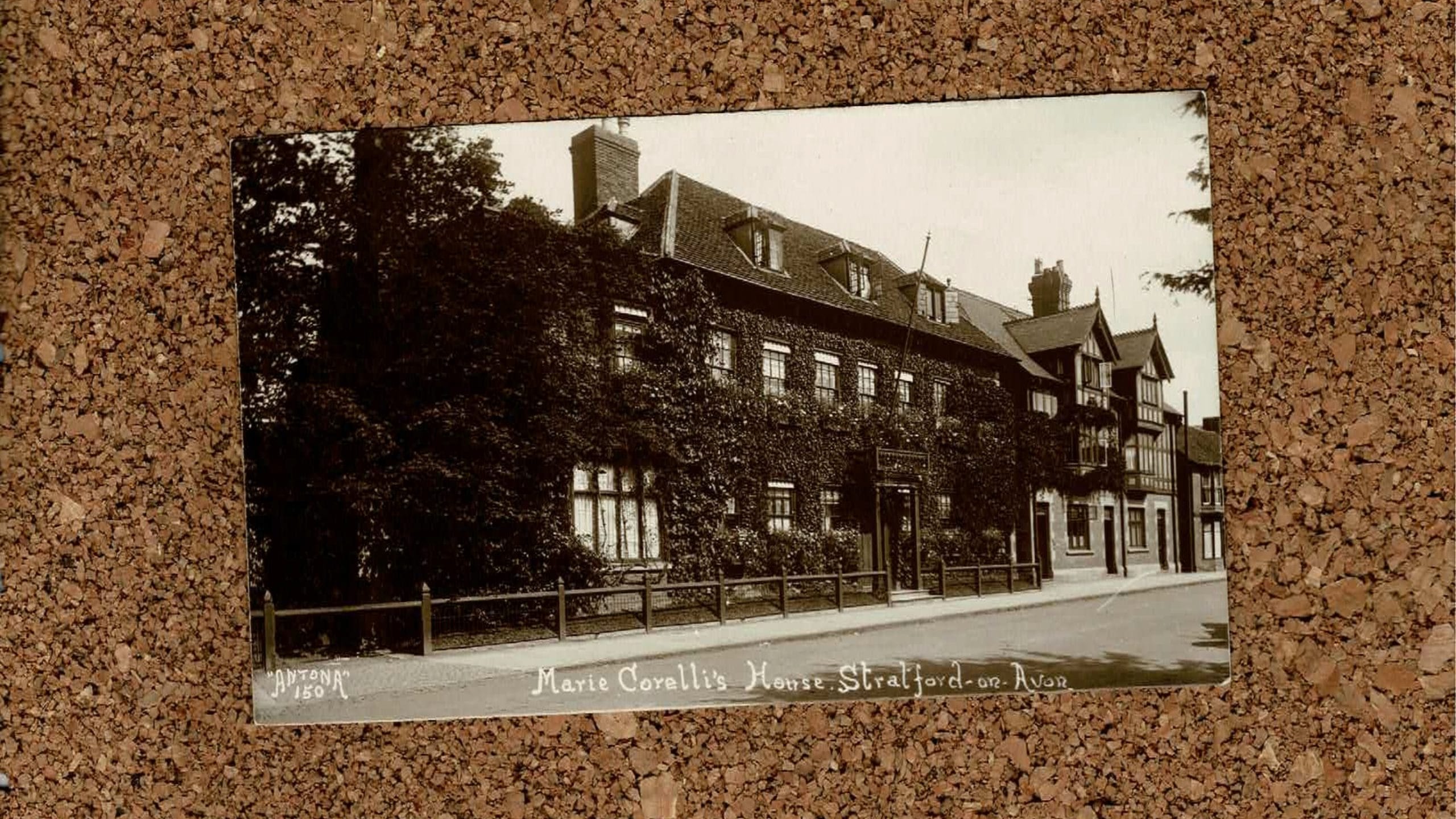
Marie Corelli was, in her time, the best-selling novelist in Britain, her works cementing the single-volume novel as the standard publishing format – as opposed, for example, for novels published in serial form in newspapers and magazines.
Her early life is obscure, with no certainty over her real name: it seems she was born out of wedlock, and changed her name to avoid the Victorian shame. Having achieved success, but disliking London’s “spite and meanness”, she moved to Stratford in 1899 with her companion Bertha Vyver, setting up house in Mason Croft, shown in the card.
She died in 1924; Bertha continued to live at Mason Croft. When Bertha died in 1941 the terms of Marie’s will provided that Mason Croft be held in trust “for the promotion of Science, Literature and Music among the people of Stratford-upon-Avon” but in the immediate term it was requisitioned by the government for war use. The will was contested by the government as the trust’s objects focused too much on people from other countries, and eventually the University of Birmingham bought the property.
I had never heard of Marie Corelli before and her life story – eccentric hardly comes into it.
Anyway, in 1951 the University of Birmingham established a research institute – the Shakespeare Institute – which was based in Mason Croft. This enabled it to link with the work of the Shakespeare Memorial Theatre which was by the river Avon in Stratford, creating a hub for research and scholarship into the Bard. You might know the theatre better as the Royal Shakespeare Theatre, to which it was renamed in 1961 following the establishment of the Royal Shakespeare Company.
Here’s the write-up in The Stage of 9 August 1951.
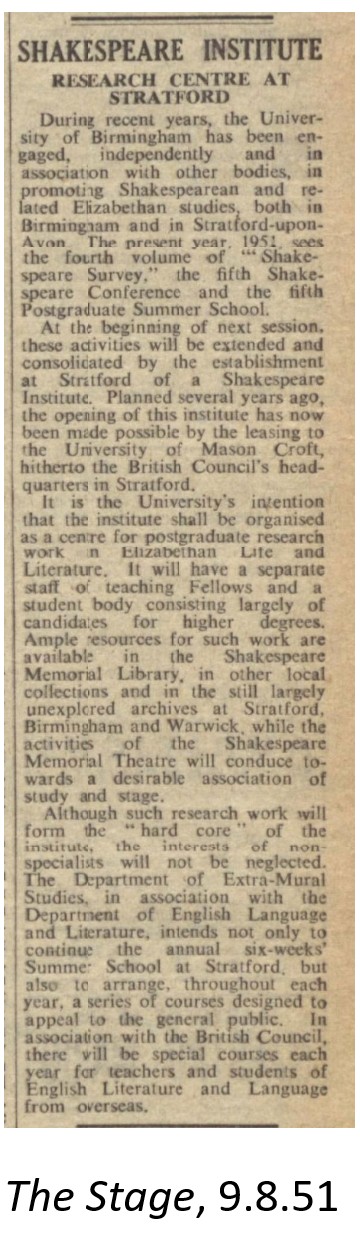
It was clear that the excitement felt was in part due to the institute being so close to the other Shakespeherean places: so elegant, so intelligent a solution.
The story goes that the institute thrived at Stratford; that in the 1970s it was relocated to the university’s campus in Birmingham to save money; that in the 1980’s it returned to Stratford; and that in 1996 its tenure in Stratford was confirmed by the building of a new library.
And then you have to look at what is said in this appreciation, published in the Birmingham Daily Post in March 1978 on the death of the institute’s then director, Terence Spencer.
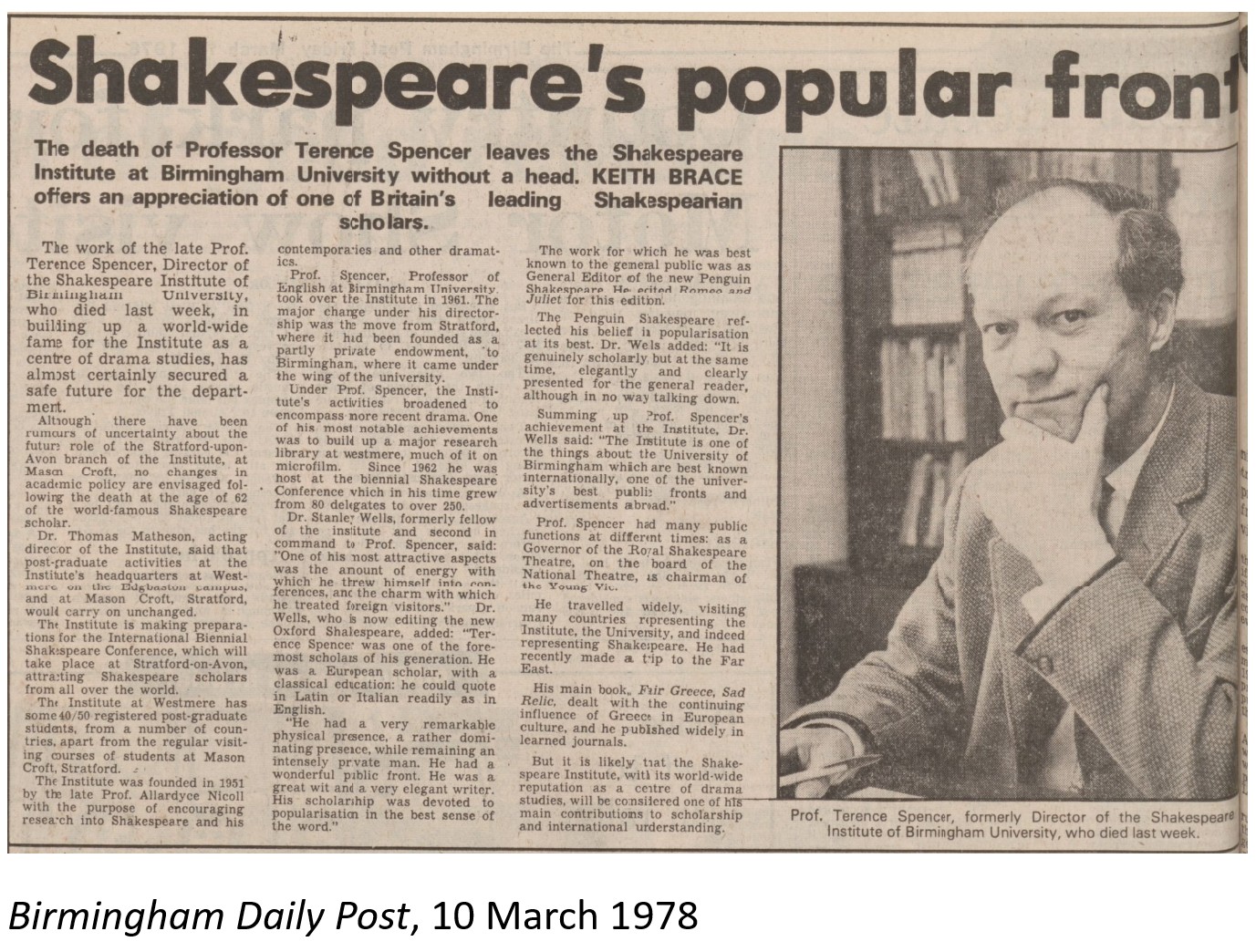
In this account, the institute’s headquarters moved from Stratford to the University of Birmingham, at the Edgbaston campus, some time after 1961. And this enabled the creation of a significant library resource at the university.
So what really happened? What follows is speculation on my part – I haven’t been able to find specific details. I suspect Spencer also had university responsibilities at Edgbaston, and so the move to be mostly based there worked well for him. Subsequent directors recognised the benefits of being based at Stratford and so the centre of gravity of the institute moved there. And when in the 1970s there was pressure to move back to Birmingham it was successfully fended off, helped in part by the raising of funds for the new library at the Institute in Stratford.
What comes next, though, is not speculation: it is being reported that the university plans to move the institute back to Edgbaston from September 2027. This has led to the resignation of the current director, Michael Dobson and much angst, amongst the current retrenchments across UK higher education.
Here’s a jigsaw of the postcard, which has not been sent. My guess is that the card dates from the 1920s, when there would still have been a wide readership – or at least awareness – of her novels.
It’s worth noting that on Wednesday 18 November, the University of Birmingham paused the process to move the institute from its Stratford base to Edgbaston. Here’s the university’s statement and the BBC News write up.