The HE sector is making progress on transformation – but government support could turbo-charge the potential gains
Setting out the next steps for Universities UK’s transformation and efficiency agenda, Nigel Carrington calls on government to back the sector’s ambitions
Comment|

Nigel Carrington
Nigel Carrington is chair of Universities UK's Transformation and Efficiency Implementation Group
Since the publication of the Universities UK Towards a New Era of Collaboration report in June last year, momentum has been building across the sector to put the Transformation and Efficiency Taskforce’s recommendations into action.
Universities UK, sector bodies and institutions have collectively driven progress on sector wide procurement, digital transformation and governance, as well as offering support to help institutions to catalyse the sort of broader change that greater collaboration will deliver. And the government and its agencies are listening.
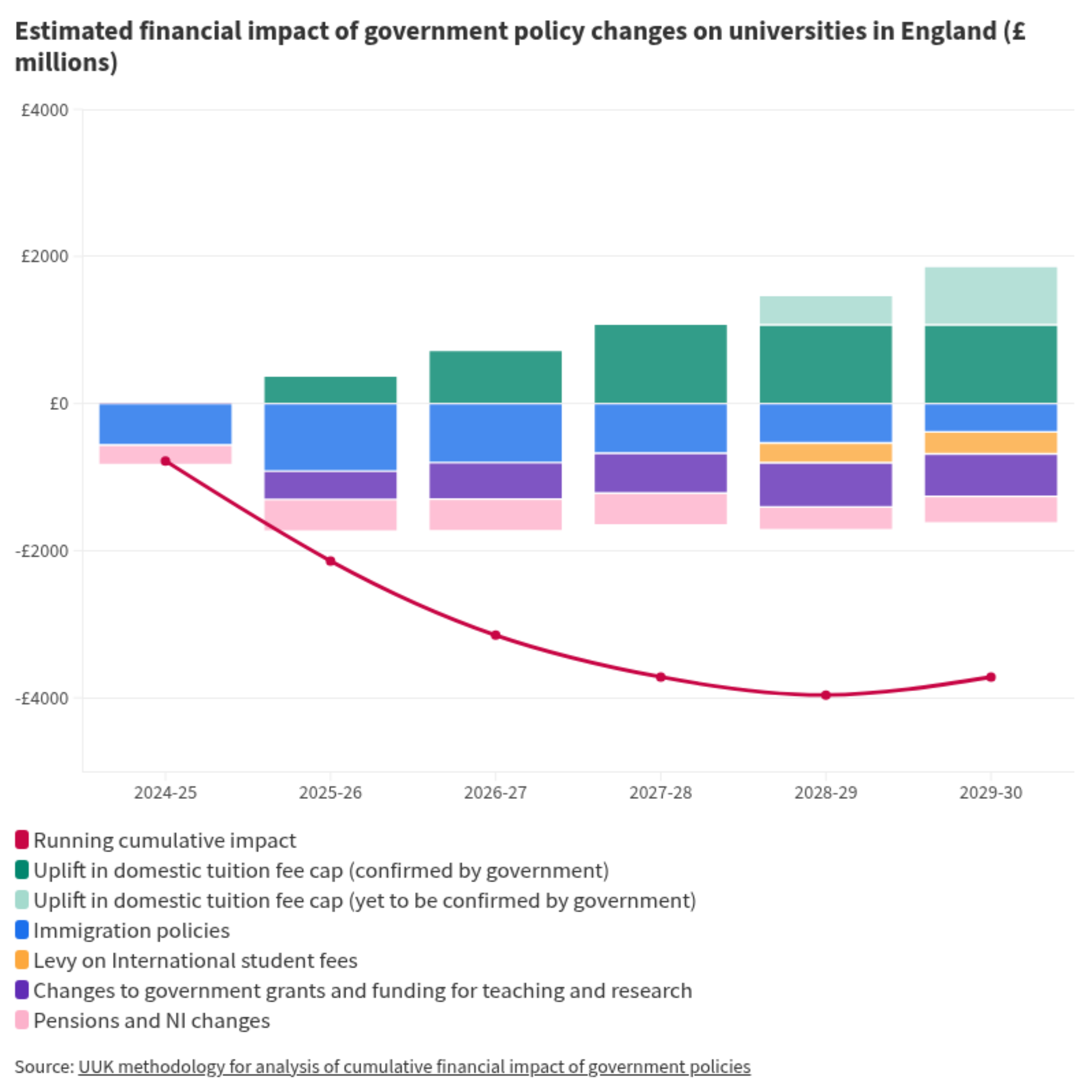
The need for institutions to go further and faster when it comes to finding efficiency savings is plain to see. Recent UUK analysis shows that universities are facing a prolonged financial squeeze: between 2024–25 and 2029–30, government policies will result in £9 billion in additional costs from tax, pensions, the international student levy and reduced international income, and a net funding reduction of £3.7 billion when tuition fee changes are factored in.
These pressures are already having a tangible impact. Last year, 89 per cent of institutions reported that they were considering course closures in the next three years, and 79 per cent were considering reducing research activity in the same period. UUK is currently surveying its members to update this insight and will publish our findings in the coming months.
Walking the walk
UUK and its partners have been driving sector-led progress on the actions identified in our report, which both help in responding to the challenging financial climate and resonate with the government’s policy agenda.
Navigating competition law
The taskforce heard that competition law is often viewed as a barrier to pursuing collaborative arrangements with peer institutions. New guidance from the Competitions and Markets Authority(CMA) follows Universities UK engagement with CMA, DSIT and DfE. Although the guidance will not answer every question, it is very welcome and gives institutions greater clarity and confidence to pursue shared services models, joint procurement and new collaborative structures.
Supporting robust governance
The Committee of University Chairs (CUC) has recently concluded its consultation on a refreshed code of governance, which aims to provide a clear framework to support governing bodies to manage risk and strengthen decision making at this time of heightened uncertainty. As financial pressures intensify, governance reform is a necessary enabler of transformation, and UUK will work with CUC and the Association of Heads of University Administration (AHUA) to help embed the new code once agreed.
Better procurement deals and alignment on data models
Jisc and UK Universities Procurement Consortia (UKUPC) have secured improved deals at national level, helping universities reduce duplication and achieve better value for money, such as improved deals with the Big Five publishers. These agreements demonstrate the power of collective action and the savings the sector can unlock when given the space and incentives to collaborate. In parallel, UCISA, working with Jisc and the Academic Registrars Council, is driving forward a new UK-wide digital student data records framework, which will create a single digital language for student information and enable secure real-time data exchange.
Benchmarking operational efficiency
AHUA, in collaboration with SUMS Consulting, have recently launched the organisational efficiency maturity assessment (OEMA), providing the sector’s first standardised, open‑access framework for assessing operational efficiency. It does this by diagnosing strengths, benchmarking costs and identifying opportunities for improvement across eight critical themes, and thus offering a clear baseline and a roadmap for meaningful efficiency gains.
Building leadership and shared learning
Since the Taskforce report, Universities UK has been running a series of learning events on collaboration, financial sustainability and governance, creating vital spaces for university leaders to learn from one another. UUK is exploring developing a refreshed leadership development offer for incoming vice chancellors, tailored to the unique challenges facing the sector. This investment in leadership capacity will enhance the sector’s long-term resilience and demonstrates our commitment to meaningful change. Our second Transformation and Efficiency Summit, on Thursday 7 May, will welcome over 100 senior university leaders to Woburn House to keep the conversation moving forward.
Government policy must match government ambition
All this is taking place against the backdrop of the policy agenda set out in the Post-16 education and skills white paper, which signals a major shift toward a more specialised and collaborative tertiary system. It calls for universities, colleges and employers to adopt distinct, complementary roles, driven by regional skills needs and comparative institutional strengths. The white paper emphasises greater regional collaboration, encouraging institutions to work together to tackle local skill gaps and deliver higher quality, mission aligned provision.
This chimes with activity to pursue new forms of collaboration that the HE sector is already undertaking, though in my view cash-strapped institutions need more support from central government to capitalise on these opportunities.
While evidence of sector-led progress is clear, the sector cannot fully recognise the potential dividends without government partnership. Considering the high upfront cost of ambitious radical collaboration programmes – potentially running to tens of millions of pounds – the taskforce identified the need for a government-backed transformation fund as a key enabler of collaboration at scale. This would enable institutions to take bold decisions, catalyse innovation and help avert the far higher costs of institutional failure.
Without such a fund, many transformational opportunities simply will not be realised. As part of a wider conversation to ensure a coherent policy and regulatory framework for the sector, it is the missing piece that would allow the sector to go further, faster, and could avert a costly financial failure which not only damages the lives of thousands of students but has broader political ramifications.
On Thursday 7 May Universities UK will host the second Transformation and Efficiency Summit, including discussion on efficiency in university research activity, designing shared service models, and digital enablement.