The Green win in Gorton and Denton signals a shift to the left for Labour
Jonathan Simons argues that a Green surge in key constituencies could increase the political salience of higher education issues
Comment|

Jonathan is a partner and head of education at Public First
By now, you’ll have read a dozen or more pieces opining on what last week’s byelection result in Gorton and Denton means for Keir Starmer, or for Reform, or for the Greens. But I bet you haven’t read even one considering what it means for the REF in 2029, have you? Well, strap in.
Labour’s election strategy in 2024 was pretty simple. They pulled in 14 per cent of those who voted Conservative in 2019. Each of those voters count twice – once for Labour and once away from the Conservatives as incumbent government. But this group was slightly atypical both of Conservative voters and of the broader Labour coalition. They were older, more likely to have voted Leave in 2016, and much more concerned about migration (39 per cent saying this issue was a top issue facing the country against 22 per cent of all Labour voters).
This strategy, and these voters – termed “hero voters” in Labour HQ and latterly in No10 under Morgan McSweeney – were prioritised both before and after the election. And as those voters became disenchanted, and indicated an increasing propensity to vote Reform, so went the government strategy chasing after them.
This approach was despite the fact that lots of other groups also voted Labour – most pertinently, graduates. Here’s the breakdown of how graduates voted in 2024.
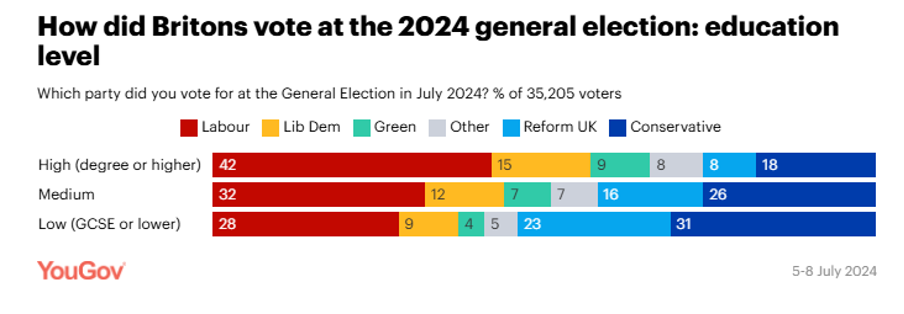
The brutal assumption which has held since 2024 is that graduates – who tend to be younger within the electorate, and on most attitudinal surveys tend to skew more liberal – didn’t have anywhere else to vote, at scale.
Gorton and Denton shows this is not true.
Students plus graduates electoral maths
The fascinating thing about Gorton and Denton is that it has been written up as a graduate heavy seat, when it’s not. In fact, if you rank all 650 seats by the proportion of residents who are graduates, this seat comes…..466th. Though in fairness, it contains a lot of current students, which makes the estimated percentage of the constituency population that is made up of graduates and students around 42 per cent.
What this means is that there are a lot of seats now where either the graduate population, or the graduate plus student population, might start to become an electoral factor.
Here are two ways of showing this data. The first way is to look at seats where a majority of constituents are graduates (it’s not easy to do graduates plus students for any one seat, given student number data tends to be based on old constituency boundaries pre 2024 – so the actual number of constituencies where that combined group would be a majority of residents will be higher).
| Constituency | Region | % of constituency who are graduates |
|---|---|---|
| Battersea | London | 65.2 |
| Hampstead and Highgate | London | 64.7 |
| Richmond Park | London | 64.1 |
| Cities of London and Westminster | London | 62.2 |
| Tooting | London | 61.8 |
| Putney | London | 60.9 |
| Chelsea and Fulham | London | 60.6 |
| Kensington and Bayswater | London | 60.6 |
| Wimbledon | London | 60.5 |
| Clapham and Brixton Hill | London | 60.3 |
| Hornsey and Friern Barnet | London | 60.2 |
| Hammersmith and Chiswick | London | 58.4 |
| Twickenham | London | 58.2 |
| Islington North | London | 57.6 |
| Lewisham West and East Dulwich | London | 57.6 |
| Bermondsey and Old Southwark | London | 56.9 |
| Dulwich and West Norwood | London | 56.3 |
| Bristol Central | South West | 56.3 |
| Islington South and Finsbury | London | 56.2 |
| Edinburgh North and Leith | Scotland | 55.9 |
| Cambridge | Eastern | 55.7 |
| Greenwich and Woolwich | London | 55.4 |
| Ealing Central and Acton | London | 54.9 |
| Hackney South and Shoreditch | London | 54.5 |
| Manchester Withington | North West | 54.5 |
| Lewisham North | London | 54.3 |
| Poplar and Limehouse | London | 54 |
| Edinburgh South | Scotland | 53.3 |
| Vauxhall and Camberwell Green | London | 53.3 |
| Finchley and Golders Green | London | 53 |
| Harpenden and Berkhamsted | Eastern | 51.8 |
| St Albans | Eastern | 51.7 |
| Esher and Walton | South East | 51.6 |
| Holborn and St Pancras | London | 51 |
| Sheffield Hallam | Yorkshire and the Humber | 50.9 |
Bear in mind, eyeballing those seats, that a lot of them will be populated by older graduates – so they will probably skew more liberal, but may not otherwise have much electorally in common with younger seats.
So the second way to look at it is the most student heavy seats which Labour currently hold. And taking a fairly arbitrary threshold, here are all the constituencies where there are at least 10,000 students living there, set against Labour’s current majority
| Constituency | Labour majority in 2024 | Number of students |
|---|---|---|
| Leeds Central and Headingley | 8422 | 36256 |
| Nottingham South | 10294 | 25781 |
| Manchester Rusholme | 8235 | 25169 |
| Sheffield Central | 8286 | 24995 |
| Liverpool Riverside | 14793 | 22577 |
| Nottingham East | 15162 | 20904 |
| Cambridge | 11078 | 20117 |
| Birmingham Ladywood | 3421 | 18113 |
| Exeter | 11937 | 17797 |
| Cardiff South and Penarth | 11767 | 17132 |
| Birmingham Selly Oak | 11537 | 15739 |
| Portsmouth South | 13155 | 15059 |
| Canterbury | 8653 | 14929 |
| City of Durham | 11757 | 14629 |
| Holborn and St Pancras | 11572 | 14340 |
| Newcastle upon Tyne Central and West | 11060 | 14272 |
| Liverpool Wavertree | 16304 | 14127 |
| Loughborough | 4960 | 14066 |
| Lincoln | 8793 | 13368 |
| Norwich South | 13239 | 13362 |
| Newcastle upon Tyne North | 17762 | 12635 |
| Oxford East | 14465 | 12499 |
| Lancaster and Wyre | 9253 | 11680 |
| Bournemouth West | 3224 | 11462 |
| Plymouth Sutton and Devonport | 13328 | 11151 |
| Bethnal Green and Stepney | 1689 | 10616 |
| Swansea West | 8515 | 10609 |
| Manchester Withington | 13982 | 10344 |
| Manchester Central | 13797 | 10343 |
Now not all those students will vote – and some who vote will vote Labour. But the general trend here is obvious – that there are a lot of seats where the student vote, and/or the graduate vote, if it finds somewhere else to go, could be significant.
And for a lot of students, and younger graduates, life is pretty miserable. The Plan 2 debate over the last few weeks is best seen not as an issue in and of itself (though it is certainly that), but as a proxy for people feeling betrayed by the implicit or explicit social compact of higher education: go to university, get a good job, earn more, pay some of that back via loan repayments but still do better overall.
When 700,000 graduates are now claiming benefits, when job vacancies have decreased 9 per cent from last year, when almost one in ten 25–34s say they feel “chronically lonely” and when house prices are now almost 8 times median salary – a ratio which has doubled since 1997 – it’s not hard to see why younger voters, even those with degrees or studying for one, might seek change.
To the left, to the left
It now seems a racing certainty that Labour’s electoral strategy will pivot back more to graduate voters and young voters who deserted them last night in south Manchester. Hannah Spencer, the newly elected Green MP, knows her voters: her victory speech was defined by opportunity, the dignity of work, and the idea that aspiration is becoming increasingly unaffordable.
Higher education isn’t the only issue affecting or driving graduate voters, but the Plan 2 anger manifests itself as dissatisfaction with the HE system. It seems highly likely that the government will be forced into changes to repayments somehow – perhaps as early as the Spring Statement (look out for detailed Public First polling on exactly this issue coming out soon).
More broadly, we might well expect the government to tilt more liberal on the question of migration, which is a real bugbear of Labour’s younger and minority ethnic voters in particular. This could well include some loosening of restrictions on international students; or at a minimum, no plans to further tighten of the Graduate Route, or extend the time before Indefinite Leave to Remain.
We could see further moves on property ownership, and renters’ rights – and this could well include measures designed specifically to appeal to student renters. At a time when NEET numbers are on course to break the totemic one million number, we will likely see more action on graduate jobs, unemployment, and protecting graduates and younger workers generally against the disruption of AI.
Not all of this new policy platform would benefit HE. Anything significant on apprenticeships, for example, would cost money that would almost certainly trade off against any extra funding directly into universities (which would likely be an expansion of maintenance grants beyond the small increase promised by Bridget Phillipson).
Reform hasn’t gone away, and indeed last night’s result will likely see them lean even further into cultural attacks (and increasingly, ethnicity and religious based attacks, which will hit some students hard). But it is now much less likely that Labour will respond by also shifting to the right in a doomed effort to placate these voters.
How successfully the government manages to navigate the broader politics remains to be seen (other than we can confidently say bye bye Sir Keir, both as leader and, staggeringly, possibly as an MP).
But if the Greens replicate last night’s success in local elections in May – in which a lot of the constituencies shown above are voting, especially in London – then topics hitherto ignored by this government (HE fees, student loans, universities as drivers of local economic growth, and who knows, maybe even the REF) might find themselves having their political moment sooner than expected.
Comments · 1
New comments will come back with sign-in later this year.
Prof A Non · 2 Mar 2026
It was the Green election material juxtaposing Keir Starmer and Narenda Modi wot won it.
Related articles

Boards can’t predict the future, but they can make sure their institution is ready for it
Debbie McVitty | Comment | 19/10/26

What counts as a graduate outcome when the labour market is changing?
Angel Tan | Comment | 16/10/26

Widening participation isn’t finished while background still predicts destination
Hannah Rolley | Comment | 16/10/26

Higher education postcard: The Warburg Institute
Hugh Jones | Comment | 16/10/26

If not university then what?
David Kernohan | Comment | 15/10/26

John Healey’s drive for a resilient economy could further squeeze universities
James Coe | Comment | 15/10/26