Higher education postcard: The Warburg Institute
This week’s card from Hugh Jones’ postbag reminds us of a previous, awful, culture war
Comment|
Hugh Jones is a freelance HE consultant. You’ll find a daily #HigherEducationPostcard if you follow him on Bluesky
Greetings from Bloomsbury!
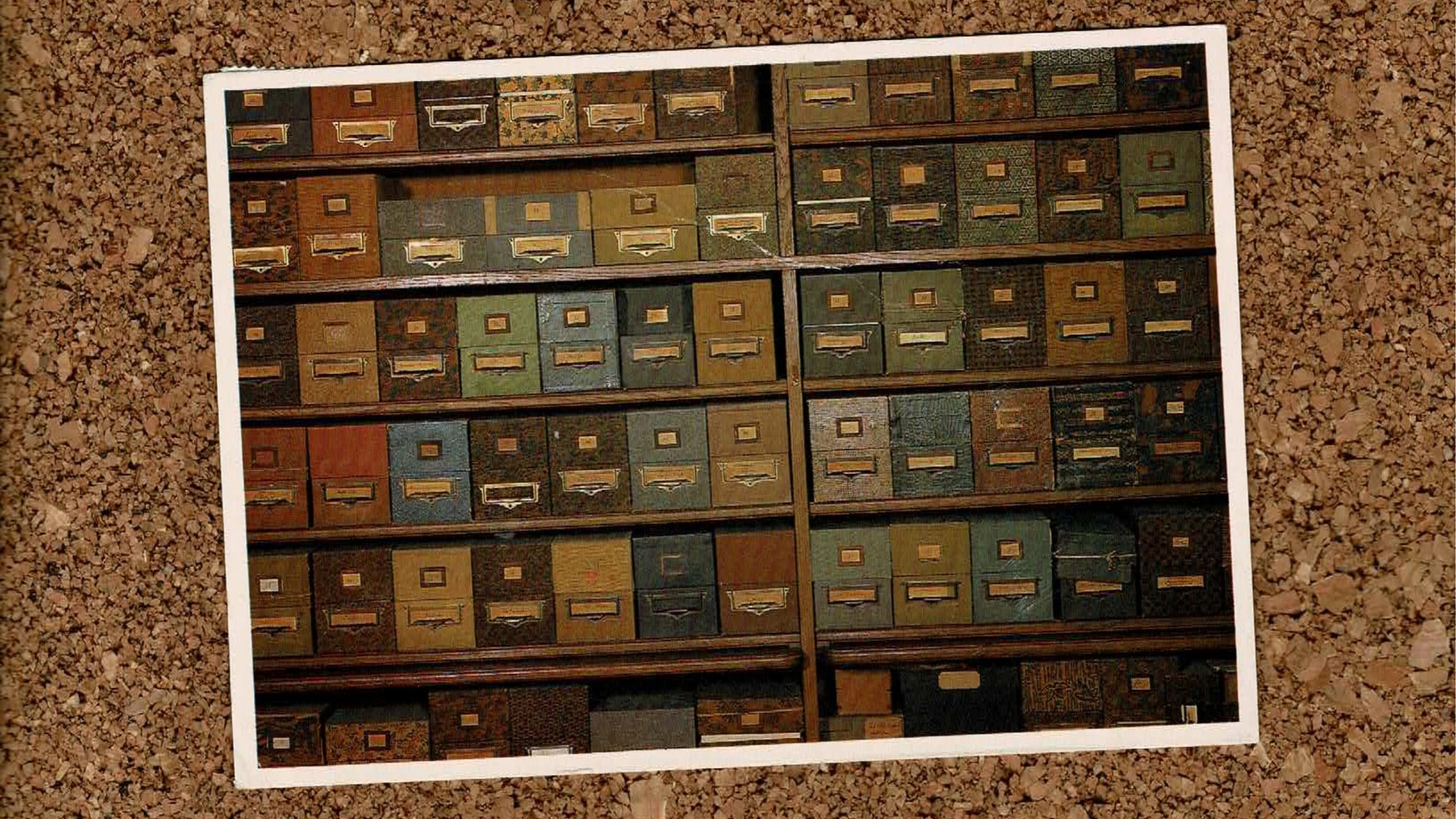
This beautiful card index belonged to Aby Warburg, the founder of the Warburg Institute. And, if you’re of a certain vintage, this will bring back memories of how libraries used to be.
The Warburg Institute is part of the School of Advanced Study at the University of London. Its collection enables the study of the interaction of ideas, images, and society (to borrow its own words). And it has a remarkable story.
And to tell that story we need to start with Aby Warburg himself. He was born in 1866 in Hamburg, eldest son of the German branch of the Warburg banking dynasty. He was Jewish, which is very relevant for this account, and his parents wanted him to be a professional – a lawyer, a doctor, or maybe a rabbi. But Aby wanted to be none of these things, and he went to study art history in Bonn, Munich, Strasbourg and Florence. He gained his doctorate in 1893.
As the eldest son, he would have been expected to succeed in ownership and leadership of the family banking firm. This obviously was not for him, so he made a deal with his brother Max that, in return for forfeiting his right to do this, Max would buy Aby any book he wanted. This turns out to have been quite a lot of books.
Aby spent time in the USA, where he hung out with anthropologists and, crucially, spent time with people from different indigenous cultures to learn about their beliefs and traditions. This informed his understanding of the significance of ideas and artefacts to culture. He then spent time in Florence, where he both married and, separately, learned more about renaissance Florence.
In 1902 he and his family returned to Hamburg, where he was active academically and educationally, helping to found the Hamburger wissenschaftlichen Stiftung (Hamburg Science Foundation) which in 1919 became part of Hamburg University; at which Warburg became a professor. He spent 1921–24 in Switzerland, being treated for depression, and in 1929 died of a heart attack. Quite a life, and quite a prelude for the extraordinary events of the next few years.
Now, do you remember that point about brother Max buying any book Aby wanted?
So by the late 1920s there were a lot of books (the library had 80,000 volumes by the time of Aby’s death) and in 1926 a building was erected next door to the family home to house the Kulturwissenschaftliche Bibliothek Warburg – the Warburg Library of Cultural Studies. This was curated by Fritz Saxl and Gertrud Bing. The family continued to support the library after Aby’s death.
Those of you who have been following the timeline will know that things are about to take a turn for the worst. The Nazi party took power in Germany in 1933. The friends of the library – with its Jewish origins and connections and staff, and a view of culture which was decidedly not Nazi – thought that it needed to move, and a search was on for a suitable home.
More immediately, the Nazis were in the habit of burning books of which they did not approve, and the library would have been full of such literature. Some of its supporters – members of the broader Warburg family – were American and the US consul in Berlin, George Messersmith, declared that some of the books, without specifying which, were American property. This kept the library safe from the flames.
The library could have found a home at the University of Leiden, but there was no money to pay for it. Italy was the same story. But in London there were supporters to be found.
You may have heard of CARA – the Council for Assisting Refugee Academics – a UK charity which, as its name suggests, supports academics across the world who are at risk. CARA has its origins in the Academic Assistance Committee, formed in 1933 at the instigation of William Beveridge, to support academics fleeing Nazi Germany.
At the prompting of the Academic Assistance Committee, two academics – Professor Constable, Director of the Courtauld Institute of Art, and Dr Charles Gibson of Guy’s Hospital Medical College, secretary to the committee – visited the Warburg Library in July 1933. In October, at their prompting, Sir Denison Ross, Director of SOAS, visited the Warburg, and on his return he recruited a committee to rescue it.
Constable and Gibson were joined on the committee by Lord Lee of Fareham, who took the chair with Sir Robert Witt, Sir Richard Livingstone, and Eric Warburg, Aby Warburg’s nephew. Warburg and Samuel Courtauld agreed to fund the library for three years, and the library was invited to “visit” the UK. This formulation was necessary to gain agreement of the Nazi authorities for the move.
The Hamburg authorities were split on what to do, and in the end they agreed to turn a blind eye to the relocation of the library and its staff, subject to 2000 books – relating to world war one – remaining in Germany.
And so in December 1933 the steamships Hermia and Jessica sailed from Hamburg to London, taking the library of 70,000 books with them. Had they waited two weeks longer, the decision would have sat with Joeseph Goebbels, and it is unlikely that the library would have survived.
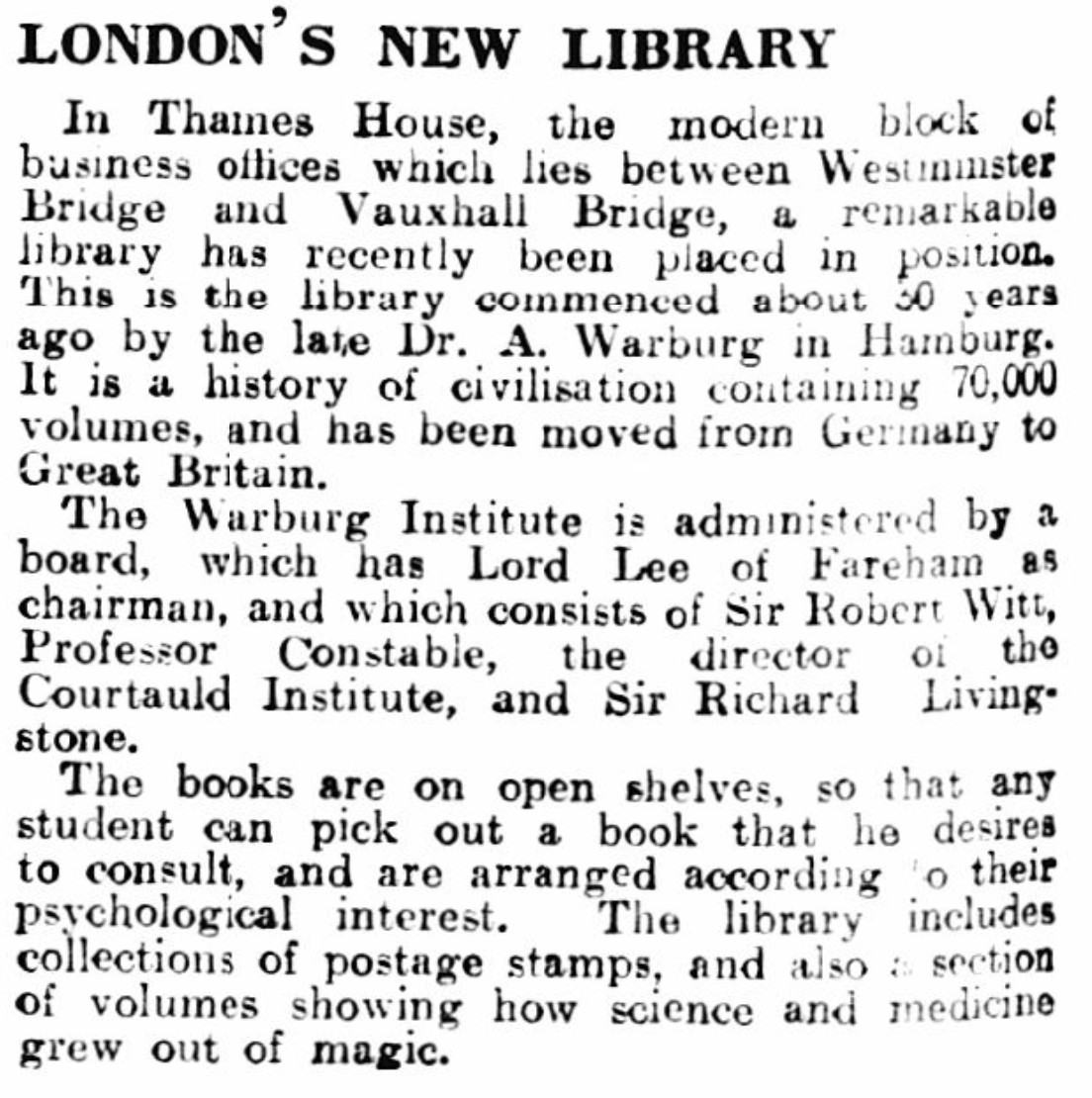
Once in London, the institute set itself up in Thames House. In line with the deal struck with the Nazi authorities in Hamburg, press coverage was not to be unfavourable to Germany: here’s an example from the Lancashire Evening Post of 23 June 1934.
It does make me wonder whether the library also has any postcards.
After three years the funding was renewed for a further seven years by Sir Samuel Courtald; and at that time the Institute also moved again, into rooms in the Imperial Institute recently vacated by the University of London. And in 1944, when the second tranche of funding expired, the Warburg Institute was entrusted to the University of London by a Deed of Trust. In 1958 it moved to a new building in Woburn Square, Bloomsbury, just north of the university’s Senate House.
The Warburg Institute has been since 1994 part of the School of Advanced Study, an umbrella organisation for the specialist research institutes which are part of the University of London but not in one of its colleges.
Our story isn’t quite over yet.
If you looked at the trust deed, you’ll have seen that it committed the university to maintain the Warburg “adequately equipped and staffed as an independent unit”. As finances became more straightened, this became an issue, and in 2011 the university and the Warburg Institute’s Advisory Council went to court. At question was whether additions to the collection since 1944 belonged to the university or to the Warburg, and the extent of the obligations owed by the university under the 1944 trust deed. The trigger was the Warburg being charged a proportion of overheads for other elements of the university’s estate. The judgement – summarised in a Warburg Institute press release – was for the Institute. In short, independent means independent. In perpetuity means in perpetuity.
If you want to read more in depth about this extraordinary story, the Warburg Institute has a history on its website, and also an account by Eric Warburg of the move from Hamburg, both of which I have drawn on.
Here’s a jigsaw of the postcard, which is, I think, possibly the most enjoyable jigsaw that I’ve shared so far.
The card was sent in 1994: “Another Warburg gem, to follow up my message (2) to you via Richard about having to postpone lunch on Tues. Due to spending a long weekend in Harrogate I shall have to work a full day on Tues, which means lunch impossible. Would you throw me a couple more dates in April, so that we can make up for the disappointment? I can do any day but Mondays.”