The PM has moved the admissions debate forward
UCU’s Angela Nartey says that, in his intervention on universities and race, the Prime Minister is right that there is something “ingrained, institutional and insidious” about universities today
This article is more than 10 years old
Comment|
Angela Nartey is a policy officer at the University and College Union (UCU), specialising in widening participation and fair access
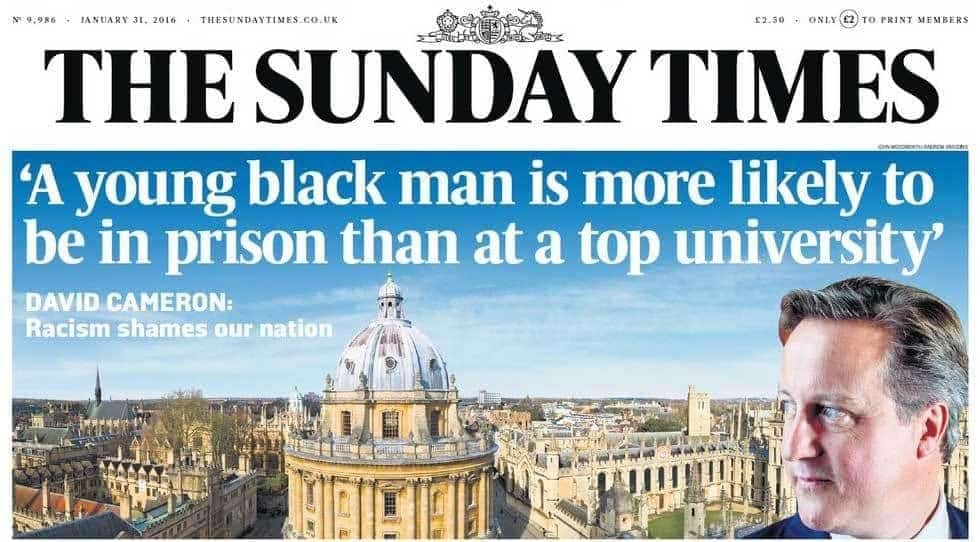
Even the most casual observer will have noticed that we at UCU are by no means uncritical of the current Prime Minister and his Government. However, credit where it is due: David Cameron’s intervention on universities and race last weekend has moved the admissions debate forward.
Yes, there are complex, structural and economic reasons for why we see significant disparities in higher education participation by socio-economic factors, but, whisper it if you must, Cameron is right that there is also something “ingrained, institutional and insidious“.
The higher education application and admission process is archaic. It is not just that it damages the chances of young black people or white working class males, as Cameron acknowledges. It also favours private school children and those who have access to high-quality information, advice and guidance – something typically determined by an individual’s socio-economic background. In short, the current process is bad for almost everyone and long overdue for reform.
Cameron called for radical thinking and we welcome the prospect of name-blind applications and the publication of annual institution-level data to show application and admission by gender, ethnicity and socio-economic background. We would go further and add more characteristics, including school type, part-time student status, and qualification-type upon entry to propel the admission process into the 21st century and implement a fair and transparent post-qualification application (PQA) process.
In December 2015, we surveyed our members and found that seven in 10 staff involved in the undergraduate admission process backed a PQA system where students apply for their undergraduate courses after they receive their final examination results. Support for the proposal is consistent; this figure remains unchanged from when we asked our members the same question the previous year.
The previous survey also highlighted professional concern about the use of unconditional offers for students with predicted grades which promise students a place regardless of their grades. The process is coming under increasing criticism because it typically disproportionately benefits students from affluent backgrounds and challenges the professionalism of admissions tutors. Our most recent survey found six in 10 respondents say that they are in use at their institution and 58% say that their use should be banned.
PQA could support greater fairness and transparency in the application process. Quite frankly, the current system now appears anomalous to those who are not in the know. Notable examples include:
- Teachers make predictions about what grades their students will get – half of these predictions are wrong.
- Students use those predictions to select up to five courses that advertise entrance requirements that that are similar to their predictions – many institutions advertise higher grade requirements to increase their positioning in league tables but in actual fact often let in students with much lower grade predictions; this is not known by all applicants.
- Students write a personal statement in which students from higher socio-economic backgrounds are more likely to be able to write about high-status relevant activities that they have had the opportunity to undertake. Personal statements may have input from teachers and parents, but research has shown that what teachers and university tutors think makes a good personal statement can be worlds apart.
- Statistics about a student’s socio-economic background are included. Students have no idea whether this information will be considered or not, and it can vary by course and institution.
- There is an application deadline set by UCAS but for some courses acceptance rates are higher for earlier applicants. Private school students overwhelmingly benefit from this because they are advised and given additional support to apply early.
- If students don’t get the grades they go into clearing, which can play out as a stressful and hasty telephone race to get a place at an institution that still has places left on a course.
- If students get better grades than predicted, they can go into adjustment, another stressful and hasty process whereby students race to find a course that matches their actual achievement. Although very few students use this process; in 2015, just 750 UK 18-year-olds were placed through this route, compared to almost 180,000 who went through the main first/insurance choice route.
PQA would enable students to make more considered choices about where and when to study. They could then apply to courses once they have their grades – taking out the guess work on the part of students, teachers and assessors who navigate the process alongside the wider complex and constantly changing higher education policy environment. PQA could perhaps even support The Sutton Trust’s estimated 3,700 ‘missing’ state school students from Russell Group institutions.
I have highlighted the practical flaws in the current system to make the case for PQA elsewhere, however our current system also has social costs. We know that over half of Russell Group institutions fall below HESA benchmark estimates for what the social mix of entrants would be if an institution’s intake was representative of the general intake of students with the required grades entering a university that year.
This analysis caused the Social Mobility and Child Poverty Commission to recommend the consideration of a shift to a post-PQA system, despite the logistical challenges involved. Without a radical and deliberate shake up of the admissions process, our higher education institutions do students a disservice by only exposing them to people like themselves and by ignoring this, we facilitate the replication of the current unequal pattern of social stratification in wider society.
Confusingly, whilst Cameron’s intervention heralded a helpful announcement, it precedes a slow attack on students from low-participation backgrounds. The Teaching Excellence Framework proposals risk undermining the institutions with the best record and deliberate methods of enabling students from non-traditional backgrounds to attend university.
In allowing institutions that do well in widening participation to charge more, we may see the perverse, and surely unintended, consequence of putting off the very students that the proposal is aimed at helping. Furthermore, the proposals may in fact disproportionately reward institutions that make relatively smaller progress in widening participation. The introduction of high tuition fees, the precedent of retrospective changes to rules on student loan repayment, cuts to HEFCE’s student opportunity fund and the decision to abolish means-tested maintenance grants in favour of loans all serve to make the decision to participate in higher education a complex one.
PQA has done the rounds several times so I was surprised recently be told that if I thought about it, we already have PQA – through clearing, adjustment, and the option of “simply” applying the following year. Without access to the figures I feel it would be reasonable to guess that, apart from the small proportion of gap year students who have made a deliberate and informed decision to apply later, the proportion of students from low socio-economic backgrounds who go through these routes is far greater than the proportion of those from higher ones. This is not a two-tier process to be celebrated and justified, but rather, challenged and improved. This is exactly the reason why we need a new exploration of PQA with a modern, efficient and transparent methodology.