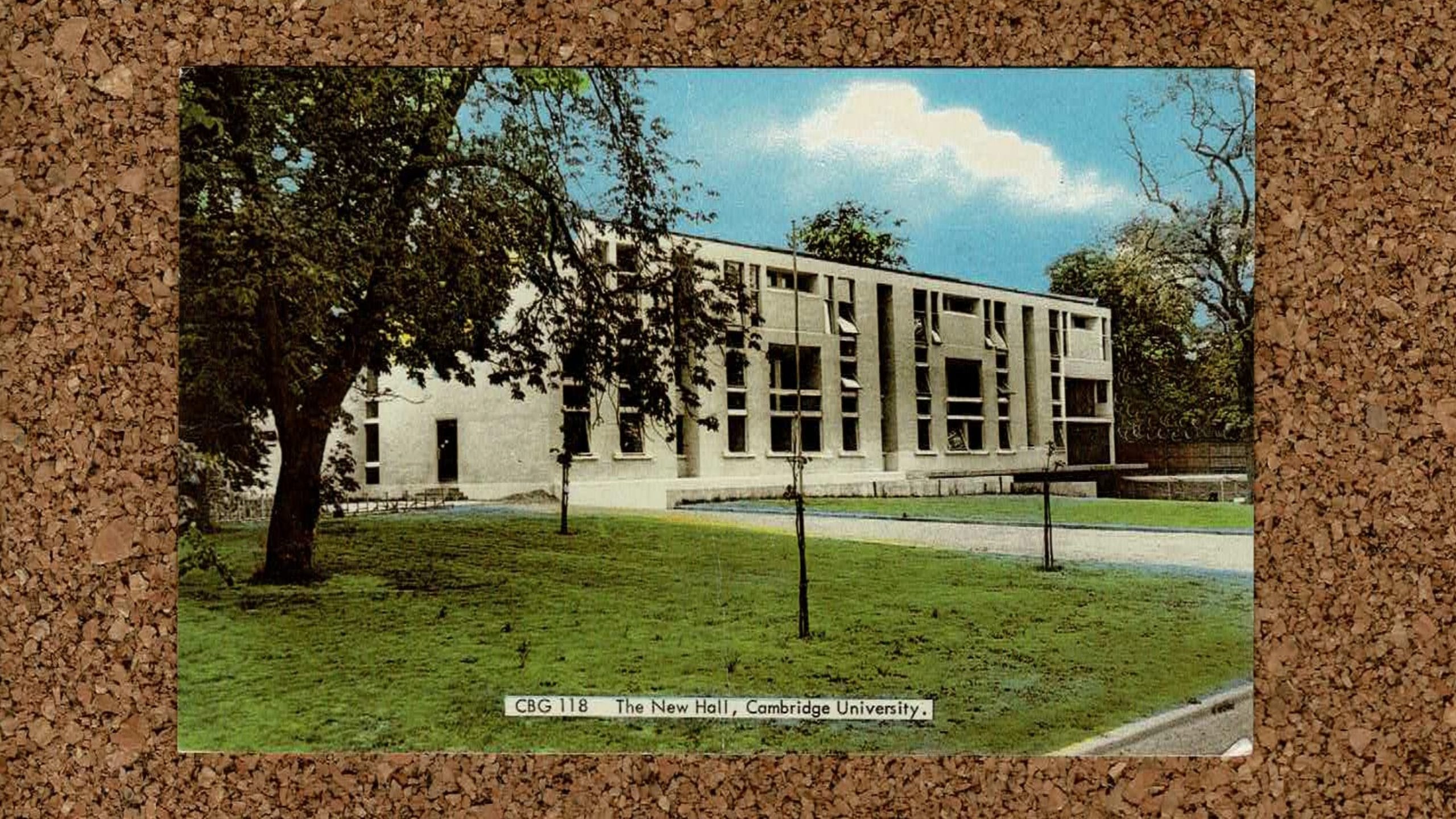
Higher education postcard: Murray Edwards College
This week’s card from Hugh Jones’ postbag tells a story of post-war women in Cambridge
Comment|
Hugh Jones is a freelance HE consultant. You’ll find a daily #HigherEducationPostcard if you follow him on Bluesky
We’ve looked before at Cambridge’s historic reluctance to offer women an education on equal terms with men.
Today we’ll visit another of the colleges which sought to buck the trend and help Cambridge adjust to some elements of modernity.
The year is 1954. Cambridge has been admitting women to degrees since 1947 – only seven years previously. The vast majority of Cambridge colleges were, at that time, for men only. And so if you were a woman who wanted to study at Cambridge there was still a problem.
Enter Rosemary Murray. Murray was a lecturer in chemistry at Girton. She’d studied for her BA and PhD at Lady Margaret Hall, Oxford; and had then gone on to lecturing positions at Royal Holloway College in London and at the University of Sheffield. Lady Margaret Hall, Royal Holloway, and Girton were all at that time women-only colleges. And so we can infer a few things.
Firstly, Murray understood the advantages which a woman could gain from studying at a women-only college. Secondly, she had probably experienced some bias against her given the male dominance of university life at that time. And thirdly that she was probably frustrated at the lack of opportunities for woman at Cambridge.
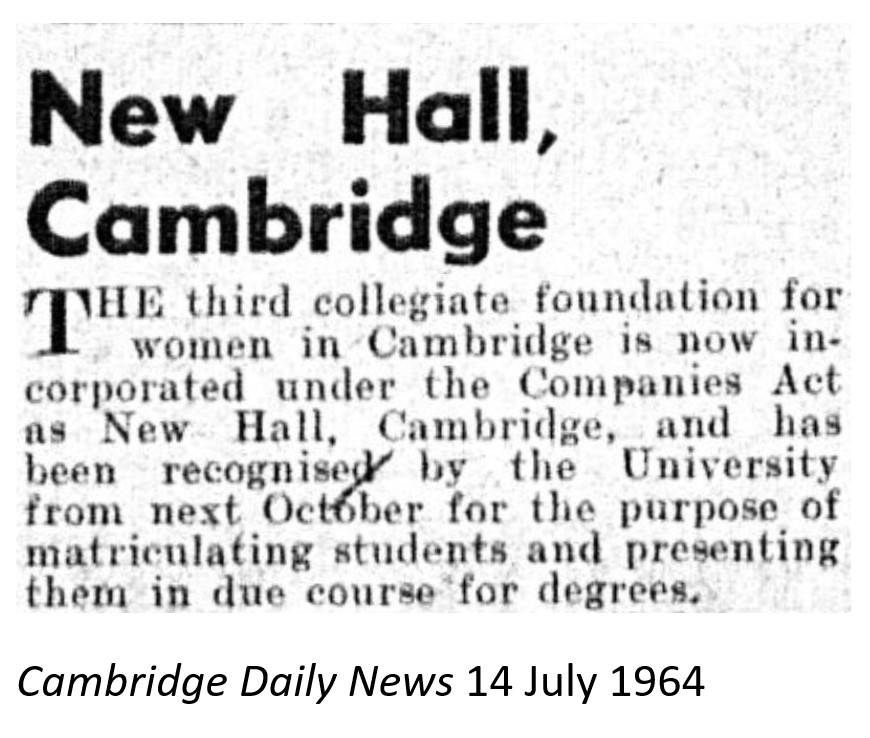
And so Murray set up New Hall, as (I think) an approved foundation of the University of Cambridge, which would admit only women students. There were sixteen in the first cohort; a house in Silver Street was their home. The university was not particularly supportive of the new venture – no funding was provided – although it was not without friends. A campaign to increase the number of women at Cambridge had been in play, and their backing had helped the new venture. The initial endowment was £25,000 – worth just over £600,000 today. This had been provided by grants from King’s College, St John’s College ,and Trinity College, and donations from girls’ schools.
New Hall flourished. In 1962 the Darwin family – descendants of Charles Darwin – gave a house and land to New Hall. Fundraising started, and by 1965 new college buildings had been completed, designed by the architects who would go on to design the Barbican Centre in London.
In 1972 New Hall gained a charter and became a full college of the university. And in 1975 Rosemary Murray became Cambridge’s first woman vice chancellor, serving until 1977.
But the thing is, being a Cambridge college isn’t cheap. And New Hall was struggling financially. That is, until 2005. Alumna Ros Smith and her then husband, Steve Edwards, donated £30 million to New Hall. This was, at the time, the largest single donation ever made to a UK higher education institution, and brought financial security to the college. In honour of this, it was re-founded as Murray Edwards College. Murray for the Rosemary Murray and Edwards for the then couples’ surname.
The college is home to the Women’s Art Collection, which is a globally significant collection of women’s art. It grew out of an initial purchase of a piece by Mary Kelly in 1986. In 1992 the college’s principal sought donations from 100 women artists – 75 responded with a gift, and the collection was born. Pieces from the collection are displayed throughout the college.
The college website has an interesting and fuller account of its history, on which I’ve drawn in writing this piece.
The college has many notable alumnae, including Dame Jocelyn Bell Burnell and Tilda Swinton.
Here’s a jigsaw of the postcard. It was sent in August 1968 to a couple in Bognor Regis – “Hope things are better for you both now. Rebecca has had measles so we haven’t been out much – however I’ve been able to help a little. Weather has been good. See you soon.”
Related articles

What can the higher education sector learn from the music industry about AI?
Athina Dilmperi | Comment | 23/10/26
The conditions for good collaboration won’t create themselves
Annette Bramley | Comment | 23/10/26

In the scramble to AI-proof assessment, fluency isn’t competence
Glenn Hurst | Comment | 22/10/26