Higher education postcard: Gloucester College, Oxford
This week’s card from Hugh Jones’ postbag smells of saltpetre and toffee-apples
Comment|
Hugh Jones is a freelance HE consultant. You’ll find a daily #HigherEducationPostcard if you follow him on Bluesky
“Remember, remember, the 5th of November. Gunpowder, treason and plot! I see no reason. Why gunpowder treason. Should ever be forgot!”
So goes the rhyme, and it’s apt for this week, but what has it to do with a higher education postcard?
And yes, it would be even more apt if today was 5 November, but we’re stuck with a seven day week and the variance in days that that brings. I blame Sargon I, King of Akkad.
You may know the 5 November as Guy Fawkes night: after the man who was caught with gunpowder in the Houses of Parliament in 1605, waiting to blow up the King. But Fawkes was just the fall guy, so to speak. The leader of the plot was Robert Catesby.
The apparent context here was religion – whether England and Wales would be Protestant or Catholic – I suspect that underlying this was, as always, dynastic politics and different countries vying for power. Henry VIII had broken with the Roman Catholic church, piggybacking on the protestant reformation in Europe. Under Edward VI the English state became more clearly protestant, with much repression of those following the Catholic faith.
Edward named Lady Jane Grey as successor, but the privy council was having none of it. Mary, Henry VIII’s eldest daughter, wife of the future king of Spain, and a staunch Catholic, was named Queen. The repression was now of protestants. And then in 1558 Mary died, and Elizabeth, Henry VIII’s younger daughter, took the throne. She established the English church as protestant and resumed the state repression of Catholics.
Elizabeth died in 1603, and James VI of Scotland – a great-great-grandson of Henry VII – took the thrones of England and Ireland, becoming James VI and I in the process. He continued the harsh treatment of Roman Catholics, and that was the spark for trouble.
So back to Catesby. He came from a landed family with Roman Catholic roots. The generations immediately before him had been hounded as Catholics, and in one instance executed for treason. He had married Katherine Leigh, a wealthy protestant, which kept him relatively safe, but after Katherine died in 1598 his Catholicism became more open and radical.
He’d been imprisoned and fined in 1601 when he was part of the Earl of Essex’s rebellion, and in 1603 he was pre-emptively arrested when Elizabeth came to the throne, as part of a round-up of the usual suspects.
In 1605 he had had enough. He plotted with others to blow up the Houses of Parliament; the plot was discovered; Catesby fled and died in a shoot-out in Staffordshire.
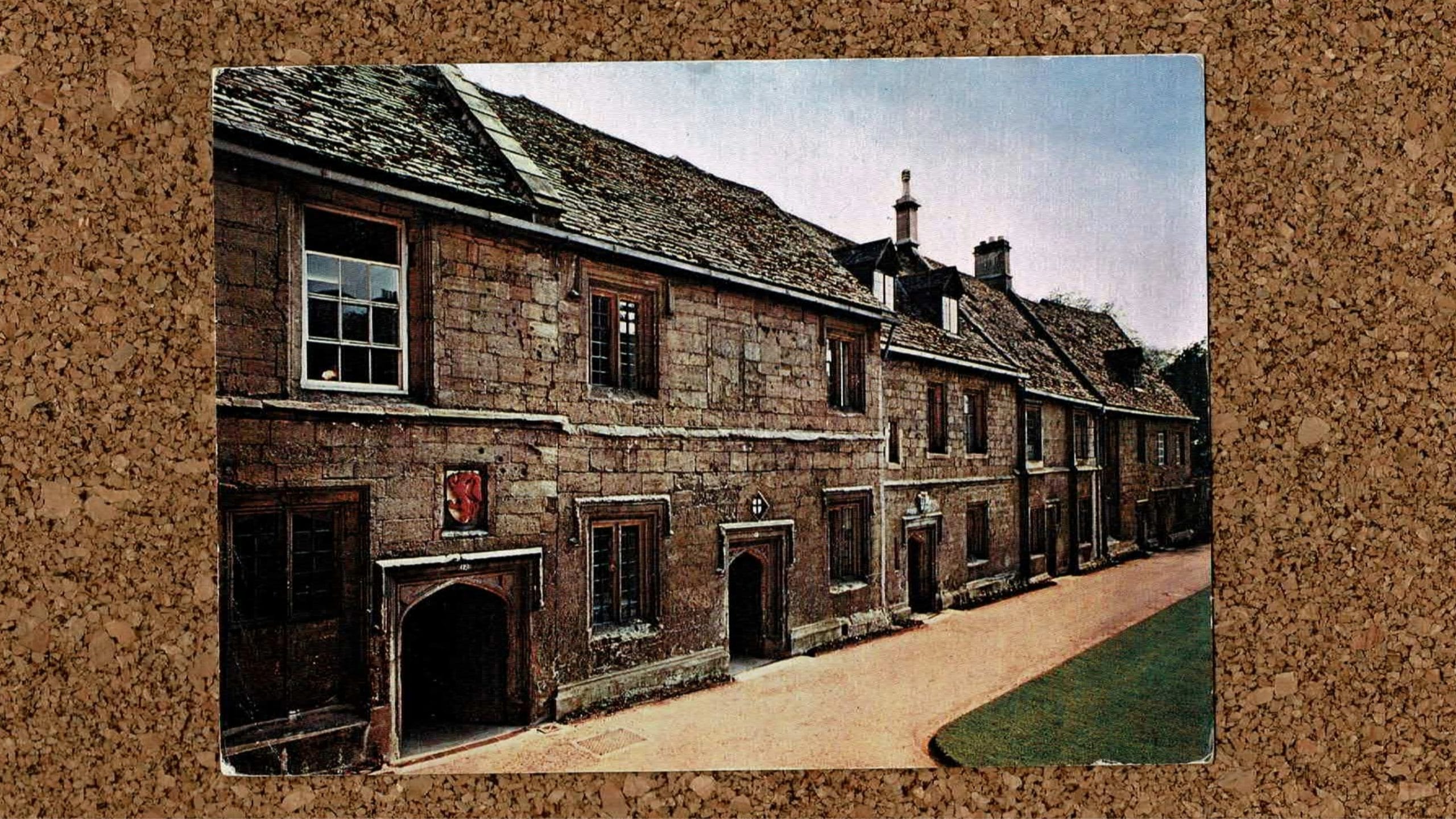
Catesby had been educated at Gloucester Hall in Oxford. This had its origins in Gloucester College, which had been established in 1283 with the gift of a house to the Benedictine monks of Gloucester Abbey. 13 of their number lived in the college as students. Over time, other abbeys sent some of their brethren to study at the college too. A peculiarity of the college was that each staircase “belonged” to a particular abbey, which had charge of the students on that staircase. You can see on the card the arms above each door: these were the arms of the abbeys concerned.
When the monasteries were dissolved, under Henry VIII’s rule, Gloucester College ceased to function. The buildings were granted to the Bishop of Oxford; in 1560 the Bishop sold them to Thomas White, who had founded St John’s College, Oxford. Gloucester College became an annex to St John’s, called Gloucester Hall.
It seems that Gloucester Hall was favoured by Catholic students – probably because of its monastic heritage – but this presented a problem. As part of their graduation, students had to swear the Oath of Supremacy – that is, swearing allegiance to the monarch as head of the Church of England. Not to do so was treason. And so some students – definitely including Robert Catesby – left before completing their degree, to avoid being placed in this politico-theological dilemma.
But this also limited Gloucester Hall’s reach. Its penultimate principal, a man by the name of Benjamin Woodroffe, attempted to rebrand the college as a Greek college, appealing to Greek Orthodox students who would come to England to study. This lasted from 1699 to 1705; there were only 15 such students recorded. The college at that point closed.
Here enters our final character: Sir Thomas Cookes. His 1714 benefaction of £10,000 – which is about £1.75 million in today’s money – led to the Hall being re-founded as Worcester College. About which I have written previously.
The cottages on the card were part of the original Gloucester College and remain the oldest part of Worcester College’s buildings. Oxford’s bus station – on Gloucester Green – is another reminder of what used to be.
The Worcester College website has a history of the college with some lovely detail and images – it’s been very helpful in writing this blog.
Here’s a jigsaw of the postcard. I can’t put a precise date on it but it feels – judging by the card stock and the colour – to be from the 1960s.