Higher education postcard: Rajabai Clock Tower, University of Mumbai
This week’s card from Hugh Jones’ postbag crosses the world to Mumbai to find yet another university clock tower
Comment|
Hugh Jones is a freelance HE consultant. You’ll find a daily #HigherEducationPostcard if you follow him on Bluesky
This week we’re visiting the University of Mumbai. Which was established in 1857 by the British colonial government.
Mumbai was one of three Indian cities – the other two being Kolkata and Madras – which had universities established at that time.
Sir George Gilbert Scott was appointed as architect for the university campus – Scott was a very big name in Victorian architecture. You might know him from St Pancras Station and the Midland Hotel, but the seal of imperial approval was the Albert Memorial.
Scott did gothic, and gothic was what the university got: the convocation house and library, and also a clock tower. It also seems that he never actually visited Mumbai, performing his duties from a distance.
Construction of the tower started in 1869 and it was completed in 1878. It was modelled on what is now called the Elizabeth Tower in the Houses of Parliament – Big Ben. You know the one. You can see below a photograph showing work in progress: the other building is, I believe, the convocation house and library, the other of Scott’s designs.
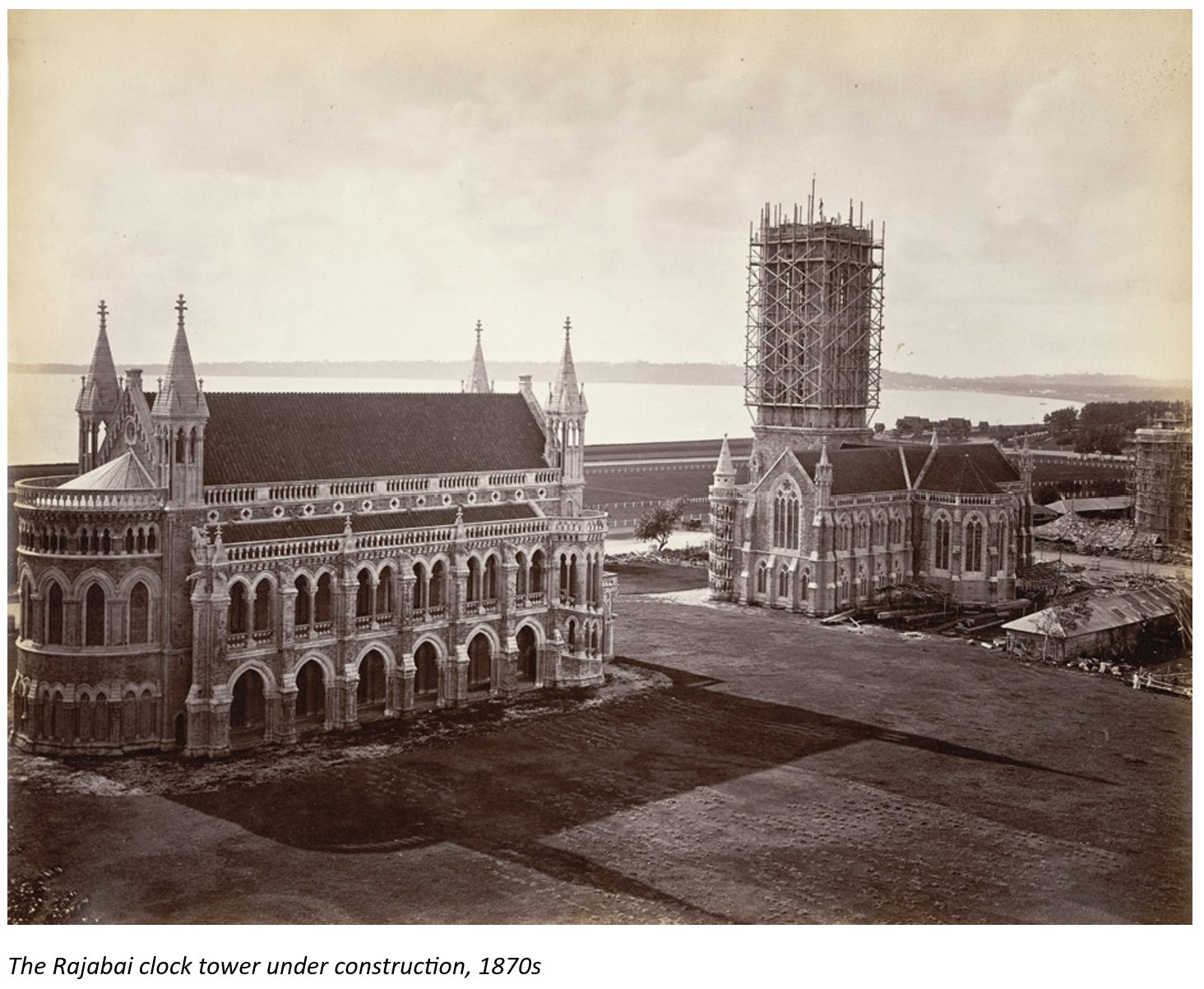
The building works themselves were supervised by Rao Bahadur Ramchandar, an Indian civil engineer and the stone carvings on the tower were done by students of John Lockwood Kipling, Professor at the Sir Jamsetjee Jeejeebhoy School of Art in Mumbai. Lockwood was Rudyard Kipling’s father; the School of Art is better known as the Sir J J School of Art, and still flourishes.
Would it surprise you to know that funds were insufficient for the tower?
The project was rescued by Premchand Roychand, an Indian businessman who also founded the Bombay Stock Exchange. Roychand donated 200,000 Rupees out of the total cost of 550,000 Rupees; his return was that the tower was named after his mother, Rabajai. The legend is that Rabajai – as a Śvetāmbara Jain – would eat her last meal of the day before sunset. The clock in the tower, and associated bells, would enable Rabajai to tell the time, even though she could not read.
There’s a really good explainer video by the Hindustan Times which looks at this from a financial perspective. The presenter describes the costs in terms of lakh and crore: a lakh is 100,000 and a crore is 10,000,000, or a hundred lakh.
The bells in the tower were designed to play tunes. In the nineteenth century it had a repertoire of sixteen tunes, and changed tune four times a day. The tower itself is 280 feet tall, just shorter than the Queen’s Tower at Imperial College which we looked at last week.
The tower was refurbished in 2015 – clearly to a very high standard, as can be seen in this page detailing the work and methods used. The restoration was awarded a UNESCO prize in 2018 for cultural heritage conservation.
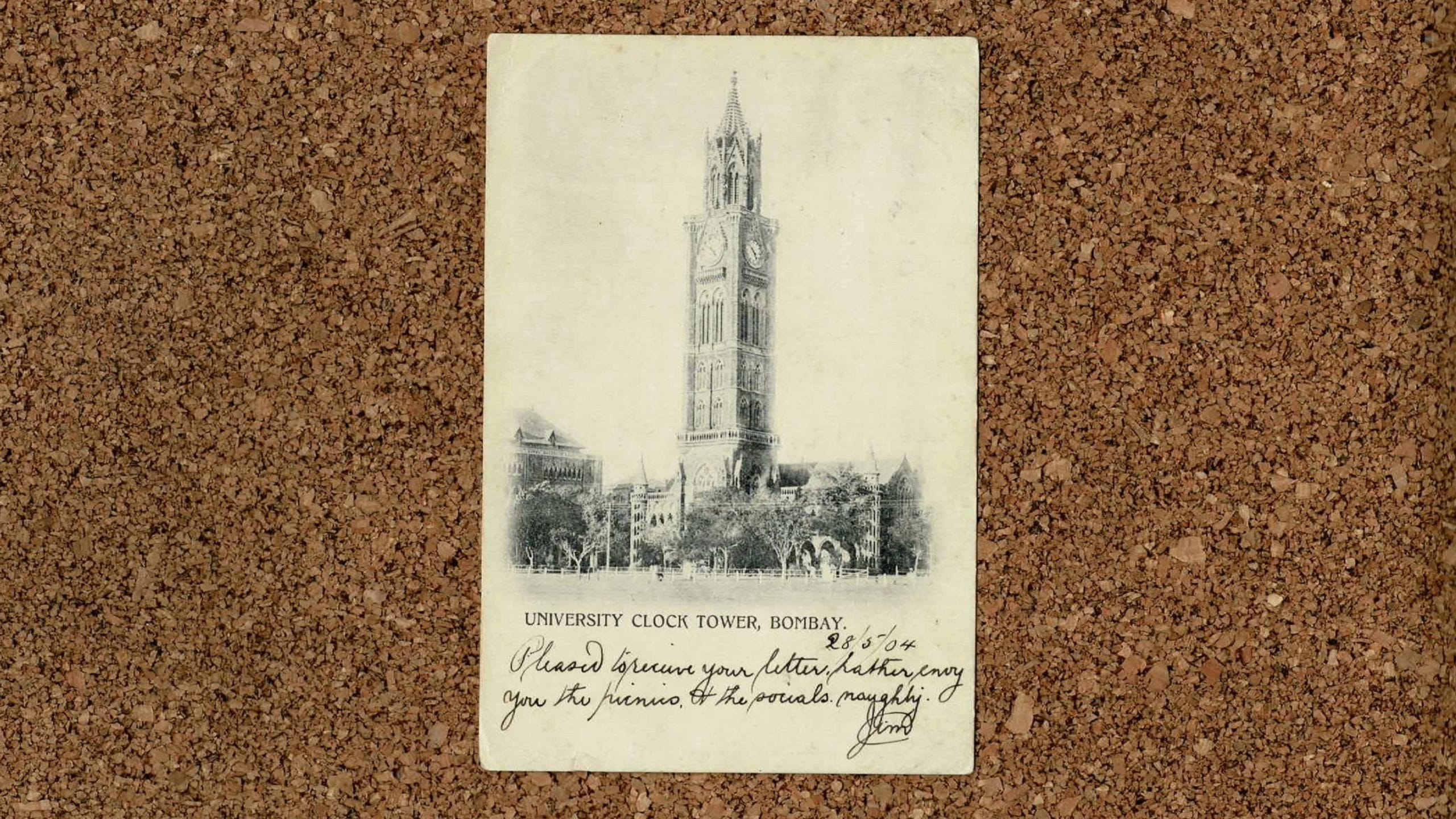
Here’s a jigsaw of the postcard. It was sent from Mumbai to Miss Gardner in Guernsey, but sadly the stamp has been steamed off so I can’t share it with you. The card dates from before 1902 – the non-picture side does not have a divided back and is only for the address, which is why the message is written on the front – and was sent in 1904. As best as I can tell, the message reads: “Pleased to receive your letter. Rather envy you the picnics. & the socials. Naughty. Jim”
And because it’s a challenging jigsaw, here’s another which is slightly easier.
Related articles

Procurement is a collaboration question too
James Coe | Comment | 9/10/26
Jo Johnson: “I still believe that student choice must be the main organising principle for higher education”
Debbie McVitty | Comment | 8/10/26

Why universities keep forgetting their anti-racism commitments
Dami Folayan | Comment | 8/10/26