Wonk Corner|17/11/26 · 14:00
Earning “or” learning? Chance would be a fine thing
Alan Milburn’s final report on young people and work has a phrase it repeats again and again.
Jim is an Associate Editor (SUs) at Wonkhe
Every young person, it says, should be guaranteed the opportunity to “earn or learn”.
It’s a good slogan. The problem is the “or”. More and more young people have to do both at once – and the more who do, the fewer first jobs are left for those the report is about.
David Kernohan has the wider picture elsewhere on the site – here I’ve looked at something narrower that turns out to be quite big.
The report works backwards from the number that frightens ministers – young people on benefits – through health, schools, careers advice, apprenticeships, employer costs, regulation and benefits.
Earning while learning? Not so much.
Built-in blind spot
A NEET isn’t in education, employment or training, so a full-time student is excluded by construction, however many hours they work. That’s fine for counting who is disconnected, but useless for seeing who they compete with for jobs.
The data underneath makes it worse. The Labour Force Survey behind Milburn’s numbers is, as I’ve banged on about before, close to blind on students. Only around one in eight of the students it finds live in halls, it barely touches international students, and more than half of full-time students’ answers come from someone else in the household, up from 45 per cent in 2019 – with proxy answers showing lower employment.
The HMRC payroll data behind IFS’s May report, Why has the NEET rate risen?, counts student jobs but can’t say who is a student. So neither source can see students, home and international, doing more of the country’s entry-level work while other young people are squeezed out.
In the Labour Force Survey, the employment rate of 18 to 21 year olds in full-time education rose from 32.5 per cent in 2022 to 35.9 per cent in 2025, while for those outside it fell from 71.1 to 65.7 per cent. The overall rate barely moved, at around 51.5 per cent.
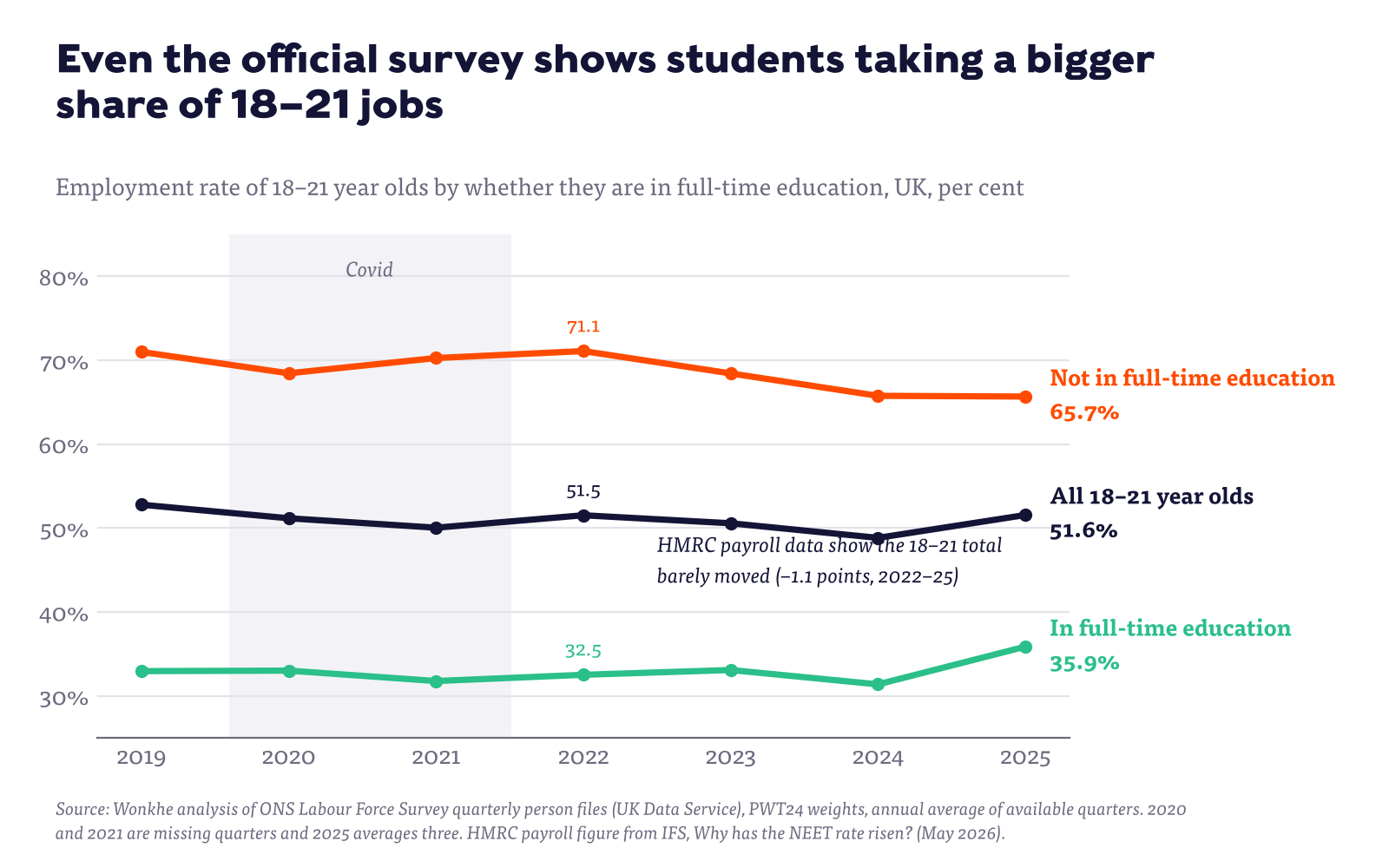
That flat total matches IFS – payrolled employment among 18 to 21 year olds fell just 1.1 points between 2022 and 2025 – but IFS couldn’t see underneath it. The Labour Force Survey can, a little, and shows students holding more of a stable number of jobs. Given who the survey misses, the rise in student working it records is a floor.
Two surveys, one direction
The HEPI/Advance HE Student Academic Experience Survey sees more – the share of undergraduates aged 21 and under in paid term-time work went from 42 per cent in 2022 to 56 per cent in 2026, and of all full-time undergraduates from 45 to 65 per cent.
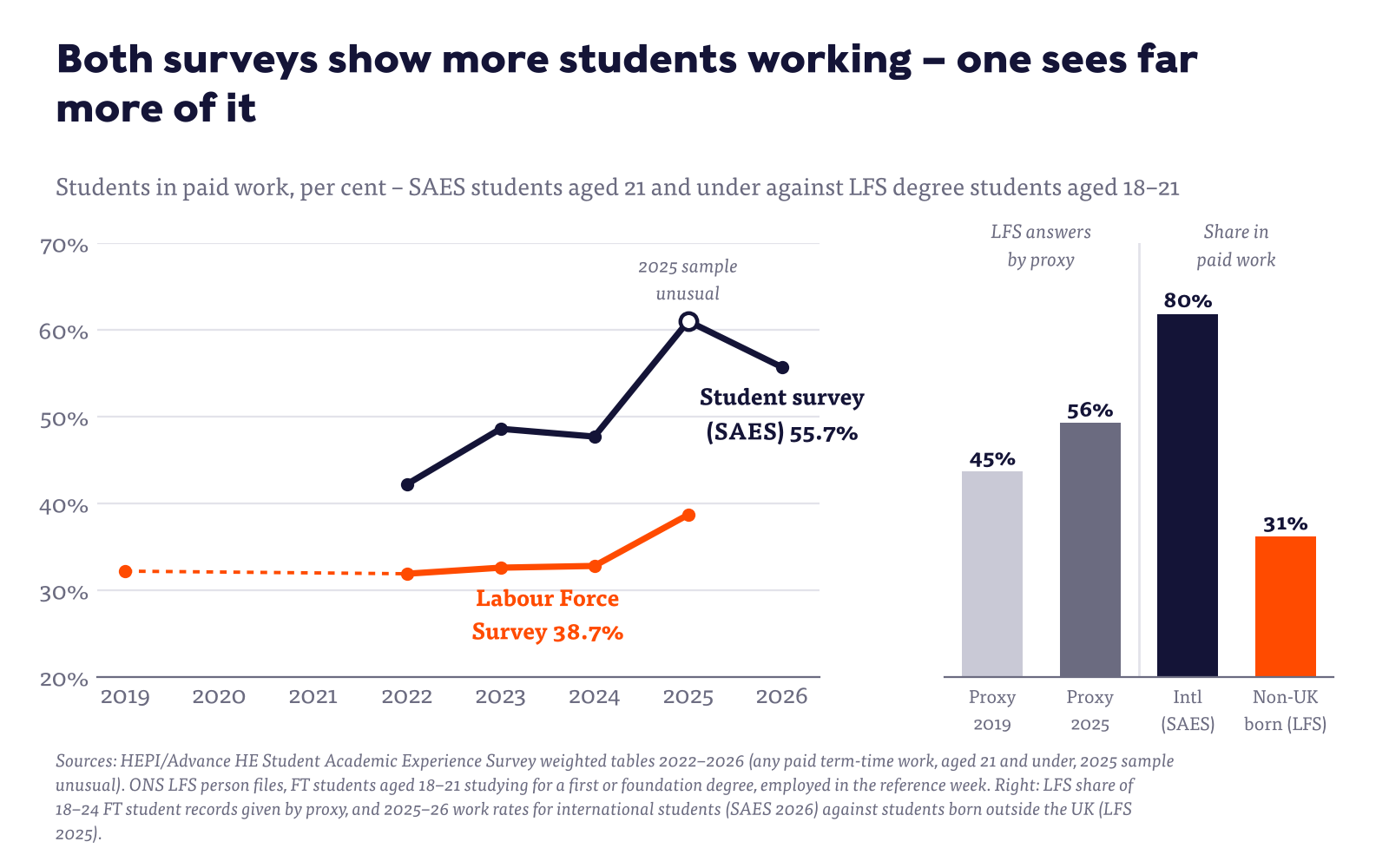
Restrict the Labour Force Survey to degree students aged 18 to 21 and employment rose from 31.9 to 38.7 per cent between 2022 and 2025 – the same direction, seen less clearly. The gap is widest for international students, four in five of whom work in the student survey.
When it broke
The employment rate of 18 to 24 year olds outside full-time education had fully recovered from Covid by summer 2022, at 77.1 per cent. It fell to 74.6 per cent in a single quarter and has drifted to around 71 per cent since.
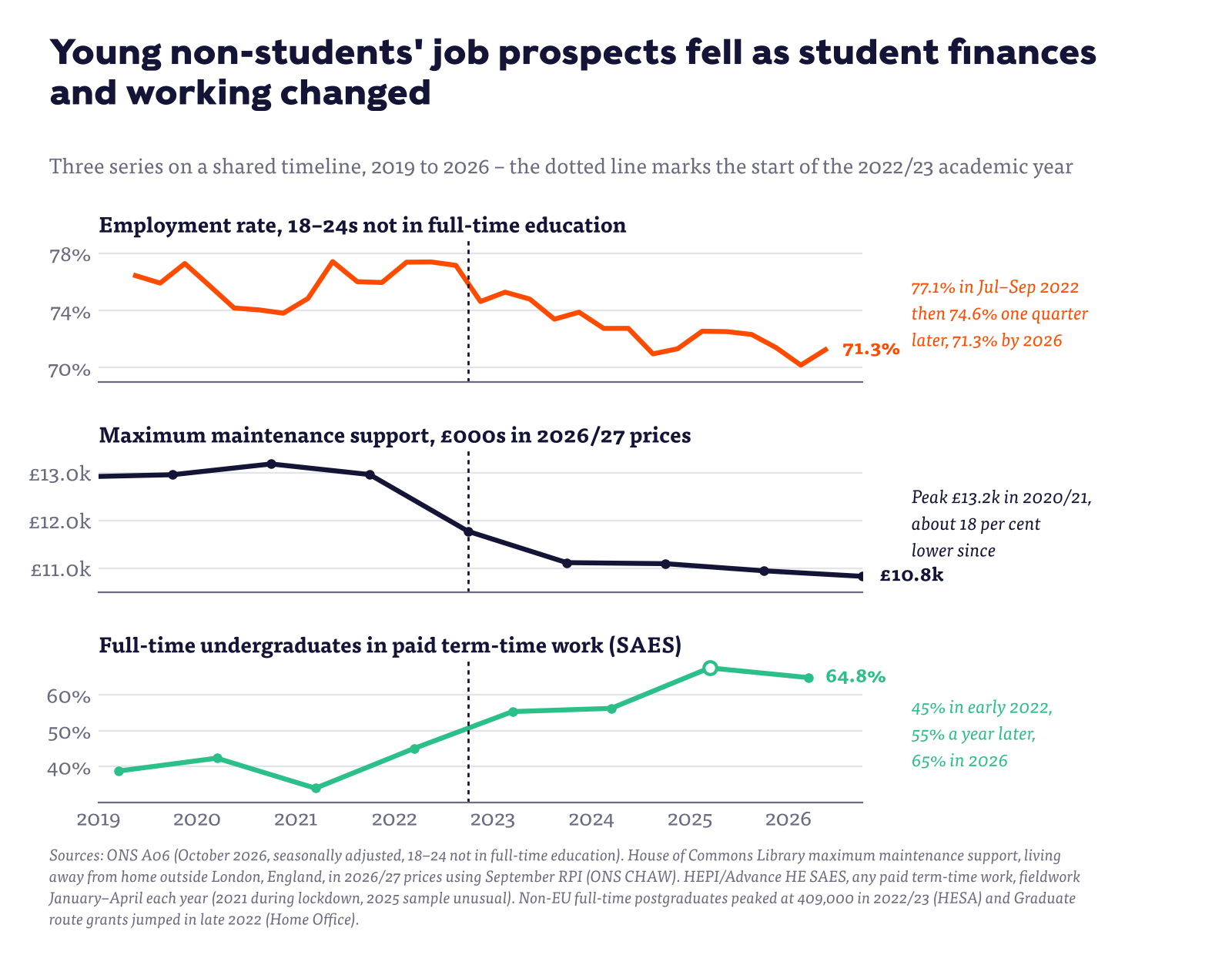
That break lines up with the start of 2022/23. England’s maximum maintenance package, which peaked in real terms at around £13,200 in 2020/21 in today’s prices, had begun a slide that has since taken it about 18 per cent lower. Non-EU full-time postgraduates peaked at around 409,000, Graduate route grants jumped, and the share of undergraduates working went from 45 to 55 per cent in a year.
IFS also dates the fall in payrolled employment among older young people to the end of 2022 – two years before the National Insurance changes employers blame. The cost of living and interest rates hit then too, so timing can’t separate causes – but a story of that quarter that leaves students out is missing something.
The kind of worklessness matters too. Since late 2019, unemployed 18 to 24 year olds outside full-time education are up about 141,000 to 439,000, and inactive ones about 133,000 to 680,000. For all Milburn’s focus on health and inactivity, more than half the rise is young people looking for work and not finding it – which fits a crowded entry-level market at least as well as a story about health.
Same jobs, different shifts
The jobs overlap too. In the student survey, 59 per cent of working students aged 21 and under are in retail or hospitality, and in the Labour Force Survey full-time students’ share of 18 to 24 year olds in distribution, hotels and restaurants rose from 29.5 to 33.5 per cent between 2019 and 2023, and of the hours from 17 to 21 per cent, before dipping in 2025.
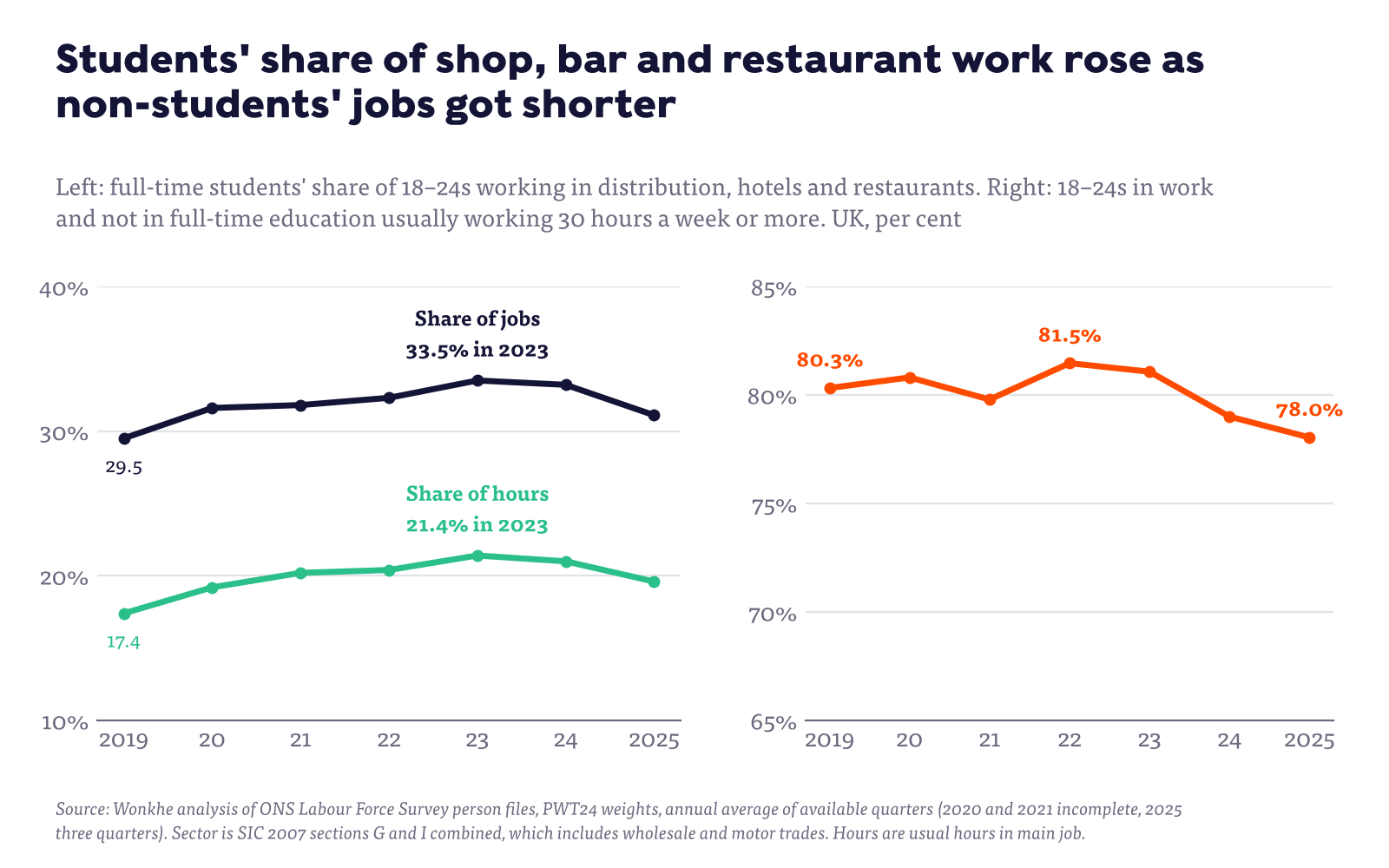
Meanwhile fewer young people outside education have worked 30 hours a week or more since 2022 – what you’d expect if shop and bar work is being cut into evening and weekend shifts that suit a timetable rather than a rent bill.
Nobody has to consciously pick a student over a NEET. University signals reliability where a CV gap or health condition can filter someone out, students rarely expect progression or full-time hours, and job shops, temp agencies and shift apps supply them through channels other young people never touch.
International students differ – only 27 per cent of those working are in retail or hospitality – and the Home Office’s evaluation of the Graduate route finds many of those in work in non-graduate jobs, often in care.
Counting the hours
Against 2019 rates and hours, young people outside full-time education are working about 9.8 million fewer hours a week – 6.2 million because fewer are in work, 3.6 million because those in work do fewer hours.
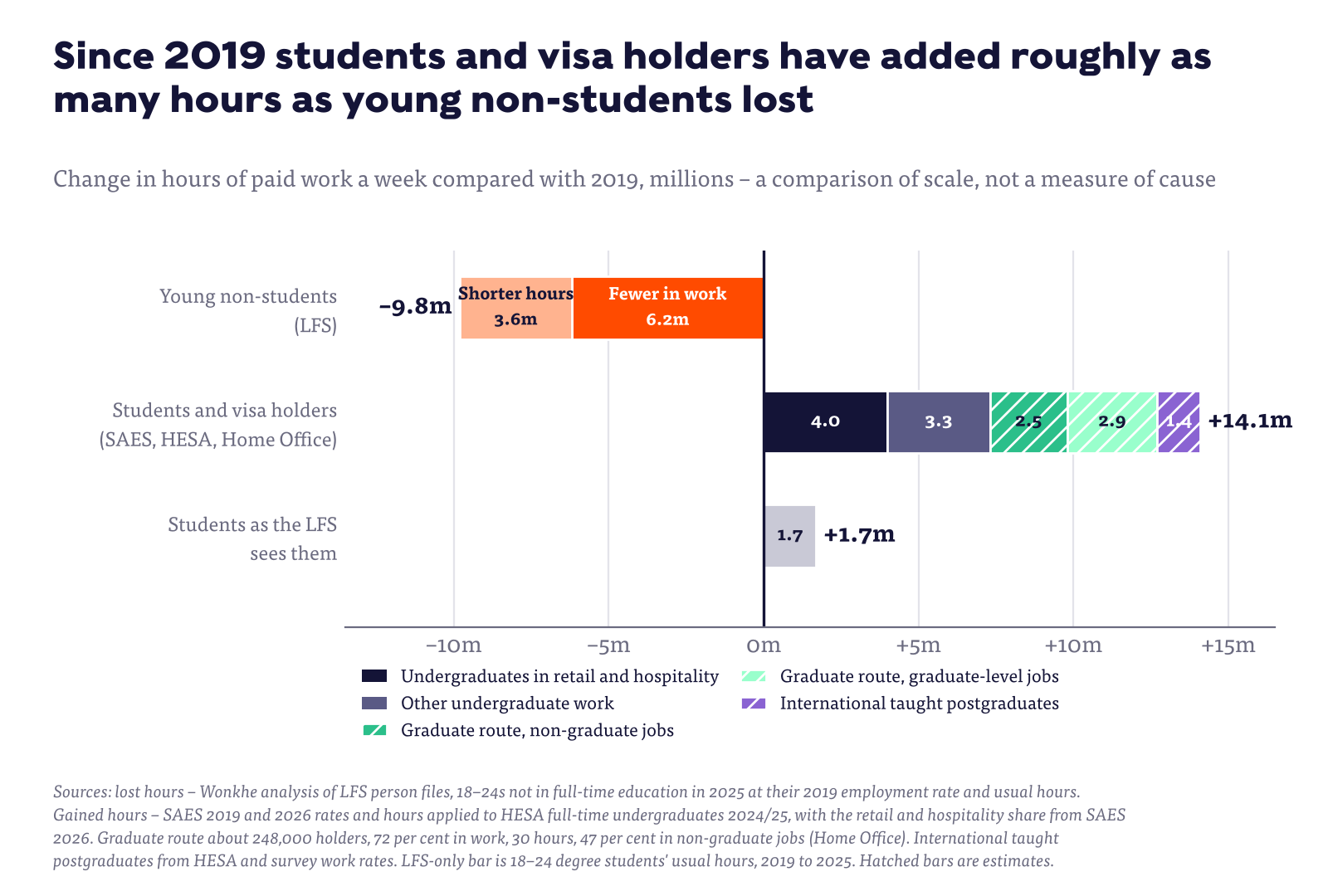
On the student survey’s rates, full-time undergraduates are doing about 7.3 million more hours a week than in 2019, around 4 million in retail and hospitality. Graduate route holders add something like 5.4 million, about half in non-graduate work, and international taught postgraduates around 1.4 million. Counting only work that plausibly competes with young people outside education, that’s 6.5 to 8 million hours.
The Labour Force Survey’s measure of students finds just 1.7 million extra hours. That gap – between explaining most of the lost hours and about a sixth – is the blind spot. It proves nothing about cause, but nobody can call displacement small using a survey that can’t see who does the work.
Reading IFS by age
The IFS age pattern fits better than its authors suggest – payrolled employment fell 7.3 points at 16 and 17, 1.1 at 18 to 21 and 4.8 at 22 to 24.
IFS reads the fall at 16 and 17 as a decline in casual work alongside studies – the Saturday jobs undergraduates now compete for. The fall at 22 to 24 sits alongside tens of thousands more Graduate route holders in non-graduate jobs.
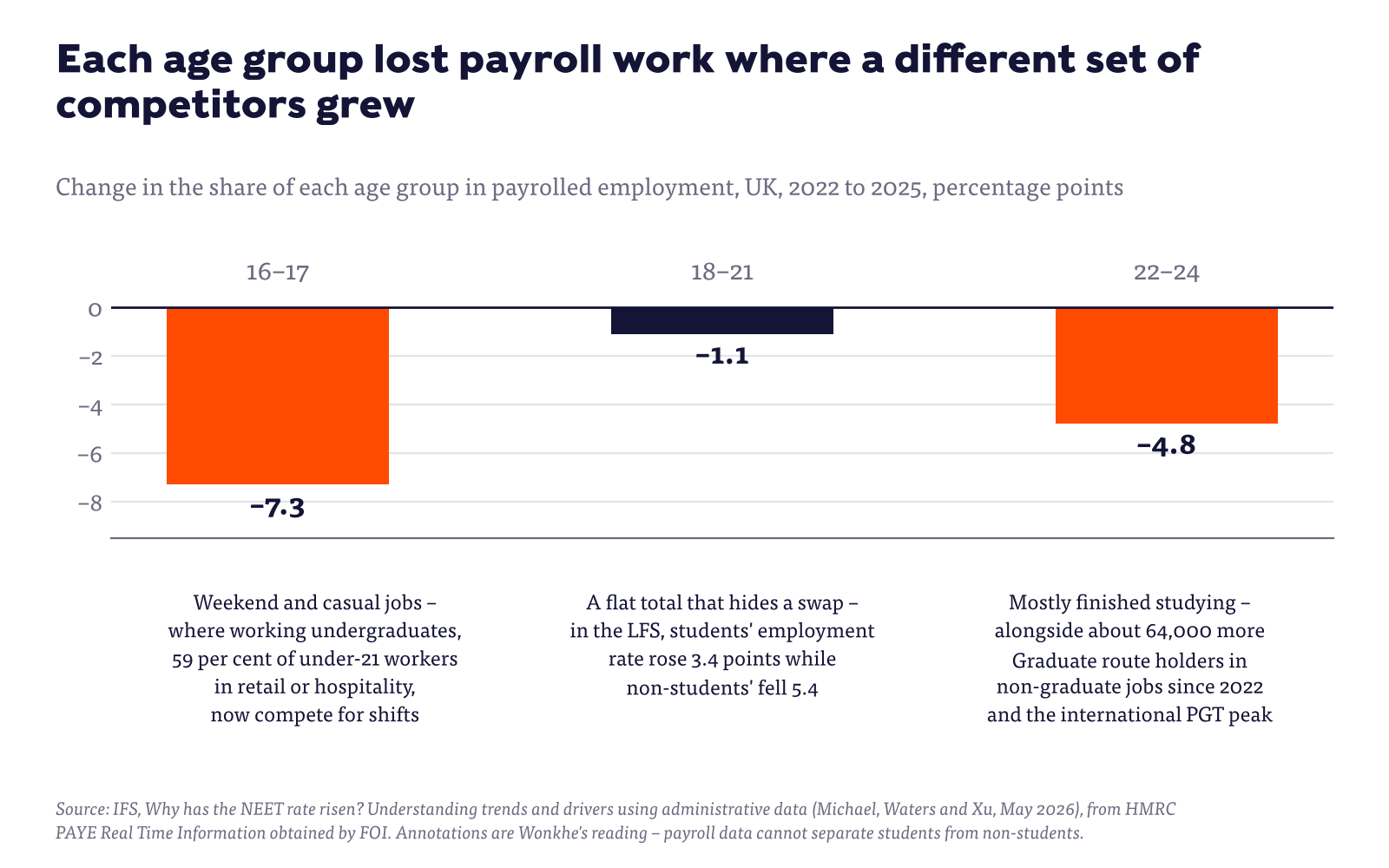
IFS even gets close to the mechanism. Asking why 19 and 20 year olds claim more benefits with no fall in payrolled employment, its first suggestion is “part-time work alongside studies offsetting falls in employment for non-students” – then it moves on. It also finds 71 per cent of the 2024–25 recovery in Labour Force Survey youth employment was among people both studying and working.
It can’t be the whole explanation. Retail and hospitality payroll jobs are down around a quarter of a million since early 2024, so demand is shrinking too, and student-heavy regions aren’t doing worse – though the areas are coarse and the survey’s student density measure misses halls. The flat payroll figure also caps headcount displacement at 18 to 21, and policy is already moving on the international side, with dependants gone for most taught postgraduates since 2024 and the Graduate route being cut to 18 months outside “high compliance” universities.
I think what we’re seeing is partial displacement – real, plausibly large in hours, concentrated in particular ages and sectors, and invisible to the official data.
Missed along the way
But none of it is in Milburn. “Student” almost always means school pupils, outcomes data or university regulation, and part-time work appears once – in polling where 48 per cent of 16 to 24 year olds blamed fewer part-time or early work opportunities for the NEET rise, against 18 per cent citing lack of motivation. That’s young people’s own diagnosis, noted and left there.
Even the review’s own modelling gets close. Its analytical annex assumes extra young people coming into the labour market are more likely to end up NEET because of “increased competition for jobs” – so competition for entry-level work counts when it comes from a bigger youth cohort, but students holding those jobs never appear, and its GDP estimate doesn’t model displacement at all.
Higher education maintenance doesn’t feature at all. The report knows money keeps young people learning – it proposes an EMA-style £50 a week for care leavers so “immediate financial pressures do not pull them away from learning and work” – but never applies that to the million-plus students whose loans don’t cover the cost of living.
In England the household income threshold for the full loan has been frozen at £25,000 since 2008, so the expected parental contribution grows every year while the maximum lags inflation. Student finance appears only as a source of savings, with support for franchised and foundation year students up for reprioritisation.
The labour market chapter then heads in a direction that will hit students who work hardest. Milburn backs slowing the move of the 18 to 20 minimum wage towards the National Living Wage, cites approvingly Dutch youth rates of around 30 to 80 per cent of the adult rate, and expects the guaranteed hours and zero-hours reforms in the Employment Rights Act 2025 to have unintended consequences.
Most working undergraduates are 18 to 20, many on exactly the flexible contracts those reforms target, and a lower youth rate means more hours to cover the same shortfall.
A Youth Jobs Grant of £3,000 to £7,000 for hiring young people NEET for six months – around 60,000 a year – would make them materially cheaper than a student, and the proposed Youth Allowance’s work allowance of ten or fifteen hours a week adds a subsidised part-time pool chasing students’ shifts. If displacement is real, that’s arguably the point.
With maintenance unchanged, students still need the money, so they’re pushed into cash-in-hand or platform work, longer hours or off their course altogether – and a student who drops out becomes a NEET.
On migration, the report would tie work visas in high-NEET sectors to employers trying young people first – its only nod to a competing workforce, and one that misses student visa holders and Graduate route graduates, neither of whom come through work visas.
Watching the benefits overhaul
The biggest proposals are a new benefits system for under-25s, aimed at young people outside education but catching students at the edges – starting, pausing or leaving a course, or turning 25 – with the Timms review of disability benefits still to come.
Full-time students are mostly barred from Universal Credit unless disabled, assessed as having limited capability for work before starting their course and on PIP, DLA or Adult Disability Payment. Milburn would scrap the Work Capability Assessment and health top-up for under-25s and swap PIP for a narrower, initially less generous Additional Cost Allowance, without saying what replaces that gateway.
PIP also passports some disabled students to extra support through student finance, so unless those rules change too, under-25s lose help that mature students on the same course keep – and anyone turning 25 mid-course switches regime partway through.
DWP’s own research with young NEETs on health and disability benefits, published alongside the report, shows what’s at stake. The few who started university all withdrew, all citing their health. Some put paid work ahead of education because they had rent to cover, and PIP paid for travel and course materials – one said getting it earlier would have let him go to university.
A student who pauses or leaves becomes a young person outside education, facing a duty to engage and a participation plan backed by loss of the Youth Allowance – with nothing on returning to university, or on breaks for illness, which student rules already handle badly.
And the Youth Allowance would pay more to those living independently, including care leavers and estranged young people, because living away from family costs more – exactly the case for estranged and care-experienced students, who are mostly barred from Universal Credit. The review makes it, then stops at the campus gates.
The fix nobody mentions
Earn or learn is a lovely ambition, but for a growing share of young people the choice has been made for them – by a maintenance system that no longer covers the cost of being a student, and a visa system that lets international students and graduates fill the gap.
The review’s own logic offers answers. If financial pressure pulls care leavers out of learning, it pulls students into work – and maintenance that covered living costs would free up entry-level hours as well as study time. A youth participation test should ask what policies do to students’ hours as well as NEETs’ job chances.
And if government wants to know whether displacement is happening, it should link payroll to student records, and set payroll by age and area against where students study.
Milburn wants every young person to earn or learn. Plenty of students would settle for being able to afford just the one.