Wonk Corner|26/11/26 · 13:42
Control, delivered by refusal
The government’s big immigration story of the day is net migration at its lowest in nearly 30 years.
Jim is an Associate Editor (SUs) at Wonkhe
In fact, the students and graduates it has been squeezing are now the only thing keeping the figure above zero.
The sector and the government want different things from international students, and today’s figures show whose priorities are winning.
The Home Office figures for the year to September 2026 show 335,801 sponsored study visas granted, down 23 per cent on the year and 49 per cent below the 2023 peak.
Main applicants fell by 96,000 to 322,287 – lower than in the year to September 2021 – and dependants fell by another third to 13,514.
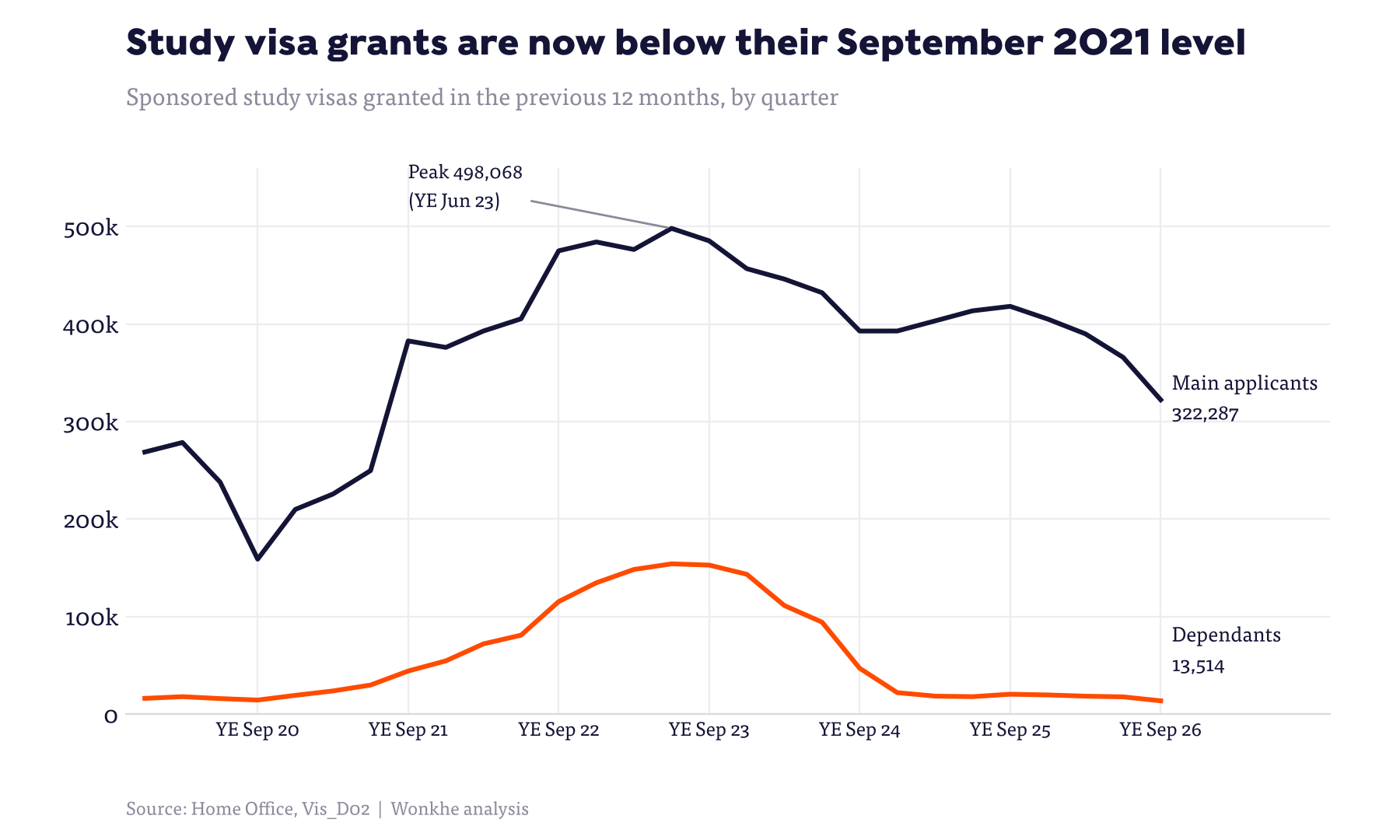
The July to September quarter, when most autumn starters get their visas, saw 222,941 grants to Student route main applicants against 266,522 a year earlier – a 16 per cent fall. Most of the drop is in taught postgraduate courses, where masters grants fell 29 per cent to 181,920, around four fifths of the total fall.
And it isn’t over. The monthly applications data show main applicant applications in the year to October down 20 per cent to 349,900, with October itself down 31 per cent.
The Graduate route looks like it’s collapsing too, with extensions down 31 per cent to 162,881 – but that’s mostly the dependant ban washing through.
Main applicants fell 11 per cent to 150,510, while their dependants fell 82 per cent to 12,371.
Money versus control
For the sector, the goal is money. January’s international education strategy swapped the old student number target for an ambition to grow education exports to £40bn a year by 2030, which looks a long way off on today’s numbers.
On a rough assumption of £20,000 a head, 75,000 fewer masters visas is something like £1.5bn a year in fee income – before the £925-a-head international student levy, which the government’s own impact assessment reckons will cost the sector £1bn over three years.
For the government, the goal is control, or at least looking like it has it. Back in 2024 I argued that whoever won the election would need to be seen to be in control after a period when the last lot visibly wasn’t, and that the bust would be as overdone as the boom. That’s more or less what has happened.
What’s different is how. As I set out in May, there’s no headline ban – the contraction comes through refusals, withdrawals, and a compliance regime that gets universities to do the dirty work of cutting themselves.
Refusals and withdrawals
On our analysis of the entry clearance outcomes data, refusals of sponsored study main applicants rose from 12,252 to 20,726 over the year, taking the refusal rate – refusals as a share of grants plus refusals – from 2.8 per cent to 6.0 per cent.
Withdrawals, which don’t count as refusals in the compliance metrics, went from 5,303 to 13,636.
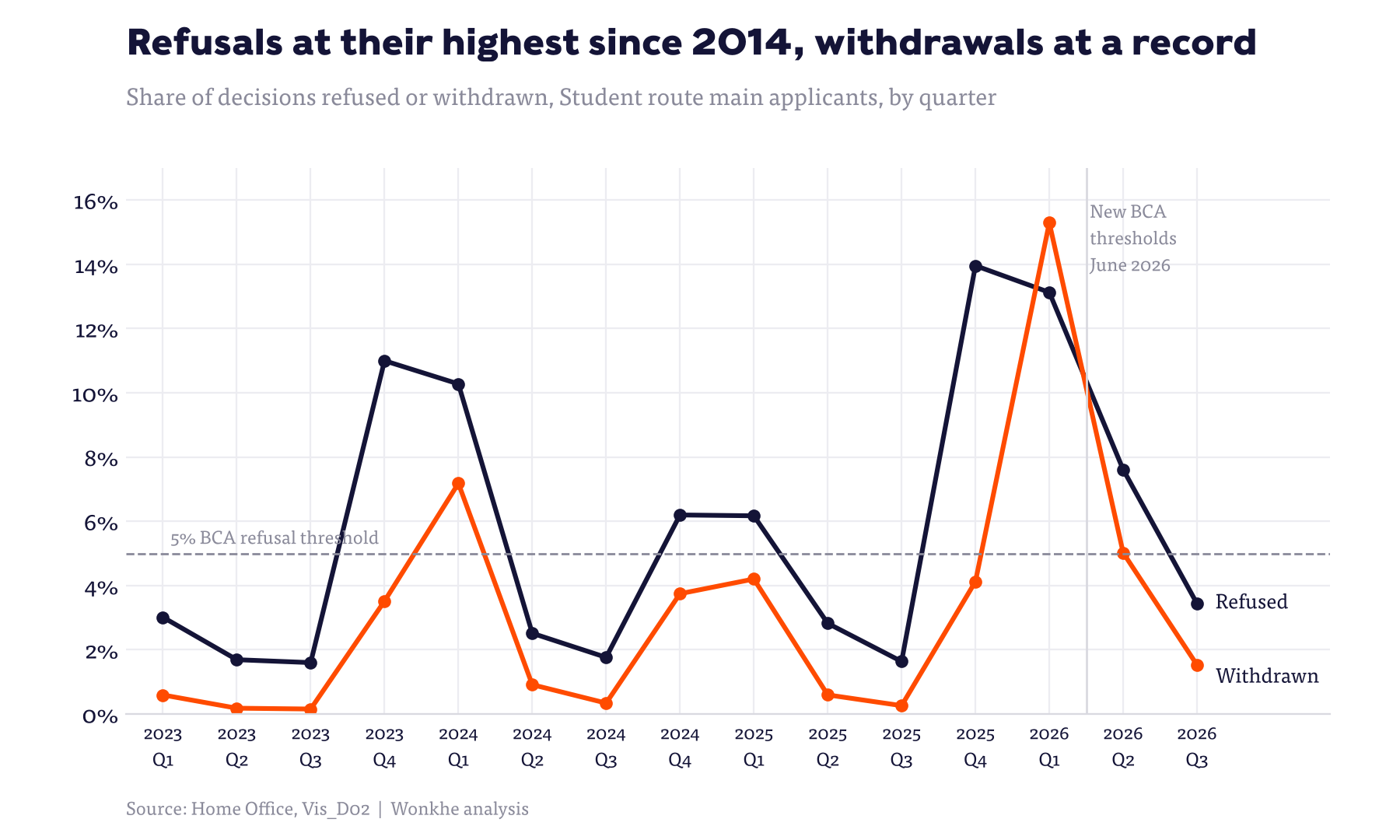
Refusals always rise over the winter, but the 13.7 per cent rate for the last quarter of 2025 was the highest since early 2014, and the 15 per cent withdrawal rate in the first quarter of 2026 is the highest in data going back to 2005. Even in the peak July to September quarter, the refusal rate doubled from 1.6 per cent to 3.4 per cent.
The rise is concentrated in a handful of countries. Pakistan’s refusal rate went from 5.8 per cent to 32.2 per cent, Bangladesh’s from 11.6 per cent to 25.4 per cent, Sri Lanka’s from 6.2 per cent to 22.3 per cent, and Nigeria’s from 4.0 per cent to 19.9 per cent. India’s more than doubled to 5.5 per cent, while China’s was 0.1 per cent.
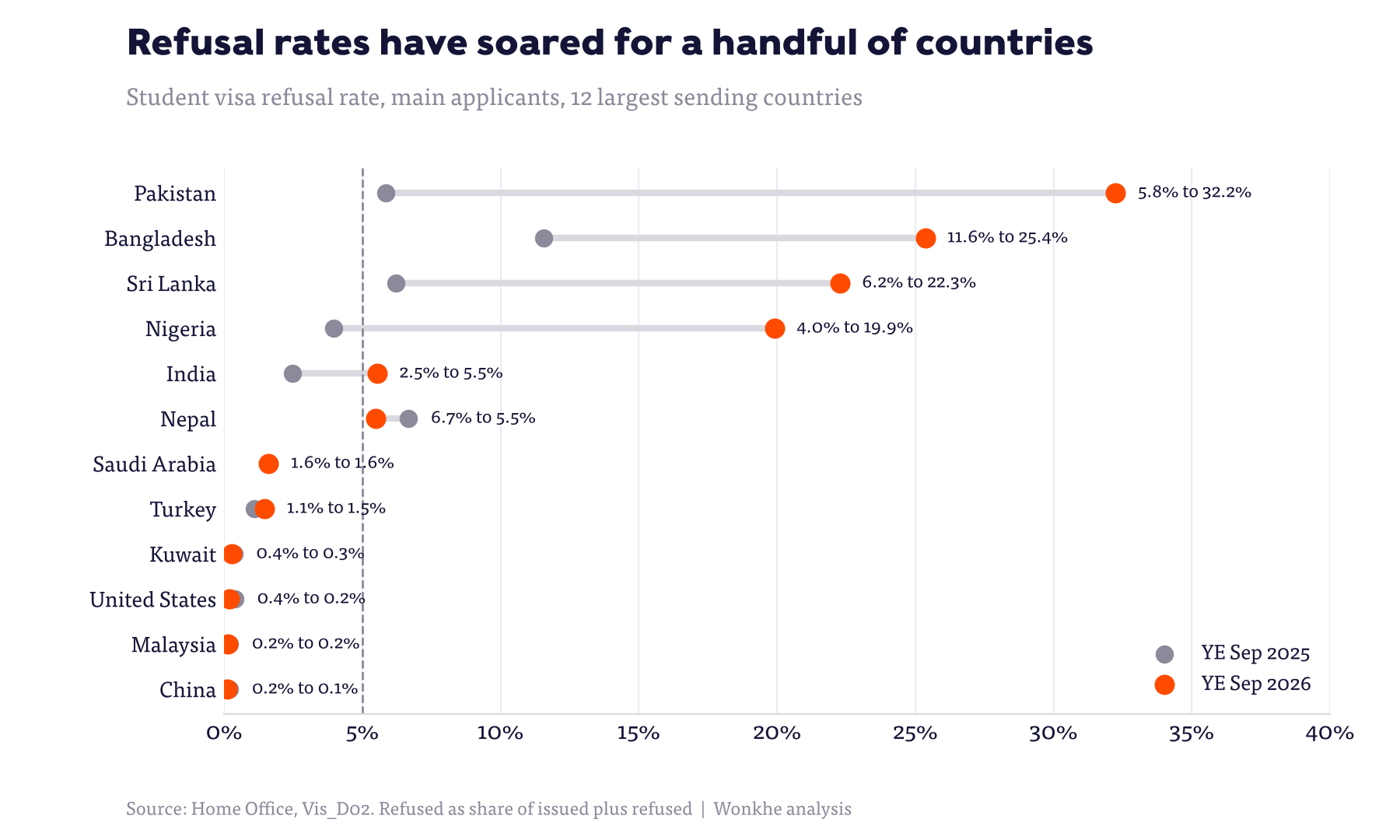
In the first three months of 2026, more Pakistani applicants “withdrew” – 2,867 – than were granted visas, at 2,163. Grants to Pakistani students fell 72 per cent over the year, India and Pakistan between them account for 58 per cent of the overall fall, and seven countries in South Asia and West Africa account for 83 per cent.
The Home Office is thrilled. Its commentary notes that the tougher Basic Compliance Assessment thresholds that took effect in June – a refusal rate below 5 per cent, enrolment of at least 95 per cent, and completion of at least 85 per cent – have led some universities to cut back their sponsorship in certain countries.
When a whole country’s refusal rate runs at four to six times the threshold, any university that wants to keep its licence will stop recruiting there.
The incentive is about to get stronger. Under the October Budget, graduates of “high compliance” universities are set to keep a two-year Graduate route while everyone else drops to 18 months, so a university’s refusal rate will also shape what it can offer the students it does recruit.
For Shabana, it’s 77,000
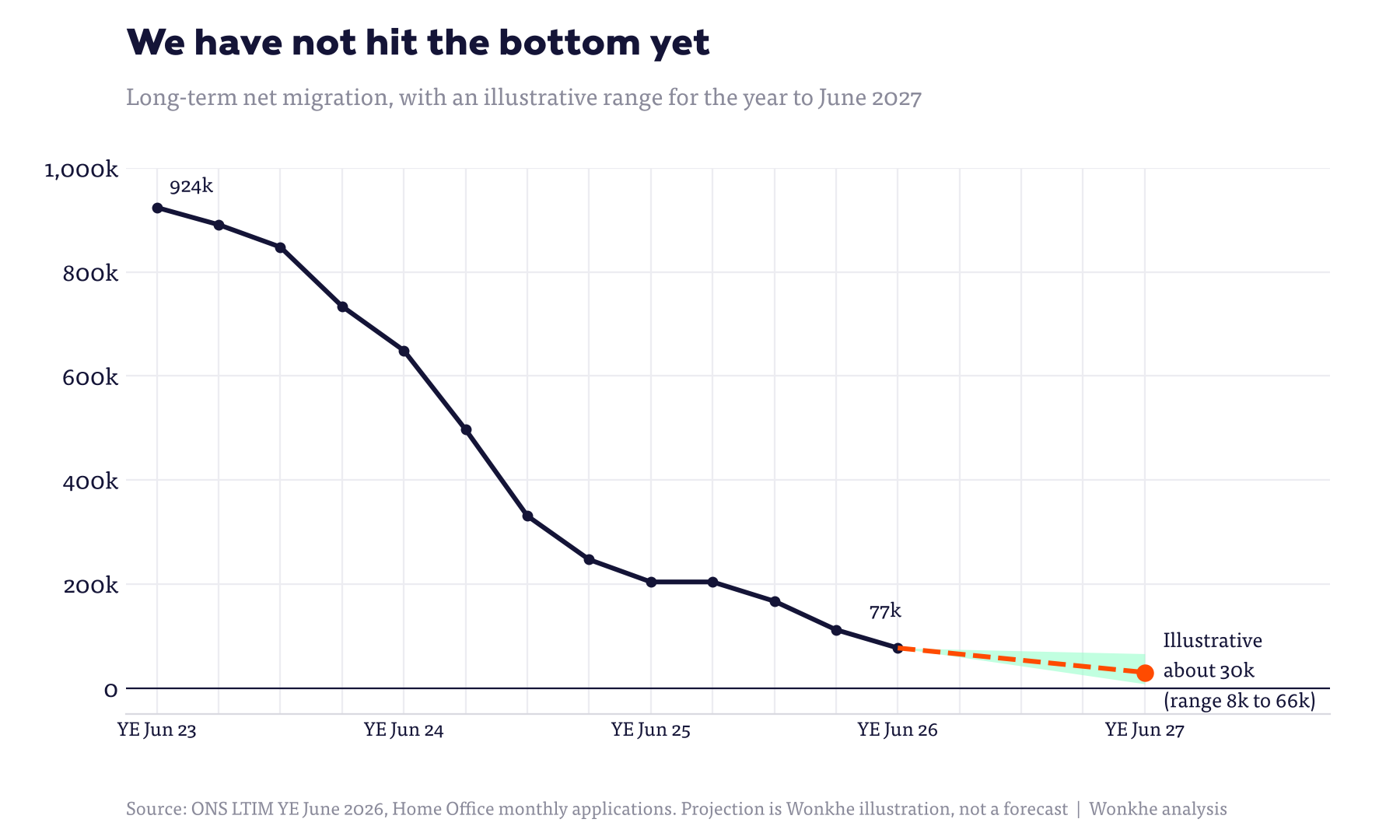
The above is not the Home Secretary’s headline. Hers is the ONS estimate that long-term net migration fell to 77,000 in the year to June 2026, down from 204,000 a year earlier and the lowest since 1997 outside the pandemic. ONS’s own range for where the estimate could end up after revisions runs from 31,000 to 128,000.
“This Government has restored control,” said Shabana Mahmood, adding that the Conservatives had lost control of the borders. A 92 per cent fall from the 2023 peak is a big number to stand behind, even if the dependant ban and the first round of work route restrictions that started it were the last government’s.
What students and graduates are now doing to that figure won’t make the press release. ONS counts people by the reason they first came, so anyone who arrived on a study visa – including those now on the Graduate route or a skilled work visa – counts as study-related whether they arrive or leave.
In the accompanying dataset, study-related net migration was 110,000 in the year to June, made up of 102,000 non-EU+ nationals and 8,000 EU+ visa holders. ONS has declined to publish a measure that takes students out – but if it did, net migration would have been minus 33,000.
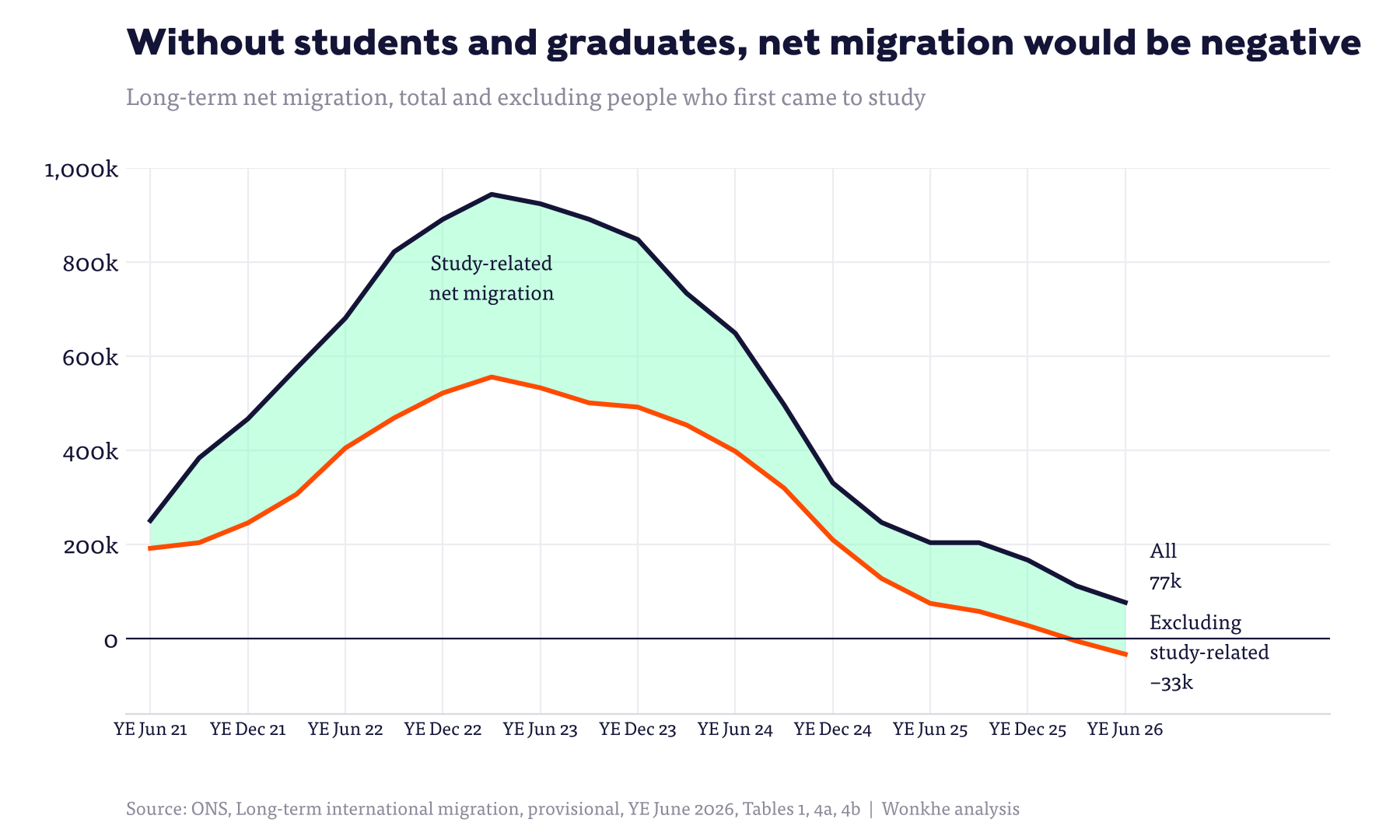
Students and graduates did little of this year’s falling – about 19,000 of the 127,000 drop. Non-EU+ work-related net migration halved from 105,000 to 50,000, and more British and EU+ nationals left than arrived. Students, in other words, have gone from the problem the system needed to fix to the only thing keeping the headline positive.
Not the bottom yet
It will fall further. The ONS year ends in June, so it misses the July to September peak that the Home Office figures show was down 16 per cent, and applications have kept falling since. Study-related arrivals were already down 11 per cent to 257,000.
Departures will stay high for a while. 155,000 non-EU+ nationals who first came to study left in the year to June, which ONS puts down to the big 2022 and 2023 cohorts finishing their courses and post-study work. The Migrant journey data show 94,760 of the 2022 cohort and 138,908 of the 2023 cohort still on the Graduate route at the end of 2025.
From 1 January 2027 most new Graduate visas shrink to 18 months, bringing departures forward – though there may be a rush of applications in December to beat the cut. And with time on Student and Graduate visas no longer counting towards settlement and the ten-year long residence route closing, fewer of those who stay on will stay for good – which shows up in the ONS figures, years later, as more emigration.
If study-related arrivals fall by around a fifth, in line with applications, while departures of former students hold at around 150,000 and everything else stays put, net migration in the year to June 2027 would be about 30,000. Vary those assumptions within reason and you get anything from 8,000 to 66,000. It’s an illustration rather than a forecast, and today’s figure is itself provisional – but it’s hard to make the numbers go up.
The demographic timebomb
All of this is happening as the birth rate falls. There were 585,396 live births in England and Wales in 2025, the fewest since 1977, and the total fertility rate fell to a record low of 1.39 children per woman.
Only last month the Office for Budget Responsibility (OBR) expected net migration of 120,000 in the year to mid-2026, rising to 230,000 by 2031 – today’s figure is more than a third below that. On those numbers the adult population grows by around 320,000 a year, about 150,000 of it through net migration.
The OBR judges that lower migration makes little difference to GDP per person, but it does mean fewer workers (and taxpayers) supporting an ageing population, and Oxford Economics has modelled a long-term zero net migration scenario in which borrowing rises sharply, because lower tax receipts more than offset the savings from a smaller population.
Students arrive young, pay to come, are selected by universities, are educated here, and can then be kept or not according to what the country needs. Treating them mainly as a number to be driven down is an odd response to a fertility rate of 1.39.
Elsewhere, both at once
Tough politics on immigration doesn’t have to mean shutting out the people a shrinking country needs. Japan’s governing party has been adapting to anti-immigrant sentiment under Sanae Takaichi and has made permanent residency much harder to get – yet Japan has kept its target of 400,000 international students by 2033, and passed it eight years early. The number of Japanese nationals fell by more than 900,000 in a single year, and ministers there can count.
In Italy, Giorgia Meloni’s government has authorised 497,550 entries of non-EU workers over 2026 to 2028 to fill labour shortages. Neither government is liberal on migration, but both separate the people they want to keep from the people they want to be seen to be stopping. The UK has barely started that conversation about its own graduates.
Anything else?
Asylum claims from people who arrived on study visas fell 45 per cent to 7,650 in the year to September, which weakens one of the justifications for the refusal crackdown. And short-term English study visas look to have briefly become an alternative way in – refusals peaked at 9,513 in the year to September 2025, mostly to Pakistani and Bangladeshi nationals, before applications dried up.
The Migrant journey data also show how closely the refusal map tracks who stays. Of the 2022 cohort, 73 per cent of Chinese students’ leave had expired by the end of 2025, against 31 per cent for Indian students and 12 per cent for Nigerians. Nepal aside – its students were likely to stay, and its refusal rate fell – the countries whose students were most likely to stay are the ones whose refusal rates have soared.
The sector needed money, and the Home Office got control. No-one in government seems especially keen to ask what happens if the number keeps falling, and the only migrants still adding to the population are the ones it has spent three years trying to put off.