Regional coordination is needed to tackle barriers to access
No single institution can address the most complex access issues. Antony Moss sets out the evidence from London on why collaboration must be the way forward
Analysis|

Antony Moss
Pro Vice-Chancellor and Group Executive Director for Students and Learners, London South Bank University Group
Earlier this month the Office for Students published an eagerly awaited summary of responses to a consultation it ran in 2025, looking at the future of the Uni Connect programme.
From that, we learn that regional access partnerships – a proposed successor programme – will commence in 2027. The intervening period will be used to transition to a national infrastructure that builds on Uni Connect, one which “improves outcomes for disadvantaged learners, reduces duplication and strengthens the strategic coordination of higher education outreach activity across England.”
We have been particularly interested in the question of how to achieve strategic coordination and address root causes of disadvantage in the London context, as the lead provider for the London Uni Connect partnership since 2022. To that end, we undertook a systematic analysis of the current and previous access and participation plans (APPs) of 43 London-based providers. We wanted to understand how the current regulatory framework for equality of opportunity in HE is supporting regional coordination of efforts to tackle the most pressing equality risks – and to set out where we think regional access partnerships could deliver the kind of coordination asked for by the OfS.
Our findings, published today in a new report produced with London Higher, suggest that the current APP model, while arguably improving the quality and rigour of access and participation work, is not driving regional coordination to the same extent.
Although the report assesses the picture in London, its findings and recommendations are relevant to all regions of England. Wherever cost pressures, capacity and local opportunity structures shape who can realistically participate in HE, there is a clear rationale for a more regionally tailored, coordinated approach.
Coordination deficit
Our report, which provides a representative rather than comprehensive picture of the APP-related interventions across London, finds that the overall number of access interventions in London has declined relative to the previous APP cycle. In total, there are over 40 fewer access interventions taking place now compared to the period prior to 2023.
The report also looks at which risks in the OfS’ Equality of Opportunity Risk Register (EORR) these interventions address. And it considers the extent to which these align with the risks that practitioners deemed to be the most significant regional barriers to equality of opportunity in HE.
As can be seen in the graph below, APP interventions cluster around risks one, two, and three (typically relating to knowledge, perceptions and information). Conversely, fewer interventions address structural barriers such as cost pressures (risk ten) and availability of accommodation (risk eleven: capacity issues).
These are known barriers to HE progression for disadvantaged students in the London context; indeed, the average cost of rent in the capital now outstrips the maximum student maintenance loan entitlement. The disconnect between regional risks and the focus of APPs is only further reinforced by the fact that the practitioners we surveyed overwhelmingly prioritised these structural risks ahead of the risks most commonly addressed via interventions.
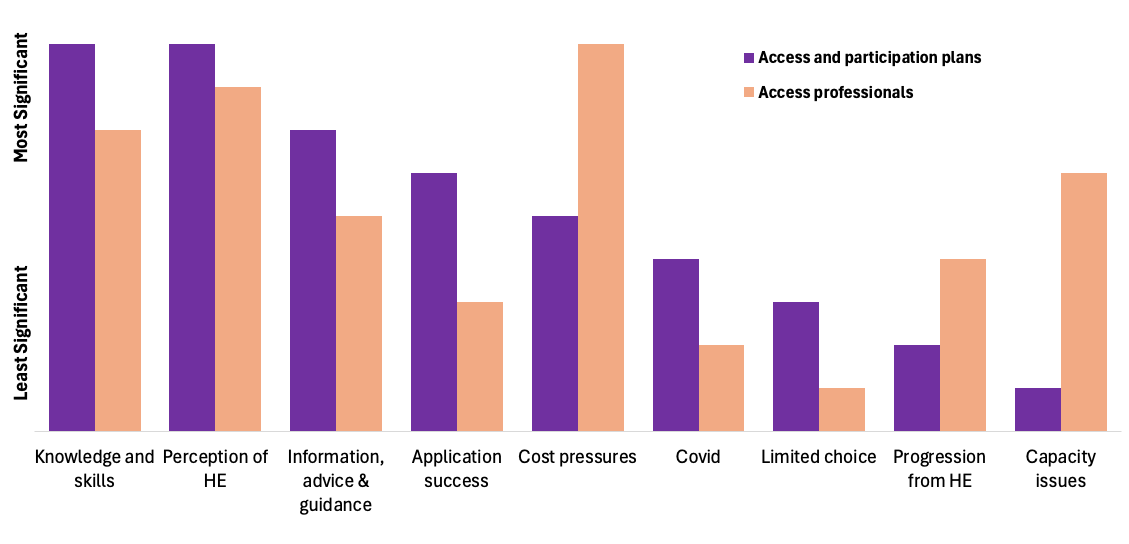
Ranking of EORR access risks in a London regional context, comparing data from APPs versus the opinion of access professionals
This is not the fault of London’s HE providers, who are – in the absence of incentives to collaborate regionally – directing limited resources towards challenges they feel most able to tackle on their own. Nor is it a comment on the effectiveness of the interventions they run. Indeed, London’s proud record on access and HE social mobility data compiled by the Institute for Fiscal Studies and the Sutton Trust, London South Bank University and others suggests that, judged on its own terms, providers’ widening participation work across the region is having real impact.
What the report instead illustrates is a structural gap in the current regulatory framework: the sector lacks a mechanism to ensure coordinated action on priority regional equality of opportunity challenges.
Time to REORRder?
The report’s primary recommendation for strengthening coordination is to develop a version of the EORR that is grounded in regional equality risks. A regional Equality of Opportunity Risk Register would serve as a powerful tool to enable detailed assessment of both the type of risks apparent in a given region, and their root causes. This would recognise the reality that, even where different regions might observe similar risks in relation to student access and outcomes, the underlying causes may differ. If developed through consultation with providers, local authorities, schools, colleges, third-sector organisations and student groups, a regional EORR would ensure a shared understanding of a region’s most material risks and support more coherent planning across institutions.
To drive this, the report calls for a reformed role for England’s Uni Connect partnerships under the proposed regional access partnerships framework. This would see them brokering collaborative work between providers within their region that explicitly addresses risks in the relevant regional EORR, and strengthening the regional evidence base for in-area interventions via an enhanced evaluation function. It also recommends regional delivery of targeted interventions for smaller, dispersed underrepresented groups, such as care leavers, young adult carers, Gypsy, Roma and Traveller students, where a shared model is more efficient than every institution working in isolation.
We recognise these proposals are just one possible approach of many, and that other regional models may hold equal promise. But we hope that, as the shift to regional access partnerships fast approaches, the suggestions offer a practical, evidence-informed basis for complementing provider-level plans with coordinated regional action capable of reducing inequality at scale.
Related articles

Whose universities are they anyway?
Jim Dickinson | Analysis | 4/09/26
We say we value diverse research, but can we assess it?
Ola Thomson | Analysis | 27/08/26

Accommodation matters, for foundation year students too
Wendy Ashall | Analysis | 26/08/26

Going deeper: Student loans, public expenditure and the devolution funding gap
Jim Dickinson | Analysis | 25/08/26