Keeping the learning real in the AI age requires coordination and open communication
Wonkhe and Studiosity’s Keeping the Learning Real project asked what happens when AI rips up the rulebook on academic misconduct. Lisa Abrahams and Debbie McVitty explain why coherence matters to securing academic integrity in the age of AI
Research|

Lisa Abrahams is a Partnership Development Lead at Studiosity
Debbie is Editor of Wonkhe
When generative AI tools first became widely available, the public pressure on universities to show that they had a grip on academic integrity was intense. It’s not surprising that many reached for a “prohibition and detection” model – just as it’s clear, in hindsight, that this was the wrong approach.
Both Wonkhe’s Trained to stop learning research and Studiosity’s recent research on student wellbeing and AI highlighted the level of stress and anxiety academic integrity issues have placed on students. So during September, Wonkhe and Studiosity conducted a “temperature check” of institutional progress on securing academic integrity in the age of AI. We reviewed the latest information on institutional policies, and guidance from the Office of the Independent Adjudicator, and conducted three online round tables, two with institutional leaders and one with student representatives.
The findings we’re publishing today in our Keeping the Learning Real report reveal that the approach is moving decidedly away from detection of misconduct and towards a more supportive posture that is driven by effective pedagogy and active integration of AI into assessment. Institutions are – working at some pace – developing their AI literacy offer, redesigning assessments, and implementing non-punitive measures to retain accountability for learning.
However, as the students we spoke to confirmed, there remains more to do to build an academic integrity system that feels coherent and that is understood and trusted by students. That doesn’t mean removing the guardrails entirely and trusting students to work out for themselves what’s appropriate and productive use of AI, it means taking an integrated approach that balances developing students’ critical judgement and understanding of the application of AI across multiple types of assessment task, with robust measures to validate their learning.
In search of coherence
There are a number of AI in assessment frameworks available but they all essentially function in a similar way, by making it clear for each assessment what the permitted level of AI is. Some have adopted an open/closed binary approach, while others have adopted a “traffic light” three-point or Perkins five-point scale. The corollary is that a single set of rules around academic integrity and misconduct no longer work – there needs to be engagement from across the institution to build differentiated approaches for different programmes and disciplines, and to explain and support students in navigating that variation under the auspices of a broadly consistent framework. In other words, it’s complicated.
Our consultation identified five areas of practice that contribute to the Holy Grail of total coherence. Four are technical and pedagogical questions and one is cultural. Each, focused on individually, doesn’t offer a complete answer to the academic integrity puzzle and each has specific challenges. But taken together we posit they add up to a reasonably robust and explicable approach.
The first of the technical areas is AI literacy – efforts to build up baseline understanding of AI technologies and the kind of discipline-specific and professional competence that allows students to match up tool, task, and intended outcome appropriately. Institutions are clear that this broad professional and discipline specific competence is part of supporting student employability (though in some disciplines this proposition may be contested).
The second area is appropriate use of closed or synchronous assessments. These can work to validate learning if deployed in pedagogically appropriate ways but they are certainly not a panacea. They are hard to deliver at scale, create challenges with inclusion, and are in any case increasingly vulnerable to technological change – institutional leaders and students both mentioned wearable tech as a risk factor.
The third is the approach to “open” assessments, where AI is permitted to some degree or in a defined way. The process of “designing in” AI offers real and exciting opportunities to develop more authentic assessments, formative assessments, and deploy AI as a “critical thinking partner” in creative ways. Institutional leaders are excited about the potential for AI enablement, but students warned that it’s here that vague guidance and inconsistency can easily seep in and turn what should be a creative opportunity into a source of anxiety.
The fourth is validation of learning, using measures such as forms that require students to declare their AI use, or using vivas to confirm students’ ownership of their work. It’s here that we see a gap in practice, challenges to scalability, and a risk of incoherence between a broadly supportive approach and a “policing” one. Students said that, where guidance on legitimate use is unclear or decontextualised, the process of declaration adds to that anxiety. Students do not feel confident that their institution will trust their declaration or fear their declaration may expose their lack of understanding of the appropriate use policies. This is where Studiosity may be able to help through the Support and Validate framework, which enables students to self-validate their learning in a way that is both robust and pedagogically meaningful, and that can operate at the scale required.
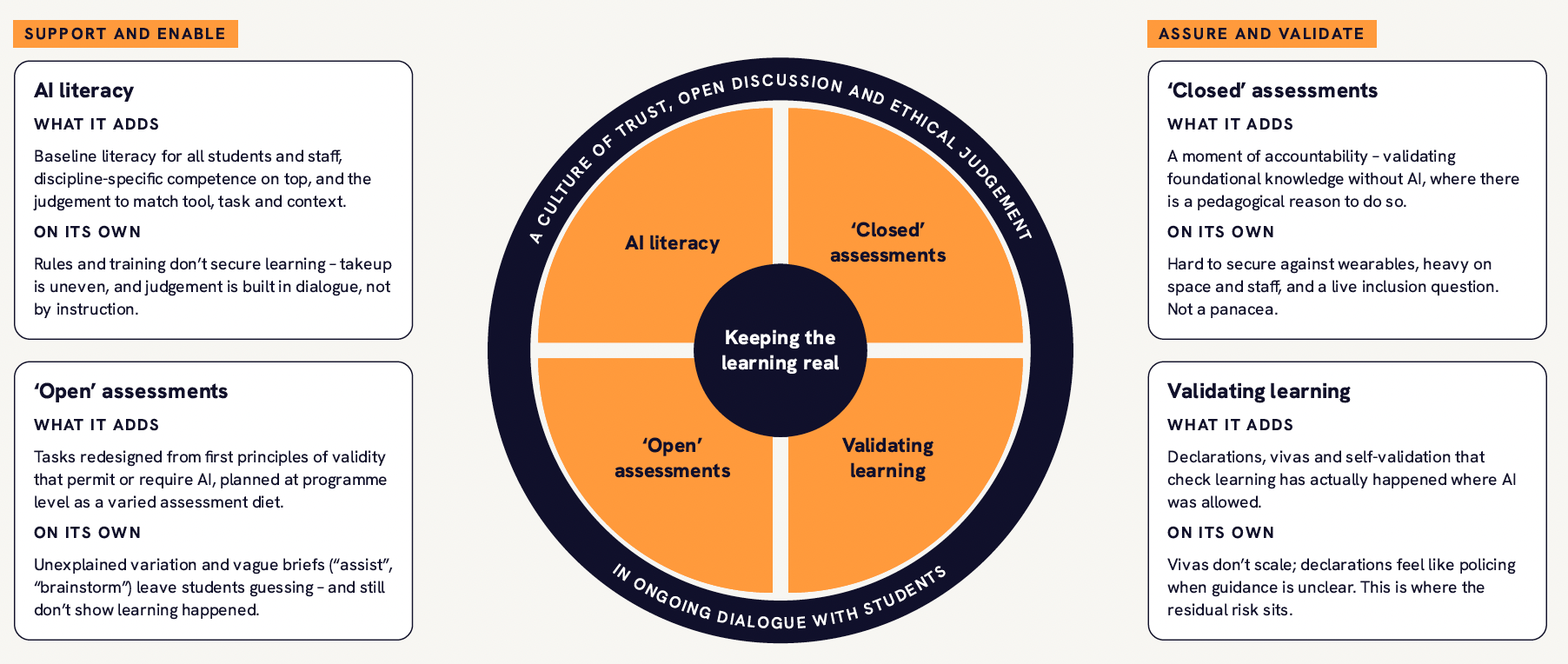
The Wonkhe x Studiosity framework for a coherent approach to academic integrity
A culture of openness and ethical practice
The fifth area of practice “wraps around” the four technical areas, and it’s about the culture in which academic integrity policies and practices are designed, specifically, the degree of openness with which AI issues are aired and discussed, and the extent to which students are trusted interlocutors into those conversations. Student representatives made it clear how much they dislike being consulted on policy already in draft; they want to be brought in at the start and be partners in defining the problem before solutions are proposed. We’ve brought our findings together into a visual framework that captures the various areas that came out of our discussion, and we hope that it can be useful in exploring what has been done, what is left to do, and the coherence of the different elements.
Underpinning all our conversations is the ethical dimension of AI – students generally don’t want to cheat, and they have concerns about what AI might mean for their careers and futures. Where staff have strongly held views these can surface to students in ways that chip away at confidence rather than building it up. Institutional leaders reflected that the slow creep of AI into institutional practices such as student communications and marking and feedback, may send a message that contradicts those going to students about appropriate use. These challenges can only be resolved through open dialogue.
Join our free webinar later this week to discuss everything above. This article is produced as part of a partnership with Studiosity. Studiosity’s Support and Validate framework offers students pedagogically sound formative feedback while shifting academic integrity away from punitive detection toward positive learning assurance via AI-infused assessment design. To explore Studiosity’s learning assurance framework, visit Studiosity.
Related articles

Trained to stop learning: How students are experiencing assessment and learning in an age of AI
Jim Dickinson | Research | 23/03/26

Securing educational excellence may demand a new leadership compact
Charles Knight | Research | 3/11/25

Capability for change – preparing for digital learning futures
James Gray | Research | 31/03/25