Higher Education Postcard: University of Leeds
This week’s postcard from Hugh Jones’ postbag tells a story of industrialisation and civic pride in a nineteenth century Northern Powerhouse
This article is more than 4 years old
Comment|
Hugh Jones is a freelance HE consultant. You’ll find a daily #HigherEducationPostcard if you follow him on Bluesky
Greetings from Leeds! Today we’re going to explore a little of how the University of Leeds came into being.
The first half of the 19th century saw a growth in specialist and technical education across England’s cities. Medical schools had been established in London, Birmingham and Sheffield (amongst others) and Mechanics’ Institutes were being created in many newly industrialised towns.
Leeds was no different. A Mechanics Institute was established – of which more another time, for that is not directly part of the University of Leeds’ story. And also, in 1831, the Leeds School of Medicine – the founders considering that:
it is desirable that a School be established in Leeds for the purposes of giving such courses of lectures on subjects connected with Medicine and Surgery as will qualify for examination at the College of Surgeons and Apothecaries’ Hall.”
And so things rested, insofar as the future university was concerned, until 1874, with the establishment of the Yorkshire College of Science. One motivation for this was concern by the local wool and textile industrialists that new technologies being developed and used in Europe would threaten their trade. (I’ve reported previously how similar concerns reinvigorated technical education in Bradford.)
The new college was an enlightened institution – like University College London, the college was open to students of any faith, and women were admitted as students right from the start. The College’s focus on science was broadened soon after to encompass classics, literature and history, and the college was renamed the Yorkshire College.
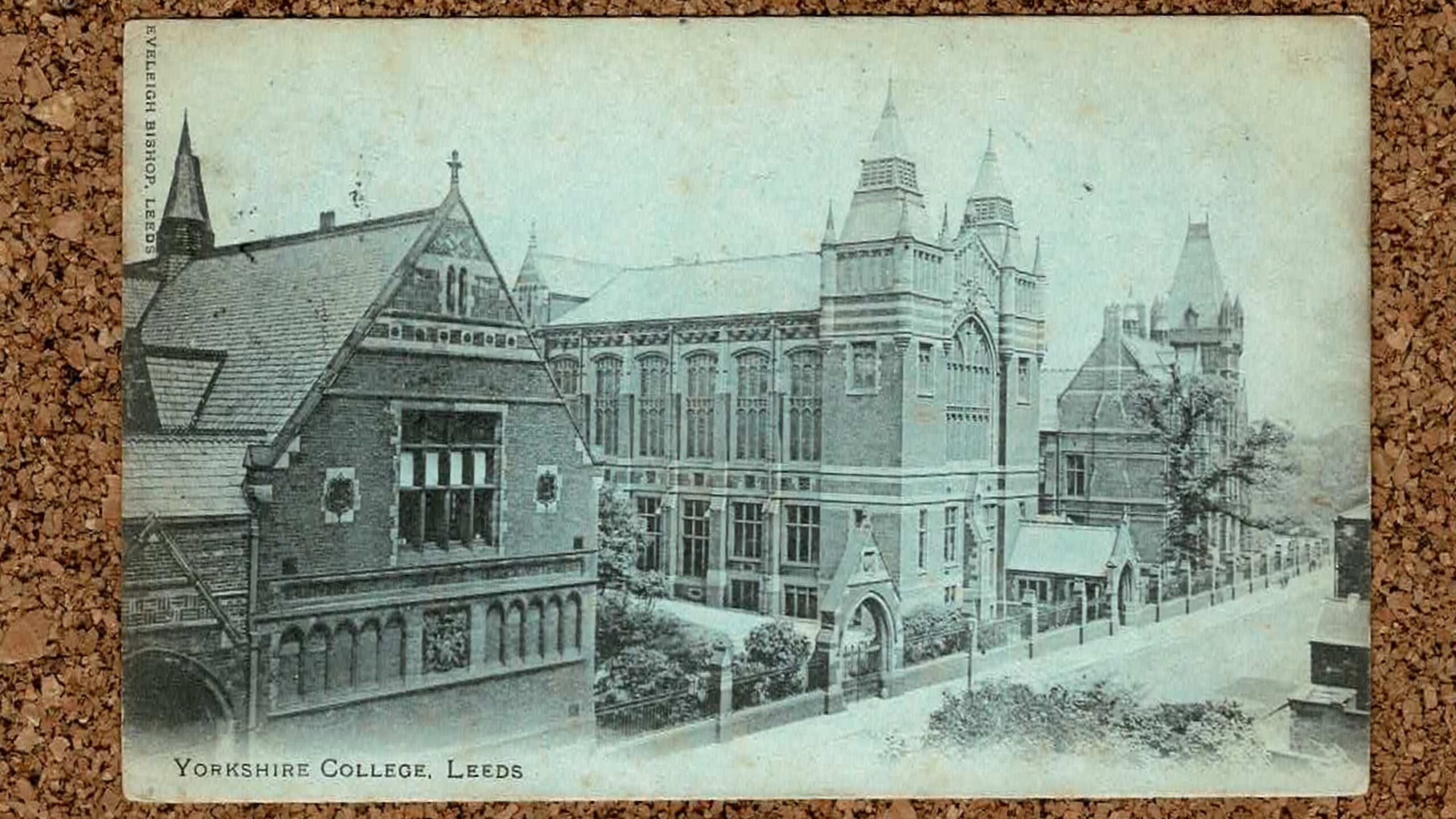
Supported by local industry, the college gained handsome buildings – the card shows the Great Hall and the Clothworkers’ Buildings next door. It incorporated the School of Medicine in 1884, and three years later was admitted as a member of the Victoria University, joining Owens College Manchester and University College Liverpool.
Did a three-campus, federal university structure thrive? It did not. University College Liverpool sought and gained its own Charter in 1903, and in 1904 the University of Leeds was founded, enabling the previous Yorkshire College to leave the Victoria University.
(A speculative question: would better rail links between Liverpool, Manchester and Leeds and a unified planning authority across the north of England have helped the Victoria University survive? One cannot help but spot the common threads across time…)
The University of Leeds is known as one of the original redbrick universities – with Bristol, Birmingham, Liverpool, Manchester and Sheffield. The card gives a clue as to the origins of the term.
The card itself was sent from Leeds on October 27, 1903, to Miss Grew in Portadown, County Armagh. It is an old-style card where the address occupied the whole of the back – we know nothing else about the sender or the recipient. Collecting postcards was a craze in the late Victorian/early Edwardian era – no doubt Miss Grew was grateful to receive this addition to her collection, and knew from the handwriting who the sender was.
Related articles

Boards can’t predict the future, but they can make sure their institution is ready for it
Debbie McVitty | Comment | 19/10/26

What counts as a graduate outcome when the labour market is changing?
Angel Tan | Comment | 16/10/26

Widening participation isn’t finished while background still predicts destination
Hannah Rolley | Comment | 16/10/26