Higher education postcard: University of Greater Manchester
This week’s card from Hugh Jones’ postbag takes you to one of the latest new names on the block
This article is more than 1 year old
Comment|
Hugh Jones is a freelance HE consultant. You’ll find a daily #HigherEducationPostcard if you follow him on Bluesky
Greetings from Bolton. Definitely Bolton.
In 1824, a mechanics’ institute was established in Bolton. Mechanics’ institutes were a new phenomenon – the first was established in Scotland in 1821. They were, in essence, a subscription-based club which provided an opportunity for education, aimed at the better-off members of the working class.
As the 1857 advert in the Bolton Chronicle shows, it was still going fifty years later.
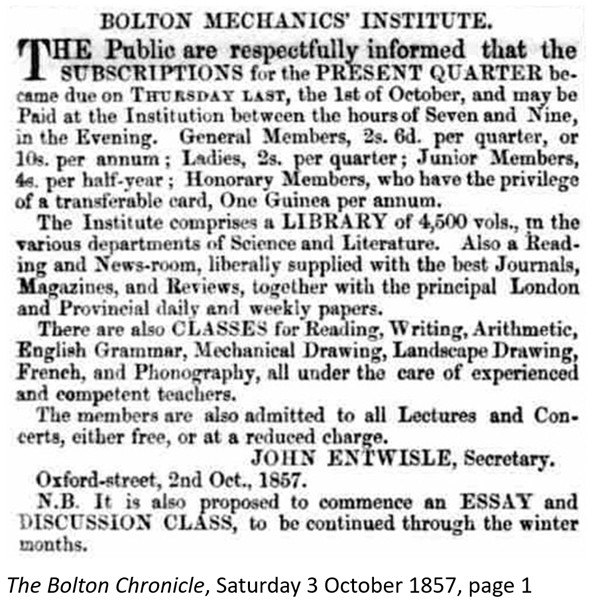
You can see the 1857 subscription fees in the advertisement. It’s hard to directly read across into today’s prices, because costs and wage structures change so much over the years. On a straightforward inflation calculation, using the Bank of England calculator, the annual fee would be about £50 today, which is a bit of a bargain. But comparing wages makes this feel different – for example, an average agricultural wage in 1857 was just shy of 11 shillings a week, so the subscription would be a quarter of a week’s wages. (And note also that the annual fee of ten shillings was just the quarterly fee multiplied by four. No discounts here for upfront payment.)
The curriculum looks good, but elementary: school rather than higher education. And this makes sense – many people would have had minimal schooling. Only about 70 per cent of the population could read and write. And so a good basic education didn’t hurt.
By the late 1880s there was a groundswell of opinion that Bolton needed better. As reported in the Bolton Evening News of 1 December 1886, the new chairman of the Mechanics’ Institute, Mr John Haywood MA, argued that:
In Manchester, they are content with one well-equipped technical school; whereas in Bolton we must, forsooth, have three struggling institutions, with the result, as far as the Mechanics’ is concerned, that the progress made is in the direction of increased debt.
The newspaper continued: “Mr Haywood thinks that Bolton has gone mad on sectarian and political distinctions when its young men cannot even sit on the same form to receive technical education.”
And so in 1887 the committee of the Mechanics’ Institute agreed to establish a technical school. A committee was established, which raised funds, but found itself short; and an appeal was made to the county council. And in 1891 the Bolton Technical School opened.
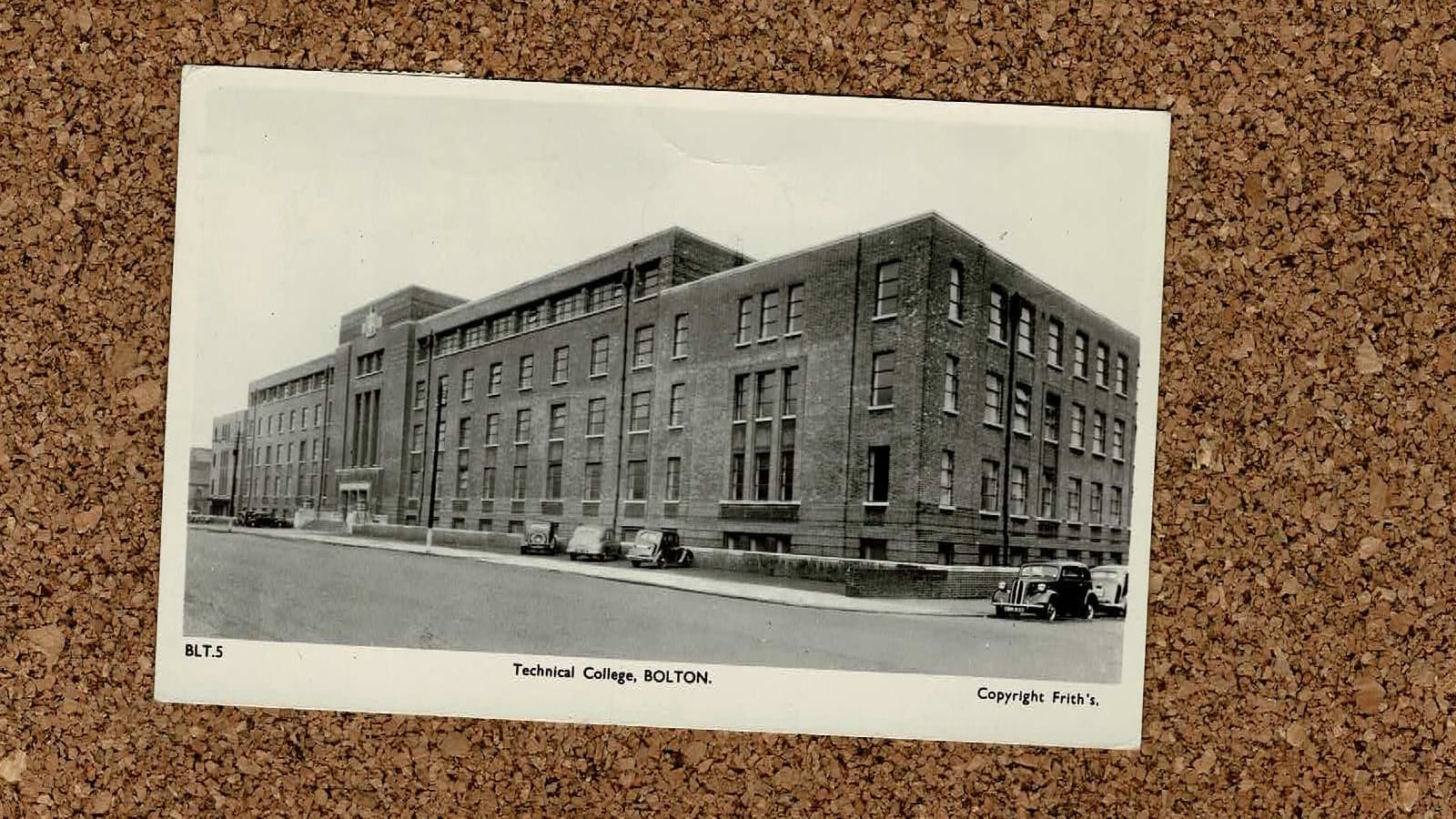
In 1926 Bolton Technical School became Bolton Technical College, and in 1941 a new building opened – that shown on the card – which enabled a broader range of courses to be offered. Engineering was, apparently, the most popular.
In 1964 the college bifurcated, splitting the lower and higher level education. Bolton Technical College focused on FE, and the Bolton Institute of Technology focused on higher studies.
A brief aside is now necessary, to introduce another institution, the Bolton Training College. This focused on training teachers for technical subjects and was one of three in the country doing this (the others being in Huddersfield and at Garnett College, in London). I’m afraid I can’t tell you when it was founded, but it is clear that there was a threat to close it in the 1950s, happily averted.
And in 1982 the Bolton Institute of Technology merged with the Bolton Training College to form the Bolton Institute of Higher Education. This gained taught degree awarding powers in 1992, research degree awarding powers in 1996 and became a university in 2004.
In December 2024 the university changed its name, becoming the University of Greater Manchester. And in what is becoming a bit of a busy year for the university, in governance terms, it was placed under enhanced OfS monitoring in February and suspended its vice chancellor in May. Let’s see what June and July bring for the university.
The postcard was sent in October 1961 to Miss Medley in Andover.
Dear Janet, Today I am going through to Blackpool to see “West Side Story”. The week has flown by, and tomorrow I shall have to return to the quiet South from the lively North. Love Jillian
And here’s the customary jigsaw – hope you enjoy it. Comment below if you can identify the cars.
Comments · 1
New comments will come back with sign-in later this year.
Kirsty Matthews · 23 May 2025
50 years later, did you mean 30? 1824 to 1857 is 33 years. Sorry for pointing it out, it just bugged me.
Related articles

Boards can’t predict the future, but they can make sure their institution is ready for it
Debbie McVitty | Comment | 19/10/26

What counts as a graduate outcome when the labour market is changing?
Angel Tan | Comment | 16/10/26

Widening participation isn’t finished while background still predicts destination
Hannah Rolley | Comment | 16/10/26

Higher education postcard: The Warburg Institute
Hugh Jones | Comment | 16/10/26

If not university then what?
David Kernohan | Comment | 15/10/26

John Healey’s drive for a resilient economy could further squeeze universities
James Coe | Comment | 15/10/26