Higher Education Postcard: University of Essex
Come for the concrete, stay for the Old English poetry, in this week’s postcard from Hugh Jones’ postbag
This article is more than 4 years old
Comment|
Hugh Jones is a freelance HE consultant. You’ll find a daily #HigherEducationPostcard if you follow him on Bluesky
Greetings from Colchester! In the late 1950’s and early 1960s, the UK was taken with a desire for more universities. This would show itself in the Robbins Report of 1963, but that did not start the race to establish new universities; it merely gave a planning basis on which to make decisions.
The story of the University of Essex starts in 1959, when the then Councillor Leatherland (later Baron Leatherland, a Labour peer) proposed to the County Council the establishment of a university. Informal discussions with the University Grants Committee followed, and in April 1960 the Council’s Education Committee was told that:
…we have an equal chance with any other applicant if we can get our proposal put before them [the University Grants Committee] by the end of May”
(as reported in the Herts and Essex Observer of 15 April 1960).
The Council endorsed the idea.
The estimated cost of the new university, which would start with about 1,000 students and grow to about 2,500, was £4 million. The council proposed to give land (estimated value of £100,000); an annual grant of £107,000 towards the university’s expenses (this was a penny on the rate); and up to £100,000 to support initial capital costs. Local industry and well-wishers were expected to contribute £400,000.
Wivenhoe Park, near Colchester, was chosen as the site – and in 1962 a Chancellor, Vice-Chancellor, and Registrar were appointed. In October 1964 the first students were enrolled – 122 in that cohort – in three schools (Comparative Studies, Physical Sciences and Social Studies).
Essex was not trying to be like other universities. Its VC, Dr Albert Sloman, gave the Reith Lectures in 1963 (still available via the BBC archive) to tell the story of its “radical innovation”.
If Essex had a radical vision, its students certainly lived up to this in the 1968 student protests. In March, there were protests against an Enoch Powell lecture – the university sought to discipline seven students but gave in after a student occupation. In May, a demonstration against a visiting speaker from Porton Down, the UK’s secret defence laboratories led to the Police being called, with dogs – and three students were suspended from the campus without a hearing. Following protests, they were reinstated a few days later. Much learning will have been done at this time.
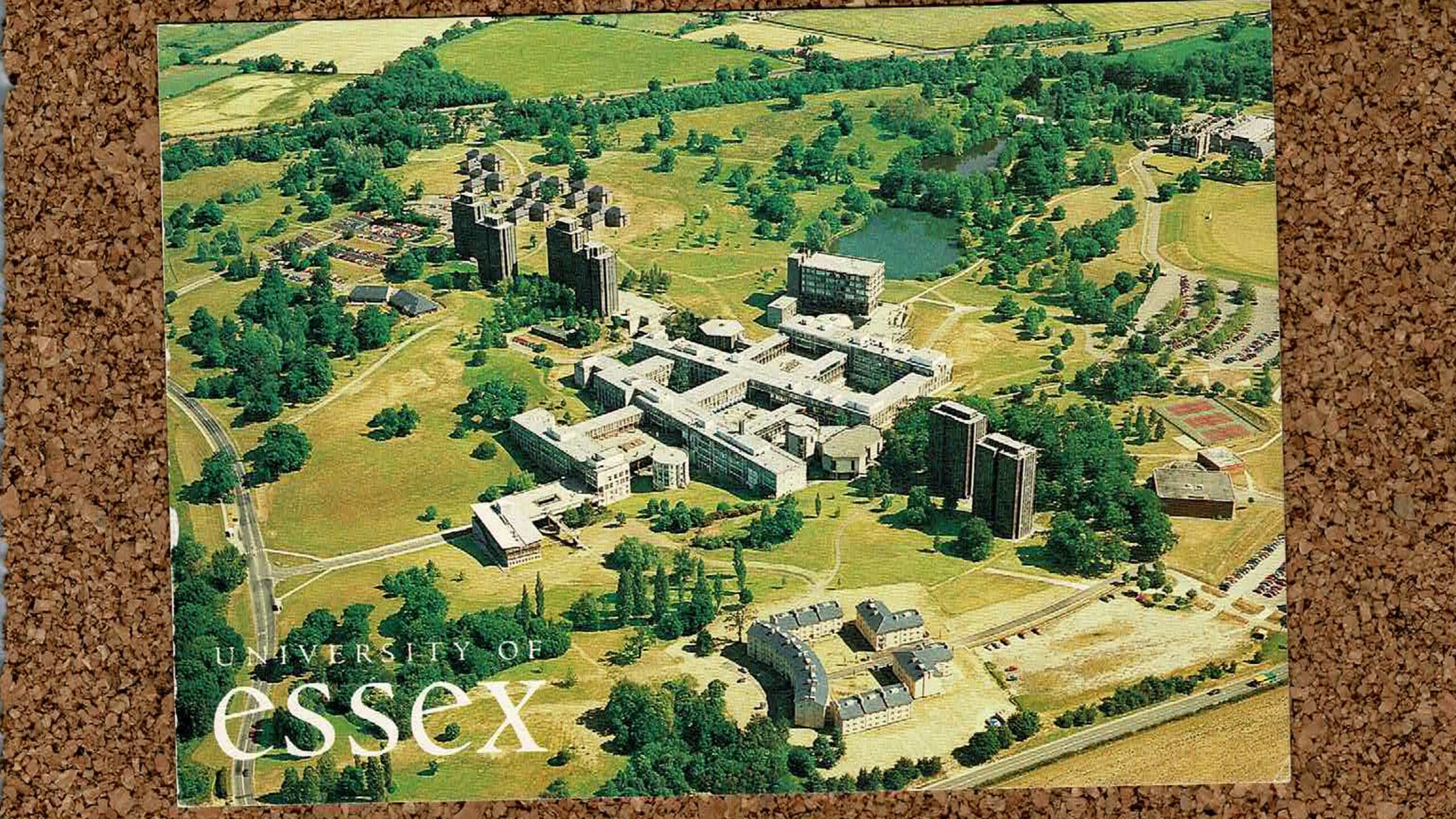
The card shows the Wivenhoe Campus, and (judging by the 01255 dialling code for Clacton given on the back) dates from no earlier than 1995. Top right is the University’s Wivenhoe House Hotel, which runs as a commercial hotel/restaurant and provides a work-based learning site for the university’s hotel management students. There are also campuses in Southend-on-Sea and Loughton.
The university’s motto – “Thought the harder, heart the keener” derives from the Old English poem, The Battle of Maldon, the action of which is set just down the coast, in the estuary of the River Blackwater. See, I think, line 312:
Hiġe sceal þē heardra, heorte þē cēnre”
Thought shall be therefore harder, heart therefore braver”
Comments
New comments will come back with sign-in later this year.
Related articles

Students just need to know where they stand on AI
Gracie Otley | Comment | 5/10/26
One year of leading UKRI
Ian Chapman | Comment | 3/10/26

Navigating the storms of student success
Kate Newby | Comment | 2/10/26
Higher education postcard: The Queen’s Tower, Imperial College
Hugh Jones | Comment | 2/10/26

A supplier shouldn’t be able to rewrite who owns students’ essays
Sam Dickinson | Comment | 2/10/26

Emeritus, honorary, and visiting professors are an untapped resource
Roger Watson | Comment | 1/10/26