Higher education postcard: University of Dundee
Today’s card from Hugh Jones postbag tells a story of jute, but not jam or journalism
This article is more than 4 years old
Comment|
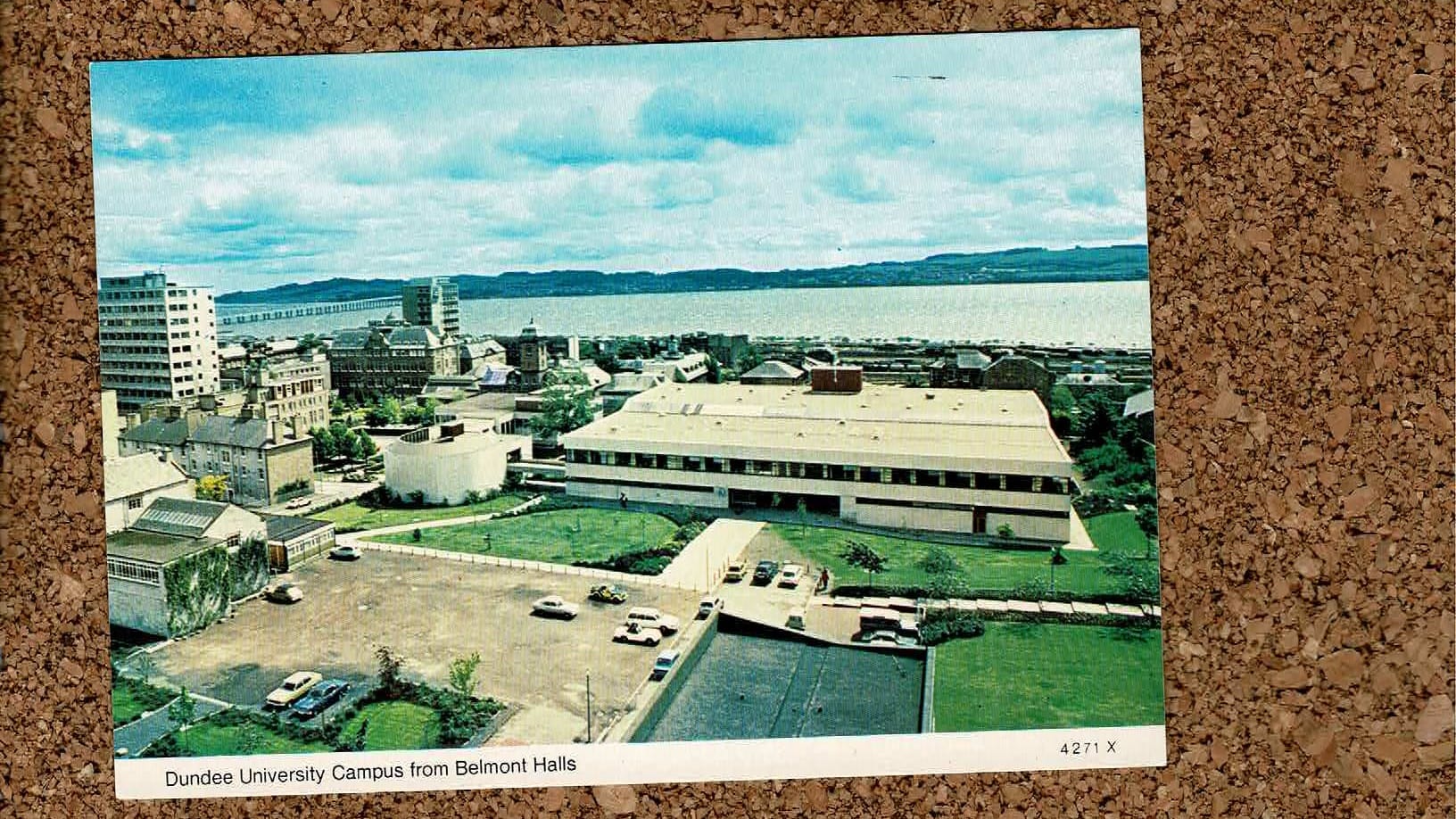
Hugh Jones is a freelance HE consultant. You’ll find a daily #HigherEducationPostcard if you follow him on Bluesky
Dundee sits on the silv’ry Tay, perhaps no more than ten miles, as the crow flies, from the ancient University town of St Andrews.
In the 19th century it was a boomtown, jute-milling replacing wool as the town’s principal industry, and its population growing for a couple of thousand in 1801 to more than 50,000 fifty years later.
And as was typical for such thriving towns in Victorian Britain, there was a clamour for higher education, and in particular a university. St Andrews was a natural magnet, and indeed an inspiration, as this extract from the Dundee Courier of 5 February 1875 shows:
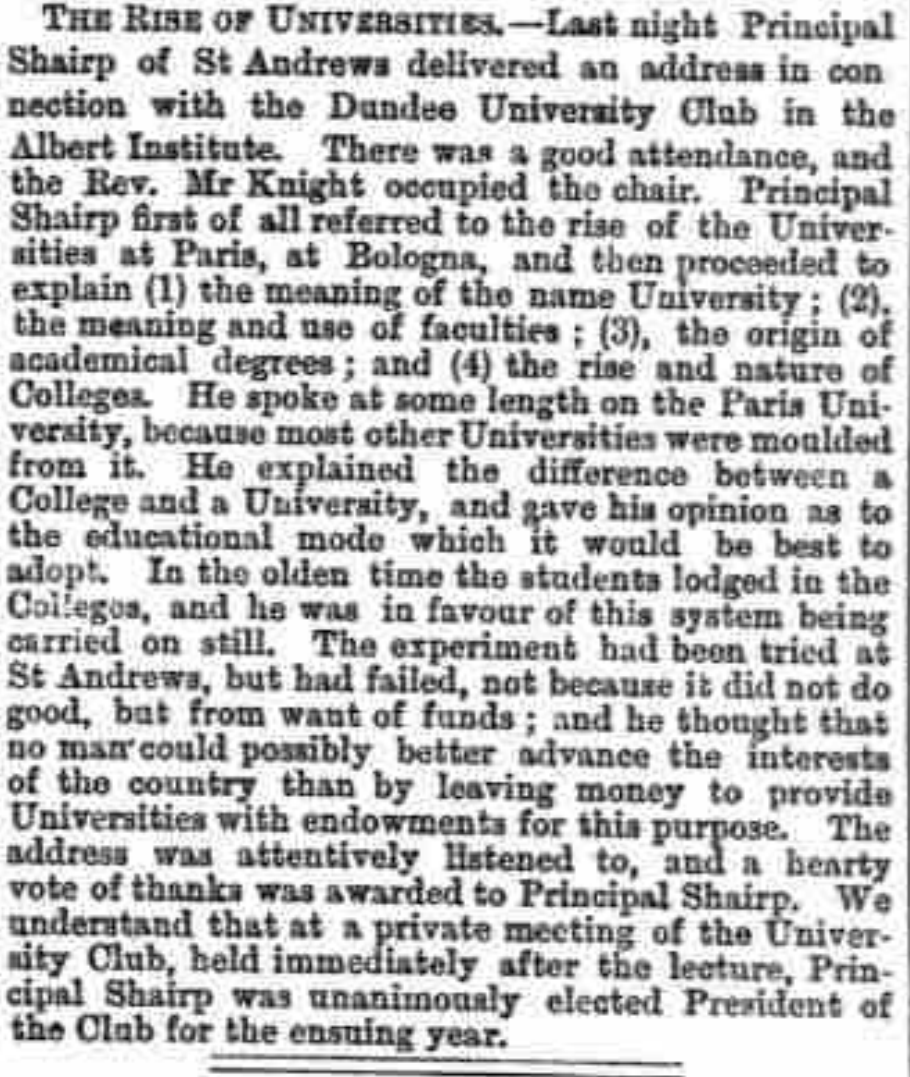
The Dundee University Club had over 150 members in 1875, and its committee comprised the Dundee great and good – churchmen, schoolmasters, bankers, lawyers, and a professor or two (presumably from St Andrews). The aim was to have a university in Dundee, and for a while there was a proposal that St Andrews should move. But this came to naught.
What did come about was the establishment, in 1881, of a University College, funded by donations from two cousins Baxter, both heirs to jute fortunes. The new University College was secular and co-educational from the get go. It was always intended to become part of St Andrews University, and although initially students read for University of London degrees, students were allowed to matriculate as St Andrews students from 1885.
An issue of contention was the desire to establish a medical school, with clinical teaching taking place at Dundee. But where there is academic medicine, then so there are often arguments, and this is how it turned out here. Should professors of Anatomy and Physiology be based in Dundee, St Andrews, or both? The question threatened to spoil everything.
Salvation came in the form of the Universities (Scotland) Act 1889. This established a commission which, amongst other things, could rule on mergers, location and so on of institutions. And the commissioners ruled that University College Dundee should indeed be established as a College of St Andrews. This was confirmed by ordinances of 1897.
Under the settlement, St Andrews would retain Theology, Arts and Pure Science; Dundee would have Applied Science. Medicine was ‘conjoint’ – my guess being the commissioners concluded that life was too short to resolve the issue, and left the institutions to squabble. St Andrews retained some professorships, and medical students started their study in St Andrews; Dundee was allowed to establish a Faculty of Medicine.
Pre-clinical teaching remained a bone of contention, as the passage of the University of St Andrews (Degrees in Medicine and Dentistry) Act 2021 highlighted.
The 1897 settlement was clearly not a happy arrangement. In 1946 Douglas Wimberley was appointed Principal of University College Dundee. Wimberley was a much-decorated soldier, who commanded the 51st (Highland) Division at El Alamein, in North Africa and Sicily, but was then set aside by Monty and finished his military career with spells leading the staff college and then infantry training. In 1947 Wimberley set out plans for UCD to gain independence from St Andrews. This provoked some thought, with two committees reporting, and finally a Royal Commission in 1954.
This re-established University College Dundee as Queen’s College: a member of the University of St Andrews but with greater autonomy. The Dundee School of Economics was incorporated into Queen’s College and, significantly, the joint medical and dental schools with St Andrews became part of Queen’s College too.
This laid the basis for a petition in 1966 to the Privy Council, for the establishment of Queen’s College as the University of Dundee. The petition came jointly from the Court of the University of St Andrews and the Council of Queens College, and the University of Dundee was duly established by royal charter from 1 September 1967. It is thus a relatively modern university, but its origins as part of St Andrews means that its governance has similarities with Scotland’s four ancient universities (St Andrews, Glasgow, Aberdeen and Edinburgh).
The University has continued to grow and develop, incorporating four previously separate institutions. Duncan of Jordanstone College of Art and Design incorporated in 1984; the Tayside College of Nursing and the Fife College of Health joined in 1996; and in 2001 the Dundee campus of Northern College became the University’s Faculty of Education and Social Work.
Comments
New comments will come back with sign-in later this year.
Related articles

Widening participation isn’t finished while background still predicts destination
Hannah Rolley | Comment | 16/10/26

Higher education postcard: The Warburg Institute
Hugh Jones | Comment | 16/10/26

If not university then what?
David Kernohan | Comment | 15/10/26

John Healey’s drive for a resilient economy could further squeeze universities
James Coe | Comment | 15/10/26

How equitable are university admissions policies?
Emma Humphries | Comment | 15/10/26

Science and university research can’t deliver economic growth – at least not as we measure it
Don Webber | Comment | 15/10/26