Higher education postcard: Norwich University of the Arts
This week’s card from Hugh Jones’ postbag: from Norwich, it’s the blog of the week!
This article is more than 1 year old
Comment|
Hugh Jones is a freelance HE consultant. You’ll find a daily #HigherEducationPostcard if you follow him on Bluesky
From the Bolton Chronicle, 7 June 1845:
[t]he following is the Report of the progress and state of this Institution made to Government, and just submitted to Parliament – The School of Design at Somerset-house was established at the commencement of the year 1837, by and under the superintendence of the Board of Trade, for the improvement of ornamental art, with regard especially to the staple manufactures of this country. The number of applicants for admission every month exceeds, by about fifty, that which the limited space in Somerset-house will accommodate.
In connection with the head school at Somerset-house, schools have been formed in many of the principal manufacturing districts, namely, in Spitalfields, Coventry, Birmingham, Manchester, Sheffield, Nottingham, York, Newcastle and Glasgow; and applications are at present under consideration for the establishment of others in the boroughs of Southward and Lambeth, in Norwich, in the Staffordshire Potteries, and in Dublin…
And it is to Norwich that we go.
The idea of a school of design had been floated in Norwich for some time. The chief magistrate, Henry Bellenden Ker, had written to the mayor in November 1841 – the letter was published with an editorial in the Norwich Mercury on 6 November – setting out the expectations on the town, were it to be granted a government school of design. Essentially, they would have to find about £150 per year, supplemented by the government funding for the salary of the head of the school.
The Norwich Mercury was very much in favour:
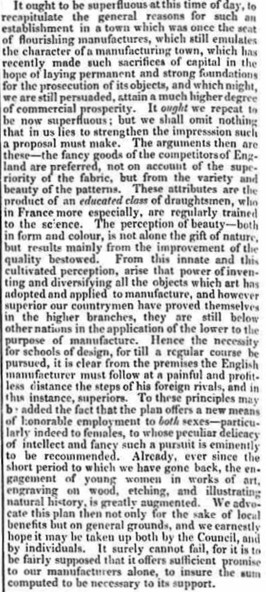
In 1842 the town council agreed to a grant of £75 towards the costs, the remainder to be made via subscriptions. And it seems that the subscriptions must have been forthcoming, for on 21 January 1846 the Norwich School of Design was formally opened with much hoo-ha and admiring of the artistic collections that it had. In addition to the pieces granted by the government, the council provided some works from its own collection. And the school was up and running!
By 1880 it was known as the Schools of Art and Science. It seems that this was by central government action: the schools of design were originally creations of the Board of Trade, and the Victorians recognised that science was just as important as creativity in that regard. (Even if this truth is one that our governments have forgotten today.)
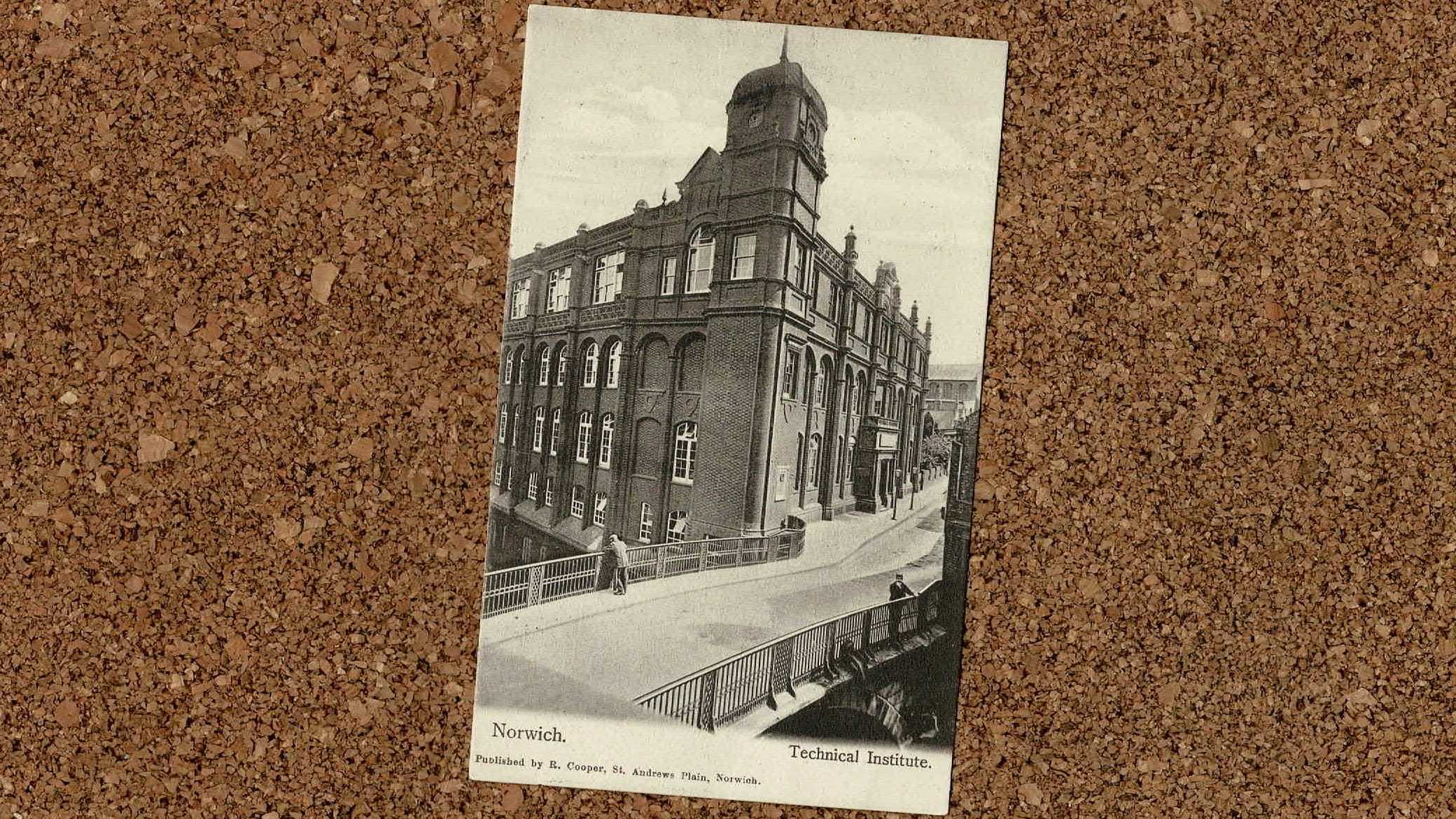
In 1899 the Technical Instruction Act empowered local authorities to control and fund technical education, and by the following year suggestions were being made that the School of Art and Sciences might fall within the scope of this act. Certainly the council was active in this area, a technical education committee having been established and an organiser and inspector of technical education appointed. By 1891 a new technical institute was being built in Norwich – the one shown on the card. The School of Art and Design was incorporated into this new Institute from 1901, as was, in 1913, the Norfolk and Norwich School of Cookery.
The technical institute became the Norwich Technical College in 1930, and then in 1938 the Technical College and School of Art, Norwich. It feels almost like the artists and designers were not entirely integrated into the college!
And in 1964 there was a separation. The college by then had a new building, and it seems that the technical subjects went to this new building on the Ipswich Road (still used by City College Norwich to this day), while the renamed Norwich School of Art stayed put. This also led to the School of Art moving into degree level education: from 1965 it offered the Diploma in Art and Design, validated by the National Council for Diplomas in Art and Design. And when in 1975 the National Council for Diplomas in Art and Design was incorporated into the Council for National Academic Awards, the school started offering bachelor’s degree courses.
In 1974 responsibility for the School of Art had shifted from Norwich City Council to Norfolk County Council. And this fact became significant in 1989 when the School was merged with the Great Yarmouth College of Art, and the Norfolk Institute of Art and Design (NIAD) was created. This became an associate college of Anglia Polytechnic University (APU, as it then was), with APU validating NIAD’s degrees. These included postgraduate taught degrees from 1993, and research students from 1995.
In 1994 the institute was incorporated as a higher education corporation – this is the legal form for most universities created from 1992 onwards – and renamed as the Norwich School of Art and Design. In 2007 it gained taught degree awarding powers and again assumed a new name, this time as the Norwich University College of the Arts. And finally in 2013, after the size threshold for university status had been reduced from 4,000 students to 1,000, it gained university status, becoming the Norwich University of the Arts.
Alumni of the university include Keith Chapman, who created both Bob the Builder and Paw Patrol; and Neil Innes, of the Bonzo Dog Doo-Dah Band and Monty Python.
The card itself is unsent, but looks to me to date from the first decade of the twentieth century. There’s a jigsaw here, for your delight and delectation.
Related articles

Boards can’t predict the future, but they can make sure their institution is ready for it
Debbie McVitty | Comment | 19/10/26

What counts as a graduate outcome when the labour market is changing?
Angel Tan | Comment | 16/10/26

Widening participation isn’t finished while background still predicts destination
Hannah Rolley | Comment | 16/10/26