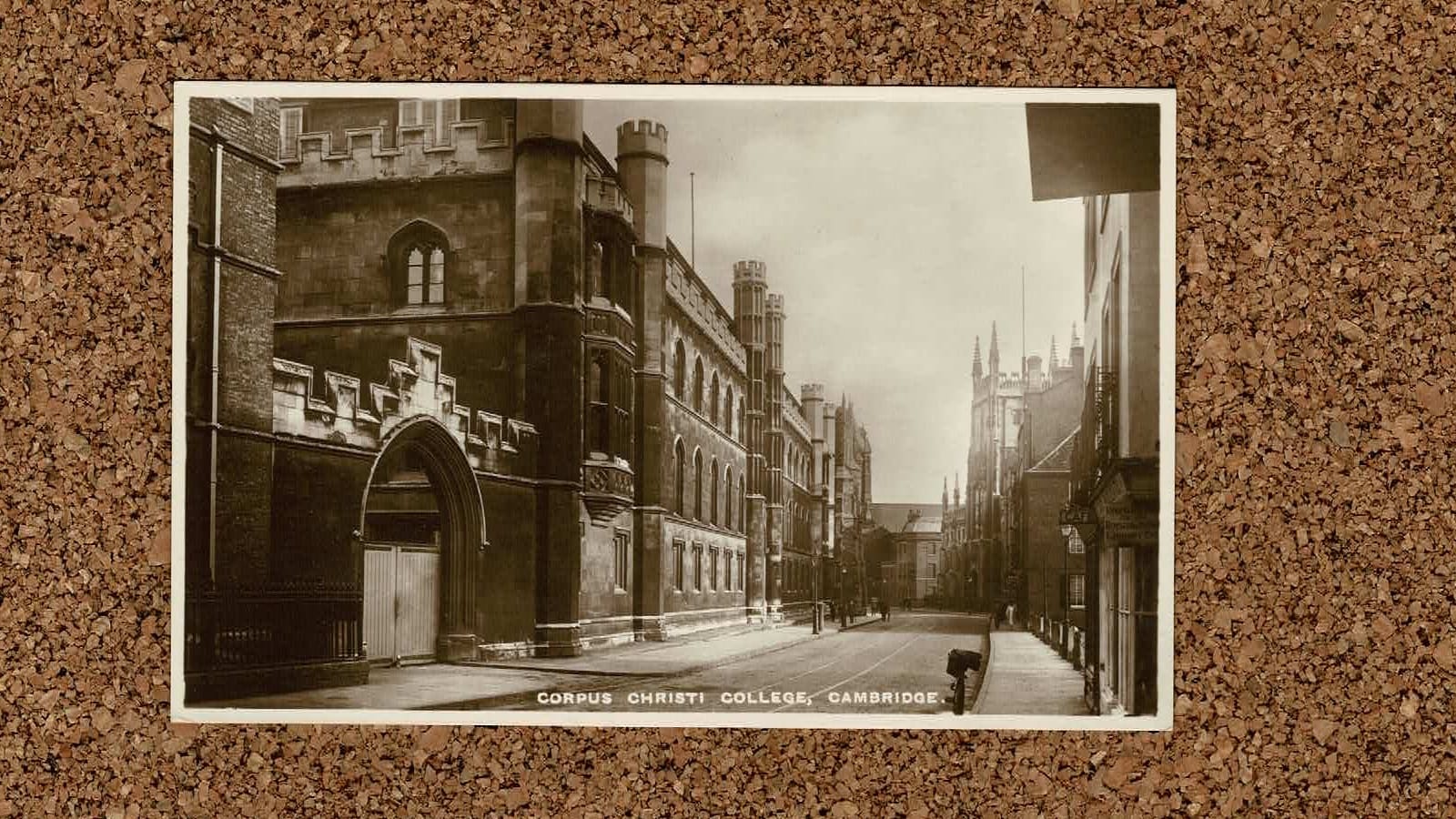
Higher education postcard: Corpus Christi, Cambridge
This week’s card from Hugh Jones’ postbag takes us to Cambridge’s original people’s college
This article is more than 1 year old
Comment|
Hugh Jones is a freelance HE consultant. You’ll find a daily #HigherEducationPostcard if you follow him on Bluesky
Greetings from Cambridge!
The large majority of the old Oxbridge colleges were founded by rich and powerful individuals. One exception to that rule is Corpus Christi College, Cambridge. This was instead founded by (some of) the townspeople of Cambridge, and specifically by the Guild of Corpus Christi and the Guild of the Blessed Virgin Mary. Its mission was to train priests, in a town and country shocked by the impact of the Black Death. And one particular benefactor was notable: Margaret Andrew, who died in 1349 and gave lands to both guilds.
What was a guild? There’s a fabulously helpful website which discusses their origin in Suffolk, and as Cambridge is next door there might not be too much difference. I’ll summarise: the word comes from the Old English term frith-gilds, associations of ten townsmen or villagers, and date from the 800s. These initially were to help enforce the peace – a medieval neighbourhood watch, if you like – but over time their character changed to take on a religious role and to act as a mutual insurance club of sorts, enabling people to have decent funerals, and celebrate saints days and the like. All of this was to help the members spend less time in purgatory after death.
Guilds became associated with specific saints and, later, with specific parish churches. The Guild of the Blessed Virgin Mary probably doesn’t need much explanation. Guilds of Corpus Christi became popular following Pope Urban IV’s founding of the feast of Corpus Christi (the body of Christ) in 1264. Indulgences – get out of purgatory free cards – were granted to those who celebrated it, and so gilds began to be formed to do so.
The love affair between the towns and the college didn’t last long. 1381 was the year of the Peasant’s Revolt, which was very active in East Anglia and Essex, Cambridge’s next-door counties. And in that year a mob from the town led by the mayor of Cambridge ransacked the college, burning books and causing mayhem, in protest against the college’s rapacious behaviour as a landlord. The specific crime was to enforce candle rents – charges payable based upon the number of candles or wax tapers present in their tenants’ homes. And in a broader context of revolt against authority, grievances would easy have been used to fan the flames.
At this time the college, although formally known as The College of Corpus Christi and the Blessed Virgin Mary in the University of Cambridge, was referred to as Bene’t College or Benet Hall. This was because it used the neighbouring St Bene’t’s Church until in 1577 it got its own chapel. Bene’t is short for Benedict, the founder of the Benedictine order, by the way.
The 1500s were notable for the college for other reasons too. In 1544, Henry VIII’s suppression of the monasteries was in full flow. The college’s master, Matthew Parker, obtained Anglo-Saxon manuscripts from several, and left them to the college, making the core of the Parker collection, of which the college is, reasonably, very proud.
In 1569 Queen Elizabeth I imposed a master upon the fellows of the college, removing for a while their right to elect a master. In 1573 the college imposed new rules requiring that Latin, not English, be spoken by scholars during full term. The punishment for transgression was being “beaten at the Buttery hatch”, which sounds both unpleasant and like a top quality innuendo. (Imagine Kenneth Williams saying it while playing Thomas Cromwell in Carry On Henry and try not to smile.)
We saw earlier that the college was founded just after the Black Death; and in 1630 another visitation of the plague took place. It seems that everyone in the college fled, except the master, a Dr Butts, who stayed behind to try to organise relief. The strain of it all was too much: he was found in 1632, having hanged himself.
During the Civil War the Oxbridge colleges – rich foundations with collections of silver – often gave their wealth to one side or the other. Presumably under duress. Corpus Christi bucked this trend, by giving fellows leave of absence, and asking them to take some of the college silver with them for safekeeping, just as someone has to take the primary school hamster home to be looked after over the school holidays. And that is why Corpus Christi’s silverware collection is better than many other colleges today.
The centuries rolled by, as they do. There were new buildings during the eighteenth and nineteenth centuries, and college life continued. The nineteenth century saw some evangelical zeal, but the number of students was also falling. Until 1906 Corpus Christi had always been led by a clergyman; the appointment of Robert Townley Caldwell as master. He was a colonel, commanding the 3rd battalion of the Gordon Highlanders in the mid-1890s, and a prominent freemason. He combined this with a career as a mathematician at Corpus Christi. His innovation was to change the policy on recruitment, so that it no longer focused on students who were, or wished to become, clergy. And accordingly the college began to grow again.
In 1953 Francis Crick and James Watson announced their discovery of the double helix at The Eagle, which was – and still is – owned by the College. And the college became co-educational in 1980.
Notable alumni include:
- Christopher Marlowe, who arrived as a scholar at the college in 1580. His mysterious absences and high Buttery bills only add to the suggestion of his intelligence work, alongside his playwrightry (and yes, this is a proper word)
- Basil Henry Liddell Hart, soldier, military historian – especially of the first world war – and theorist
- E P Thompson, historian and titan of the left
- Neil Hamilton, disgraced former politician and minor celebrity.
The college has a splendid history on its website, which has informed much (but not all!) of this blog.
And finally, here’s a jigsaw of the card – enjoy!
Related articles

Boards can’t predict the future, but they can make sure their institution is ready for it
Debbie McVitty | Comment | 19/10/26

What counts as a graduate outcome when the labour market is changing?
Angel Tan | Comment | 16/10/26

Widening participation isn’t finished while background still predicts destination
Hannah Rolley | Comment | 16/10/26
Higher education postcard: The Warburg Institute
Hugh Jones | Comment | 16/10/26

If not university then what?
David Kernohan | Comment | 15/10/26

John Healey’s drive for a resilient economy could further squeeze universities
James Coe | Comment | 15/10/26