Higher education postcard: Bull College, Cambridge
This week’s card from Hugh Jones’ postbag takes us to a Cambridge college you almost certainly haven’t heard of
Comment|
Hugh Jones is a freelance HE consultant. You’ll find a daily #HigherEducationPostcard if you follow him on Bluesky
It’s 1945, and the Second World War is over.
Lots of American servicemen and servicewomen are in Europe, and the US created a scheme similar to one it had tried in World War One. This was the Training Within Civilian Agencies program, which enabled US military personnel to study at a European university.
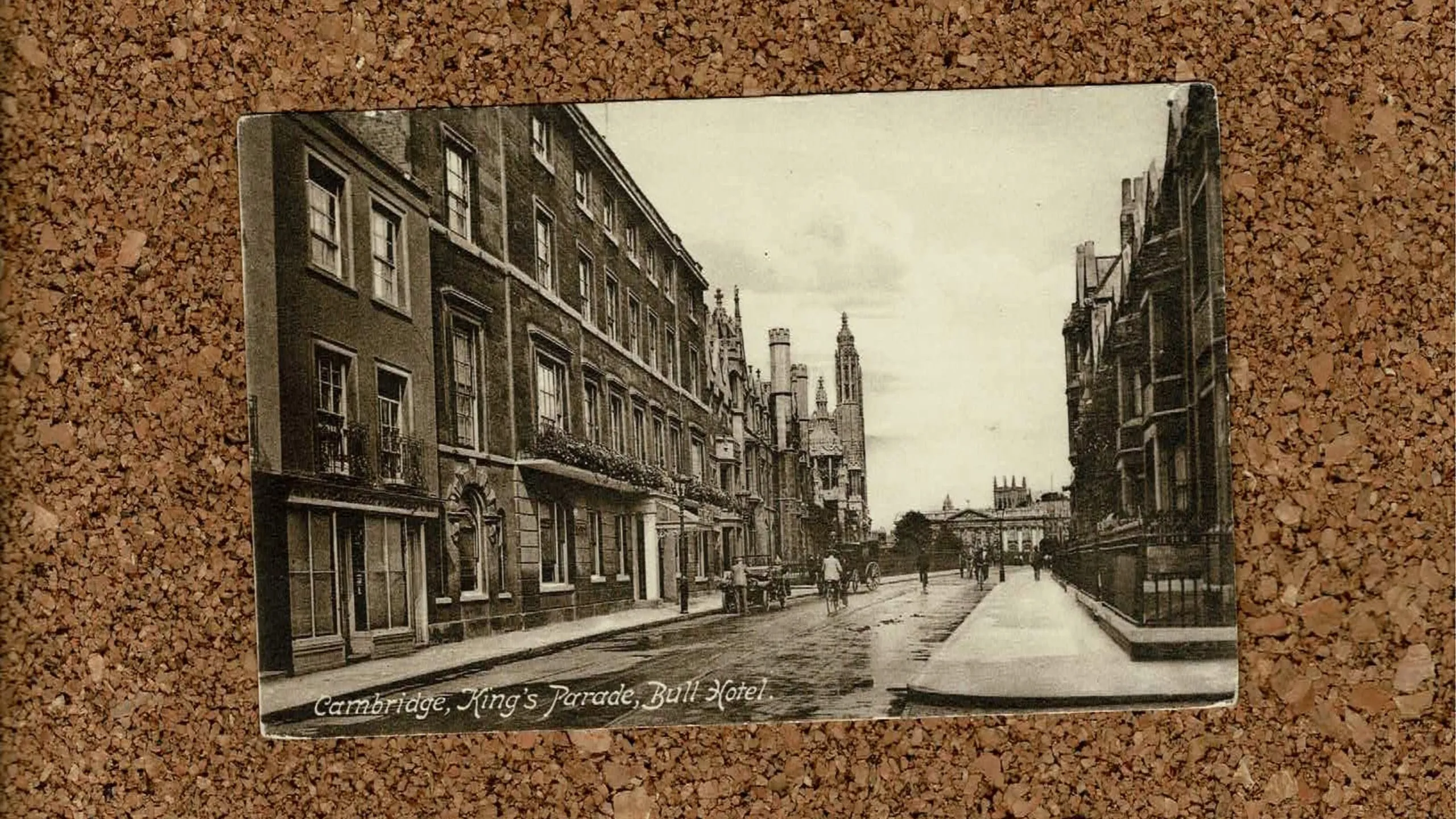
On 4 October 1945 Major George Dewey Blank of the United States Army Air Forces was appointed officer in charge of the Cambridge area, and later that month 149 US service personnel of all ranks were enrolled. Some were within existing colleges, but most were stationed at the Bull Hotel.
And we can guess that it was at the Bull Hotel that John Sheppard, Provost of King’s College, welcomed the students, saying that “As the word ‘hotel’ sounds so very undignified, I just call you simply ‘Bull College’. And you, Major Blank, I refer to as the Big Bull.”
And the name stuck. The students, reportedly, threw themselves with gusto into university life, taking part in sports and union debates as well as all of the learning. Bull College gained college colours, a college tie and an (unofficial) crest, shown below. The crest combined the flags of the US and the UK, a bull, the Cambridge University crest and the US eagle. The illustration is from William Ham Bevan’s account of which more below.
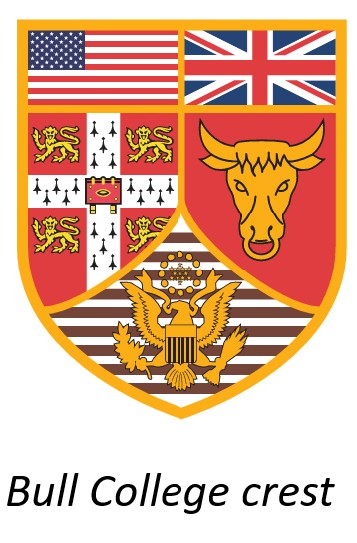
Bull College lasted just two terms. By December 1945 the Bull Hotel had been requisitioned by the British government as a base for Russian language courses – the hot war was over, and the cold war clearly looming into view. This meant that the students had to decamp to temporary accommodation within Cambridge. And at the end of the second term the US government pulled the plug: the Training Within Civilian Agencies program was cancelled, and students had to leave. There was talk of establishing the college on a permanent basis, using charitable funds, and maybe having exchanges with a similar college in America, but these came to nothing.
Mementoes of the College are still to be found in St Catharine’s College, which owns – and has since the seventeenth century – the Bull Hotel. These include a wooden escutcheon carved with the Bull College arms, as well as some paraphernalia.
And that would be that, but let’s pick up a couple of other Bull stories.
Firstly, the “Rugby Atomic Football” game, first half rugby, second half American football, which was played on 6 December 1945 between the Bull College Toreadors and the Pembroke College Generators. By all accounts it was quite the occasion, with a military band, and a running commentary over loudspeakers. Pembroke College beat Bull College 18-0 in the rugby half; Bull College beat Pembroke College 24-0 in the American football half.
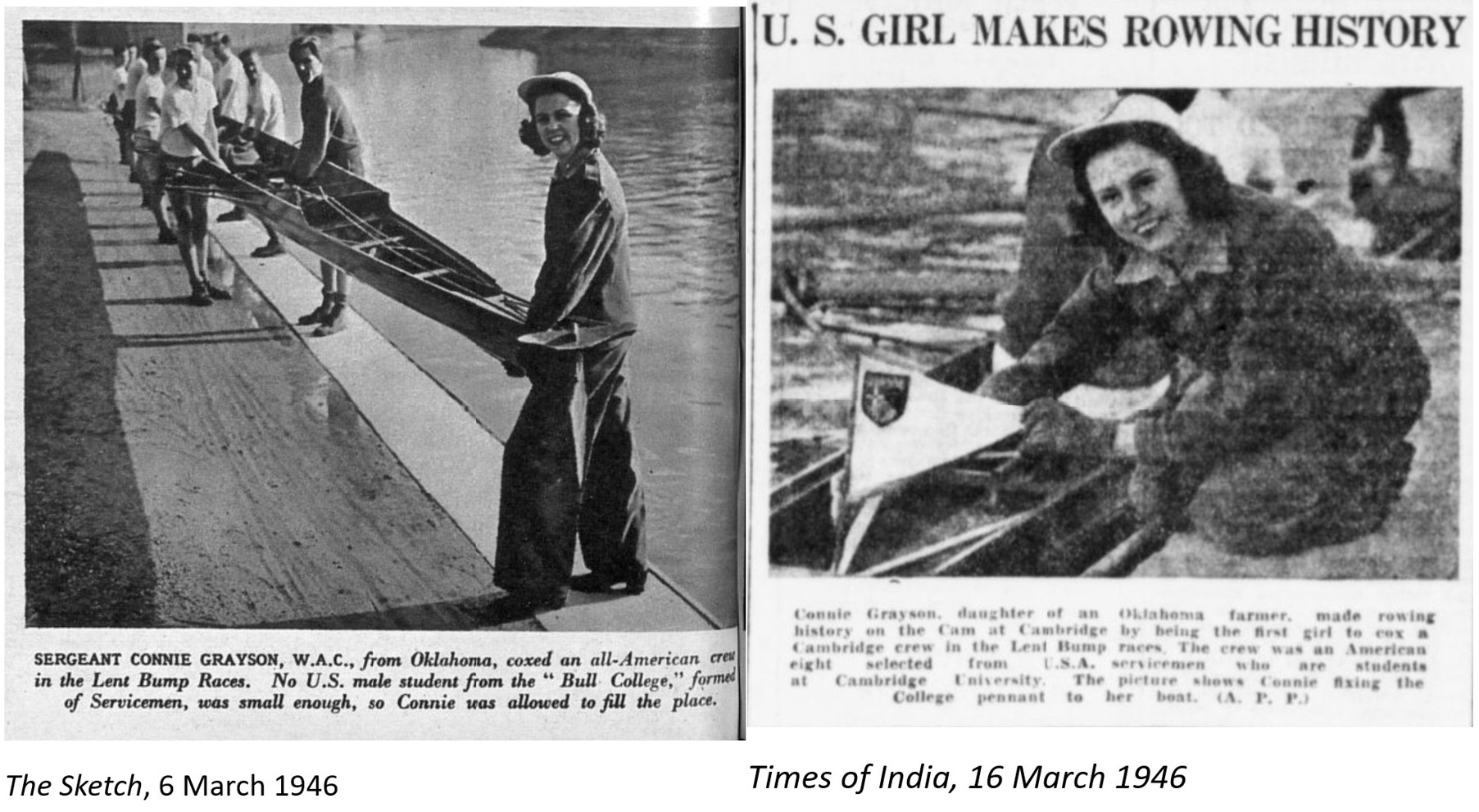
And secondly, a little slice of sporting history. Bull College had a boat (borrowed from another college), and wanted to compete in the lent term bumps. The problem: Bull College’s students were too big and heavy to cox, and so an American servicewoman – Sergeant Connie Grayson – was to cox the boat. The university authorities agreed, and so the Bull College boat raced.
The bumps involve racing the boat above you in the league table, and swapping places if you win. Bull College started last in the rankings; by the end of the week it had risen to third from last. And also managed to sink the St Catharine’s fourth boat in the process.
And there’s no doubt that Connie Grayson was the star of the show. Here’s clippings from the Sketch and from the Times of India.
A footnote: the next time a woman would cox a boat at Cambridge was in 1962.
If you want to read more, I’d recommend the article by William Ham Bevan, to which I referred above. A slightly shorter version was published in the Cambridge alumni magazine in 2010, which is available here via the Web Archive. I’ve drawn on these in compiling this account and Will’s articles have some really great illustrations too – well worth a read.
And finally, here’s a jigsaw of the postcard. It hasn’t been posted, but the space on the back for the stamp says “Affix half penny stamp”. This, the feel of the card and the divided back would suggest that it dates from sometime between 1906 and 1918.