This article is more than 2 years old
Wonk Corner|17/09/24 · 19:50
Rich men got a massive (graduate) tax cut. Can Reeves and Phillipson reverse it?
I’ve talked before on here about the (relative) absolute bargain that the undergraduate fees freeze in England represents to those who put their kids through private schools.
Jim is an Associate Editor (SUs) at Wonkhe
Schoolfeeschecker says the average cost per child is now £20,480 a year for day pupils. If you end up getting them into the Russell Group, the signalling effects of said group are a steal at £9,250 upfront a year.
But there’s been less focus on the way in which the 2023 and onwards system of student loans in England represent a bargain for those that do enter the loan system but go on to do very well.
The basics of the 2012 Plan 2 system were that students would borrow £9,000, and the government expected much less than that back.
Some would pay more than £9,000 in real terms via an interest rate that was RPI+3%. Others would pay less than £9,000 in real terms because of the repayment threshold and the write off at thirty years.
The cross-subsidy from the richest to the poorest – the sort of thing we might usually expect a tax to do – was supposed to be justifiable on the basis of the earnings that some would be trousering.
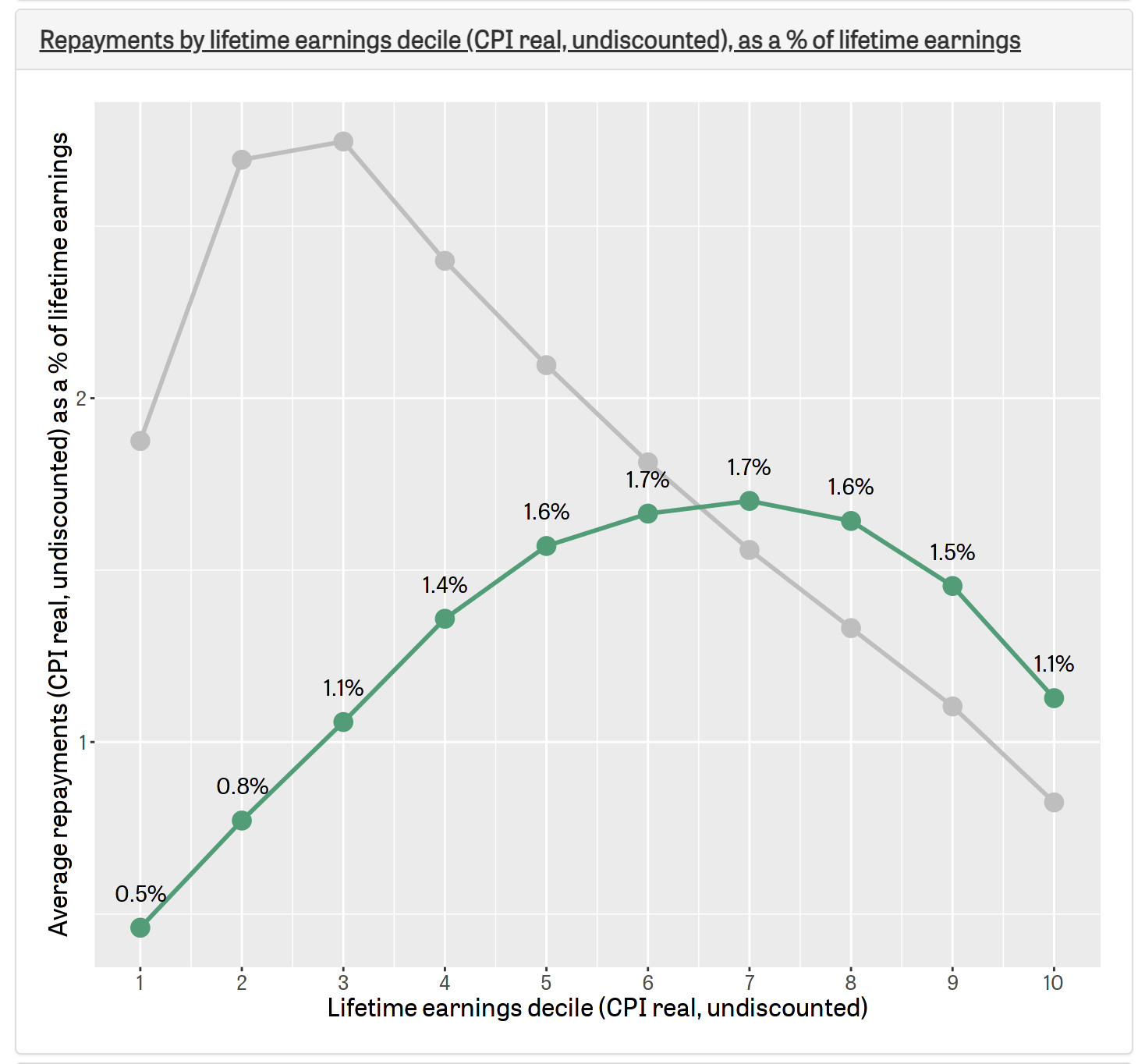
And technically, that was right. IFS reckons that those on lifetime earnings decile 9 in Plan 2 paid about 34 per cent more than they borrowed in real terms – equivalent fees of about £12,400.
Those in lifetime earnings decile 2, on the other hand, were only predicted to pay about £1,800 a year in tuition fees in real terms.
Decile 9 high-fliers on Plan 2 were (are) set to pay 1.5% of their lifetime earnings by the end of the 30 years. Decile 2 folk were (are) set to pay 0.8% over their lifetime.
It was actually always middle earners that had to pay the most – deciles 5, 6, 7 and 8 all paying 1.6% or 1.7%. But still pretty consistent in lifetime earnings terms.
Hence the government was supposedly saying “look, it’s not a straight line tax, and anyway although the richest graduates will pay the most, it still will be very affordable based on how much money some of you will be earning”.
Of course the framing of something that was much more like a tax than a loan as a loan to achieve the accounting trickery that George Osbourne liked did mean that everyone would hate the symbols of loan – interest, a ticking up principal and so on.
And then the end of the national accounts trickery (requiring the Chancellor to book the estimated subsidy to the accounts as a cost instead of pretending it wasn’t there) has made loaning students more money much harder.
Hence the 2023 Plan 5 system of a frozen/lower repayment threshold and a longer (re)payment term.
But in all the focus on the costs and the worst off graduates, we’re in danger of missing the incredible deal that high(er) earners are now getting. Because as well as those twiddles to the threshold and the term, interest has been cut back only to RPI.
And that means that by shifting the system towards the loan end of the tax/loan see-saw, we’ve abolished the idea that the most successful graduates will pay more in real terms.
The grey line here is the new Plan 5 system and the green line is the old Plan 2 system. Someone in decile 2 will now pay almost 3 per cent of lifetime earnings – while someone going on to coin it in in decile 9 will pay about 0.7 per cent of their lifetime earnings.
If you think loans should be more like loans, this is all cool. If you think a graduate/student contribution to the costs of their education should be progressive, it’s bad news.
However you think about it, when trying to fix the problem, Labour now has to attempt to take the huge lifetime (graduate) tax cut that the Conservatives gave to rich graduates (especially men) and try to reverse it. Or it funds the HE funding gap via wider public funds.
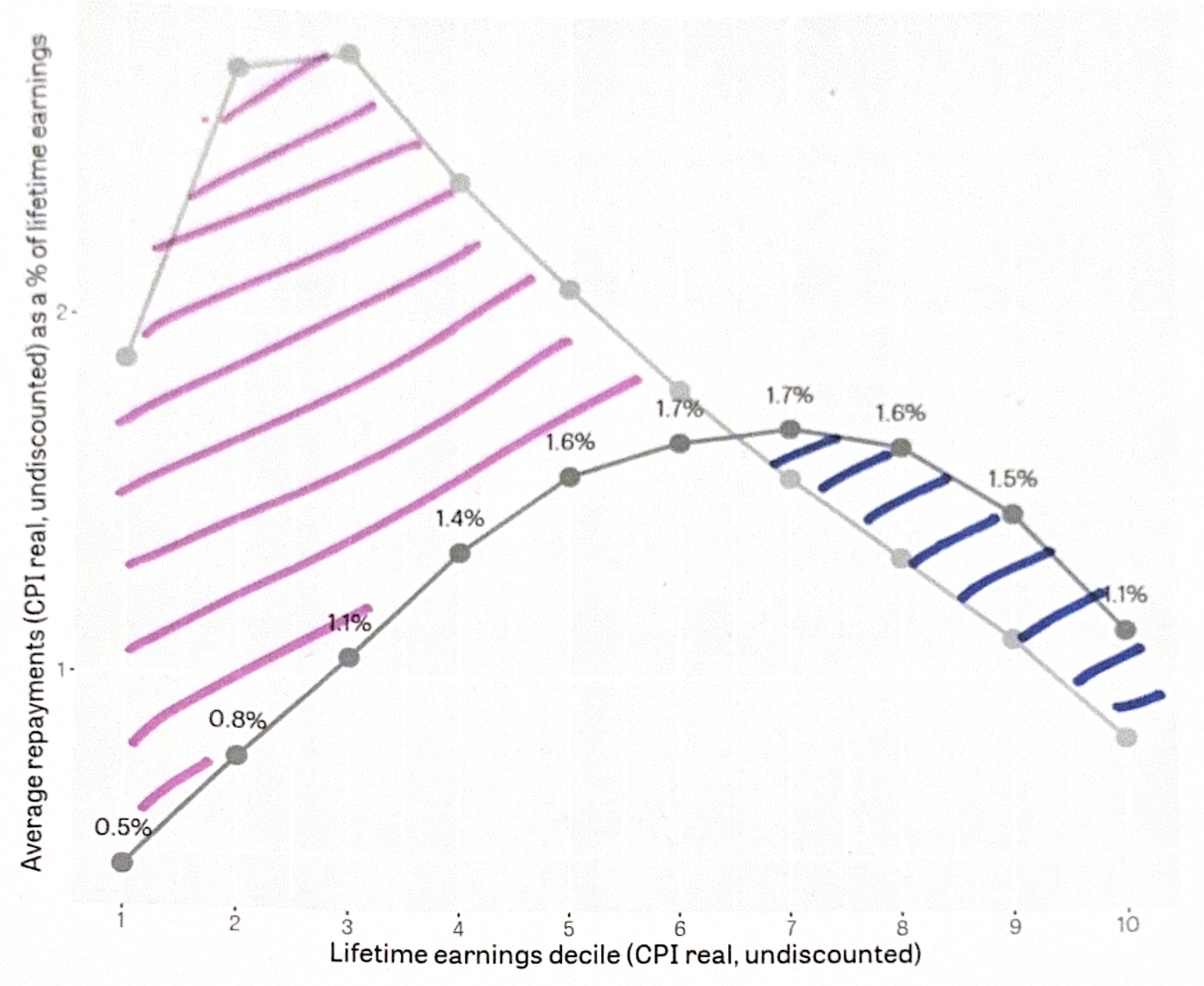
Put another way, via the magic of my sharpies in my bag, think of the pink shaded area as “robbing from the poor”, and the blue shaded area (which is worth more than the surface area below implies) as “giving to the rich”. From what I can remember from my politics GCSE, Labour usually does the opposite.
It thus sounds easy enough in principle for Labour to have at least some of that cut back. But as we know, when you take a loan scheme and bodge it into a tax, people hate that. Everyone thinks they suffer even when they don’t.
And that’s a huge headache for Bridget Phillipson and Jacqui Smith in their discussions with Rachel Reeves.