Pretty much every week the Parliamentary Under-Secretary is pushed out to defend the indefensible over some aspect or other of the student finance system of interest to back bench MPs.
Normally it’s over undergraduate funding – but his latest jaw-on-the-floor answer comes in response to a written question on the postgraduate loan repayment threshold from Lib Dem Tom Gordon MP.
To ask the Secretary of State for Education, whether her Department has made an assessment of the impact on low-paid graduates of the postgraduate loan repayment threshold remaining at £21,000 since the loans were introduced in 2016; and whether she plans to uprate that threshold in line with earnings.
Like most MPs’ questions these days, it’s a question about repayments rather than the pathetic value of the loan in the first place. But either way, the brass neck on offer in the answer is something to behold.
Postgraduate loans were introduced to help remove financial barriers to postgraduate study. An equality analysis was conducted and published by the previous government.
There have actually been two, one in May 2016 and the other in May 2017.
Ten grand from nowhere
Neither of them, nor anything else published at the time, ever explains where the £10,000 came from. George Osborne pulled the number out of the 2014 Autumn Statement, and the policy costings that went with it are all take-up assumptions and cash requirements, with nothing on why the loan was that size.
The March 2015 consultation then retrofitted two justifications – that £10,000 matched the maximum on the old Professional and Career Development Loans, and that a loan which deliberately didn’t cover everything would “encourage individuals to make informed decisions”.
What the consultation did contain was some data on fees, putting the mean full-time taught postgraduate fee at £8,010 and the median at £6,061 – so the logic, never spelled out, was that £10,000 would cover most students’ fees and leave a few thousand quid towards living costs.
When the government responded, only 51 per cent of consultees thought £10,000 was the right amount, and the 2016 equality analysis records concerns that it wouldn’t cover tuition on some courses, “let alone living costs” – before leaving them unanswered beyond repeatedly describing the loan as a “contribution to costs”.
The 2017 analysis is more interesting, because its whole case for the first uprating was that increasing the maximum loan in line with inflation would “ensure that students do not suffer a reduction in available funding via the loan in real terms” – which is precisely what students have suffered ever since.
Forecast to fail
Every year the maximum loan has been uprated by the OBR’s forecast of RPIX inflation rather than by inflation itself, with the forecast made well over a year in advance and never corrected when it turns out to be wrong. As the IFS has pointed out on maintenance loans, the 2.3 per cent rise for 2022/23 came from November 2020 projections, by which point inflation was heading for double figures.
If each year’s rise had instead tracked what RPIX actually did over the same first-quarter-to-first-quarter period the forecasts are supposed to cover, the maximum loan for 2025/26 would have been £14,989 rather than £12,858 – more than £2,100 higher, and comfortably above the average fee.
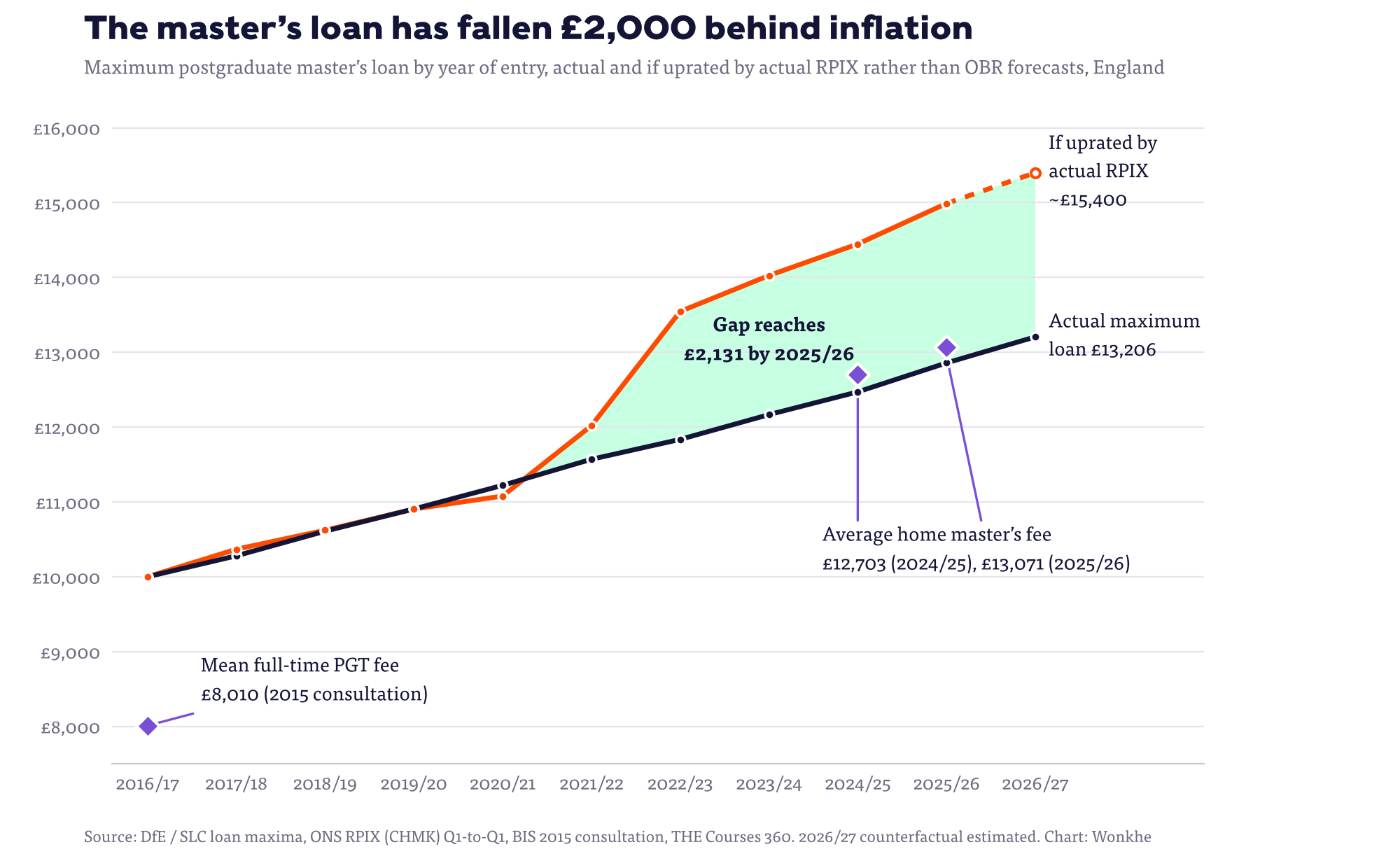
Fees, meanwhile, have run in the opposite direction. THE’s Courses 360 data put the average home fee for a full-time master’s at £12,703 in 2024, the first time it had overtaken the loan, and at £13,071 for 2025/26 entry, with 37 per cent of courses priced above the maximum loan. A “contribution to costs” that once covered fees with room to spare now falls short of the average fee before a student has paid a week’s rent.
The 30 per cent fiction
Because the loan is a single lump for fees and living costs, DWP had to decide how much of it to count as income for the small minority of master’s students who can claim means-tested benefits, mostly student parents and some disabled students.
The answer, written into the Universal Credit Regulations and the equivalent housing benefit rules by a 2016 amendment, is that 30 per cent of the maximum loan is treated as maintenance income, whether or not the student borrows it and whatever they actually spend it on.
That implied split of 70 per cent on fees and 30 per cent on living was just about defensible when the loan was £10,000 and the median fee was around £6,000, but it makes no sense at all now.
With a maximum loan of £13,206, DWP assumes that £9,244 goes on fees and that £3,962 is left for living costs – for students whose average fee is now higher than the entire loan – so a student parent on UC who puts the whole loan towards tuition still has their award cut as if they had nearly four grand to live on.
This is the sort of nonsense that could be solved if DfE’s ministers were also in DWP. Oh, Jacqui Smith is. And isn’t solving it.
Reviewed, never
Anyway, MacAlister goes on:
One of the key principles of the postgraduate loan was to ensure the majority of borrowers repay in full while recognising the personal benefits that most will accrue. Consequently, the repayment terms, including the £21,000 threshold, were modelled and chosen based on this key principle.
They were modelled and chosen – and then the people who chose them said they would look at them again. The 2015 consultation response said the £21,000 threshold would be “initially frozen until 2021 and subject to review”.
The 2016 equality analysis went further, noting that the undergraduate threshold was frozen at £21,000 “until April 2021, when it will be reviewed”, and that the master’s threshold “is set at the same level and for the same time period as the undergraduate repayment threshold”.
The undergraduate threshold went up to £25,000 in 2018 and has since reached £29,385, while the postgraduate one has stayed exactly where it started. In January 2022 Michelle Donelan announced in a written statement that it would “remain at its current level” for 2022/23 because postgraduate loans had to “remain sustainable”, which turned out to be the last time anyone in government bothered to offer a reason.
Since then it has been confirmed at £21,000 every year in one-line notices, most recently a news story from the Student Loans Company – the SLC, mind, rather than a minister – on 12 November, confirming it stays put for 2027/28 alongside a Plan 2 freeze and a Plan 5 rise to £26,025. Had it tracked average earnings since April 2016, as Tom Gordon asked, the threshold would now be around £32,300.
As for the principle itself, DfE’s own student loan forecasts show master’s loans with a RAB charge of zero per cent, but only because the accounting rules won’t allow a negative one.
A footnote reveals that without that rule, the RAB for 2025/26 loans comes out at minus 7.6 per cent – the government expects to get back more than it lends in present value terms.
The 2016 equality analysis was expecting a “very low” RAB charge. What DfE now forecasts is a profit, and graduates earning £21,000 a year are among those paying it.
No mechanism, apparently
This is my favourite bit though.
As there is no mechanism in legislation to increase the Plan 3 threshold annually, the £21,000 threshold set in the terms and conditions applies.
No mechanism? What, other than the one sitting a few lines above it in the same schedule? The thresholds aren’t really set in “terms and conditions” at all – they’re in Schedule 1A to the Education (Student Loans) (Repayment) Regulations 2009, which ministers amend by statutory instrument whenever they feel like it.
Paragraph 3 says “The repayment threshold for a plan 3 loan is £21,000.” Paragraphs 1, 2 and 5 set the Plan 1, Plan 2 and Plan 5 thresholds, and by default uprate each of them annually by a “repayment threshold variable” that regulation 8B defines as one plus the annual increase in RPI between Marches.
The previous government built that mechanism in 2022, and back in 2018 the statutory instrument that wrote the £21,000 postgraduate threshold into the regulations also gave the Plan 2 threshold an annual uprating in line with average earnings. Twice now, ministers have written an uprating rule into these regulations and left postgraduates outside it.
I’ll even draft it for you if you want Josh:
“3. The repayment threshold for a plan 3 loan is –
(a) £21,000 for the repayment threshold year ending on 5th April 2028, and (b) for each repayment threshold year ending on or after 5th April 2029, the amount rounded up to the nearest £5 (if necessary) being the product of – (i) the amount of the repayment threshold for the previous repayment threshold year, and (ii) the repayment threshold variable.”
If he wanted to make up for a decade of freezing he could swap the £21,000 for something nearer £32,000 while he’s at it – and get DWP to update its 30 per cent rule in the same breath.