This article is more than 5 years old
Wonk Corner|27/01/21 · 11:12
How many students are ignoring pleas to “stay at home”
So far this term, the Westminster government’s official policy objective has been that students who study away from home that went home for Christmas remain there until asked to return by their university.
Jim is an Associate Editor (SUs) at Wonkhe
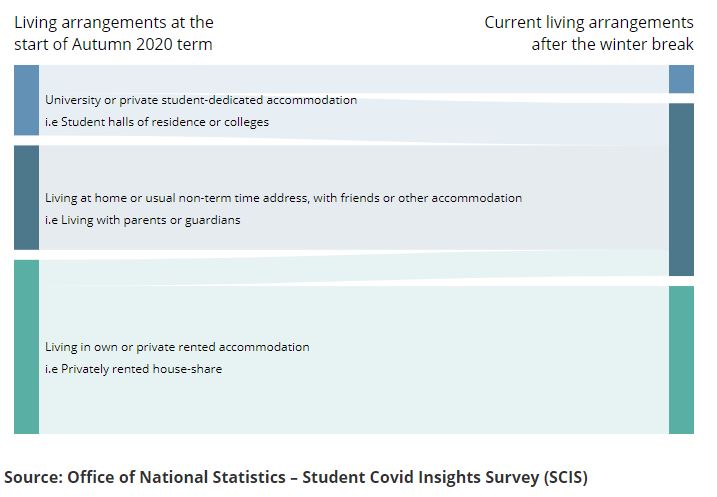
So the first alarming finding in the Office for National Statistics’ update to its Coronavirus and higher education students research is the deep extent of Department for Education (DfE) policy failure here – of those who travelled to stay with family or friends over the winter break, 40 per cent have since returned and 60 per cent have not yet returned to their term-time address.
Either there’s more medics and vets than I recall, or something else is afoot. It’s almost as if, having rented a property and been told they won’t be getting refunds or rebates, they want to use it.
Of those students who provided complete travel information, 33 per cent travelled to stay with family or friends over the winter break, and 37 per cent stayed in their accommodation – the remaining 30 per cent were already living at their usual non-term address or family home, or in “other” accommodation.
That all suggests that in reality, a minority of “Harry Potter HE” students are not in their university town or city – with everyone else either commuters, in their city or on campus over Christmas, or already back. The killer question is how many of them are being asymptomatically screened twice a week, given so many are not “supposed” to be back yet – let’s guess that the two figures are nowhere near to matching.
Alarmingly – although not surprising for those of us who understand the realities of student life – plenty of students are not intending to stay put either. Of those studying away from home that are away from home this term, almost 10 per cent are intending to travel home / back regularly, and 4 in 10 occasionally.
And of those “not back yet!”, 29 per cent figure they’ll be back in February. That’s likely to be a result of assurances about the return of face to face teaching before Easter – a prospect slipping further away by the day.
Nevertheless, wherever they are, they’re exhibiting safe behaviours. As was the case in November, findings on compliance with guidance on testing, tracing and social gatherings compare favourably with the general public.
This iteration of the ONS study, run between 8 and 18 January, has a helpfully substantial 2,698 responses – weighted to ensure provider level representation, sex and region. Outside of the “where are students”, it’s mainly an update to the data we saw before Christmas – and very little of it is good news as the academic year continues.
For example – 37 per cent of students are reporting being dissatisfied or very dissatisfied with their academic experience, compared with 29 per cent reporting the same at the end of November 2020. 49 per cent were very satisfied or satisfied with the academic experience back in November – that’s down to 41 per cent now.
We wondered whether the mental health stats in November could get any worse – they could. A statistically significantly higher number (63 per cent) of students reported a worsening in their well-being and mental health, compared with 57 per cent reporting the same in the previous survey. Average life satisfaction scores of students decreased from 5.3 to 4.8 out of 10, between the end of November and now.
[table id=244 /]
The non-academic experience – unhelpfully framed here as the “social experience” – is naturally also worse than both the academic experience and the findings back in November. This time just 15 per cent are satisfied (down from 18 per cent in November), with 56 per cent actively dissatisfied (up from 53 per cent). Again – whether you put that down to naivety on the part of students, or mis-selling on the part of universities (UK) very much depends where you sit in the sector.
“Limited opportunities for social or recreational activity” is a dissatisfaction driver for 85 per cent of those that are unhappy, “limited opportunities to meet other students” for 86 per cent of them and “limited access to sports and fitness facilities” is there for 56 per cent of them.