Some of that is almost certainly linked to the reduction in the value of real terms maintenance support for home students. Less comfortable for the sector is the portion that may be being driven by international students and graduates.
This week the Home Office slipped out a dataset that links student visas to payroll records – and on the face of it it’s a problem that’s reducing.
On Thursday it published official statistics matching visa records to HMRC payroll data, with a separate release on Student visa holders. Only 41 per cent of international students eligible to work show up on payroll, down from 47 per cent two years ago.
Notwithstanding that a significant volume of international students are likely to be being paid cash-in-hand to get around the 20 hours a week rule (with a decent proportion of them being exploited), if you’ve followed the argument about whether students are crowding young people out of entry-level work – Alan Milburn’s final report didn’t go near it, and I argued it should have – a falling share looks like good news. However.
Behind the times
Each year in the release only counts people whose visa was granted before that year started. The year to March 2026 covers grants from January 2019 to March 2025, so the September 2025 intake isn’t in it at all, and the share describes a cohort that is already a year out of date.
The user guide adds that only 69 per cent of student records could be matched to HMRC data, against 96 per cent for work visas, and unmatched students are counted as not working. Some students are also counted twice where they were granted the same visa more than once.
So the 41 per cent is a lower bound on a cohort that has already moved on, and tells us little about how many international students are working now.
Per cent and sensibility
For displacement, the question is how many visa holders are doing entry-level work, and on that the data tables are pretty clear.
Most working students end up in accommodation and food, retail, or administrative and support services, which takes in employment agencies. If we count everyone whose highest-paid job was in one of those three:
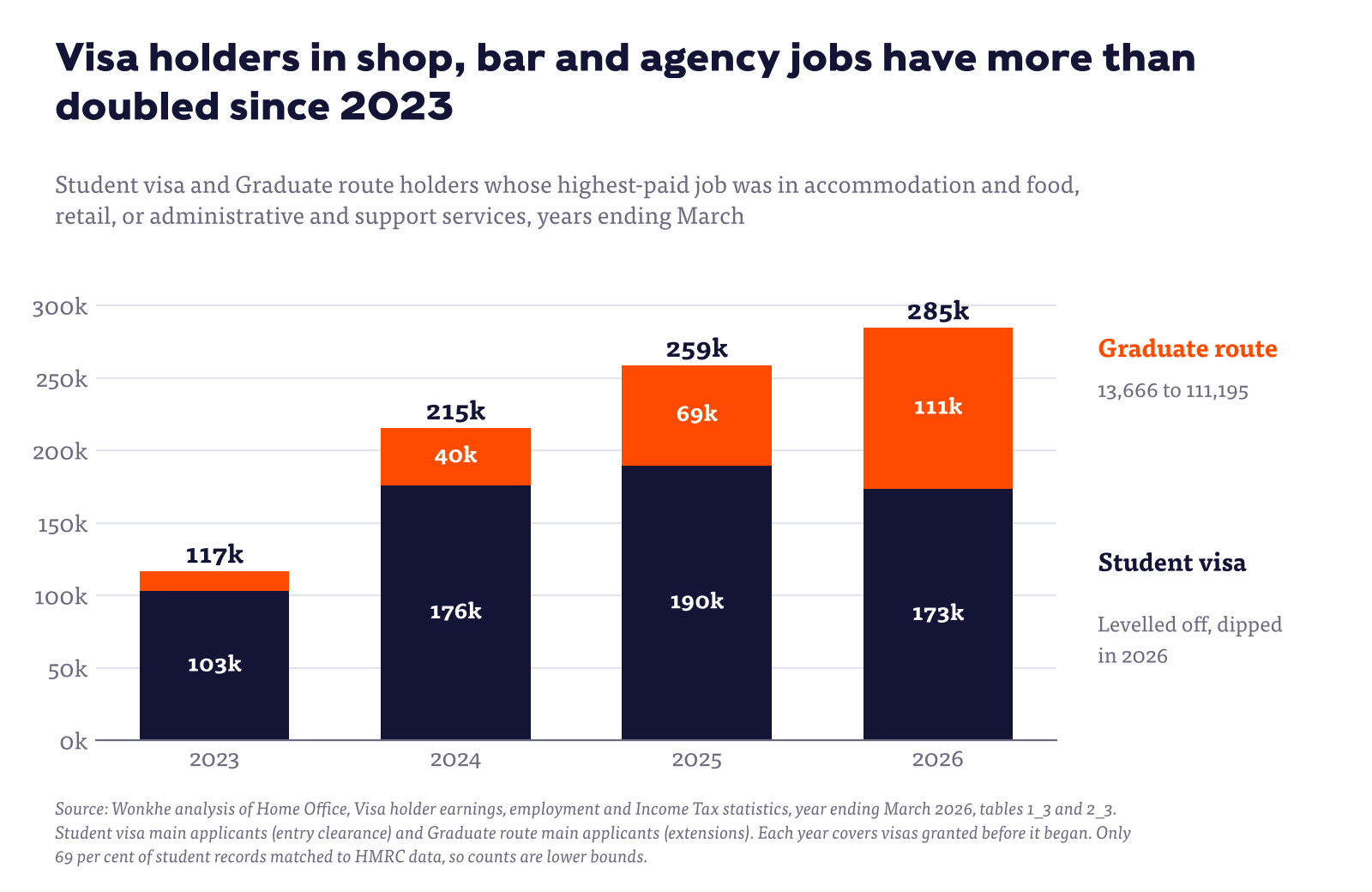
Student visa holders in those sectors levelled off and dipped this year. But the combined total has risen every year and more than doubled since 2023, and that’s before you allow for the third of student records that never matched.
Graduate to the till
My early write-ups treated the Graduate route as a footnote, because it sits in the work release rather than the student one. That’s where most of the growth is.
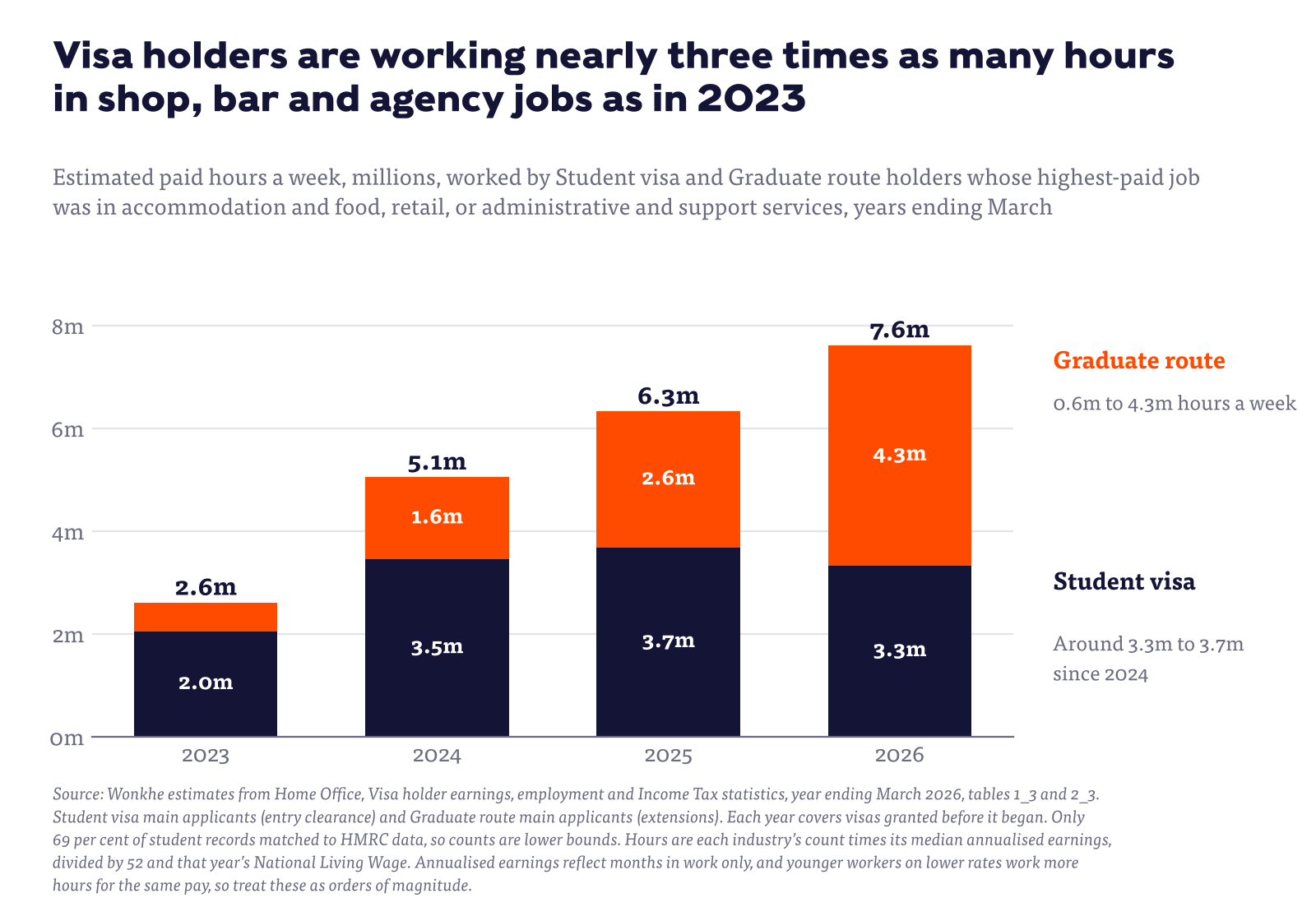
Graduate route holders in hospitality have median annualised earnings of £24,200, which at the National Living Wage is something like 38 hours a week. These aren’t “saturday jobs”, but may well be zero-hours contracts workers maxing up their shifts. Those in health and social work went from 3,749 to 42,522 in three years.
Student visa holders have median annualised earnings of £12,400, which is roughly 19 or 20 hours a week at the 2025 rate, about what you’d expect from people working up to the term-time limit and more in the holidays.
Very roughly, that adds up to seven or eight million paid hours a week in those three sectors. Annualised earnings overstate students’ hours, so treat it as an order of magnitude. Even so, it sits in the same territory as the hours young people outside education have lost since 2019, and this time it comes from payroll records rather than surveys.
Dependants’ day
Banning most taught postgraduates from bringing dependants shows up hard. Student dependants with payroll earnings fell from 78,422 to 12,665 in two years, on median earnings of around £28,600, and Income Tax from the student route fell from about £226 million to about £147 million.
The tables don’t tell us which industries those dependants worked in, which is a problem, because tens of thousands of largely full-time jobs changing hands is exactly what a NEET review ought to want to know about.
Universities don’t come out of it well as employers either. The 23,766 student visa holders whose highest-paid job was in education had median annualised earnings of £5,000, the lowest of any major industry.
Home truths
Home students, the much bigger group, are not of course in visa data at all, and there’s nothing on hours, regions or level of study.
But for the international side of the argument, we no longer have to extrapolate from surveys.
The government’s own payroll records show students and graduates on visas holding more of the jobs in shops, bars and agencies every year – while the review meant to work out where young people’s first jobs have gone still hasn’t bothered to look.