As well as the usual stuff about universities not doing enough to prepare students for work, and suggesting too many degrees are not value for money, he is reported to have said it was “frightening” that:
“…there are more graduate NEETs now than there are NEETs having finished A levels”.
Is it true though?
He was talking about Alan Milburn’s interim review of young people and work. And the weird thing is that the review appears to say the opposite.
What Milburn says
Paragraph 210 of Milburn’s interim review notes that among NEET 16–24-year-olds, about 15 per cent have a degree and over 21 per cent have a Level 3 qualification.
The accompanying data tables firm it up – for 2025, 15.5 per cent of NEETs have a degree as their highest qualification, and 21.4 per cent have a row labelled “A-level”. The A-level row is bigger by almost six percentage points.
So on the face of it, Haldane has the comparison the wrong way round. But “NEETs having finished A levels” could mean different things – and depending on which you pick, you can get a different answer.
Which A-level population?
The Labour Force Survey classifies people by their highest qualification. Someone who did A levels and then a degree counts as a graduate. Within that, there’s a narrow code labelled “A level or equivalent”, and a much broader Level 3 grouping that sweeps in apprenticeships, T Levels, BTECs and the rest.
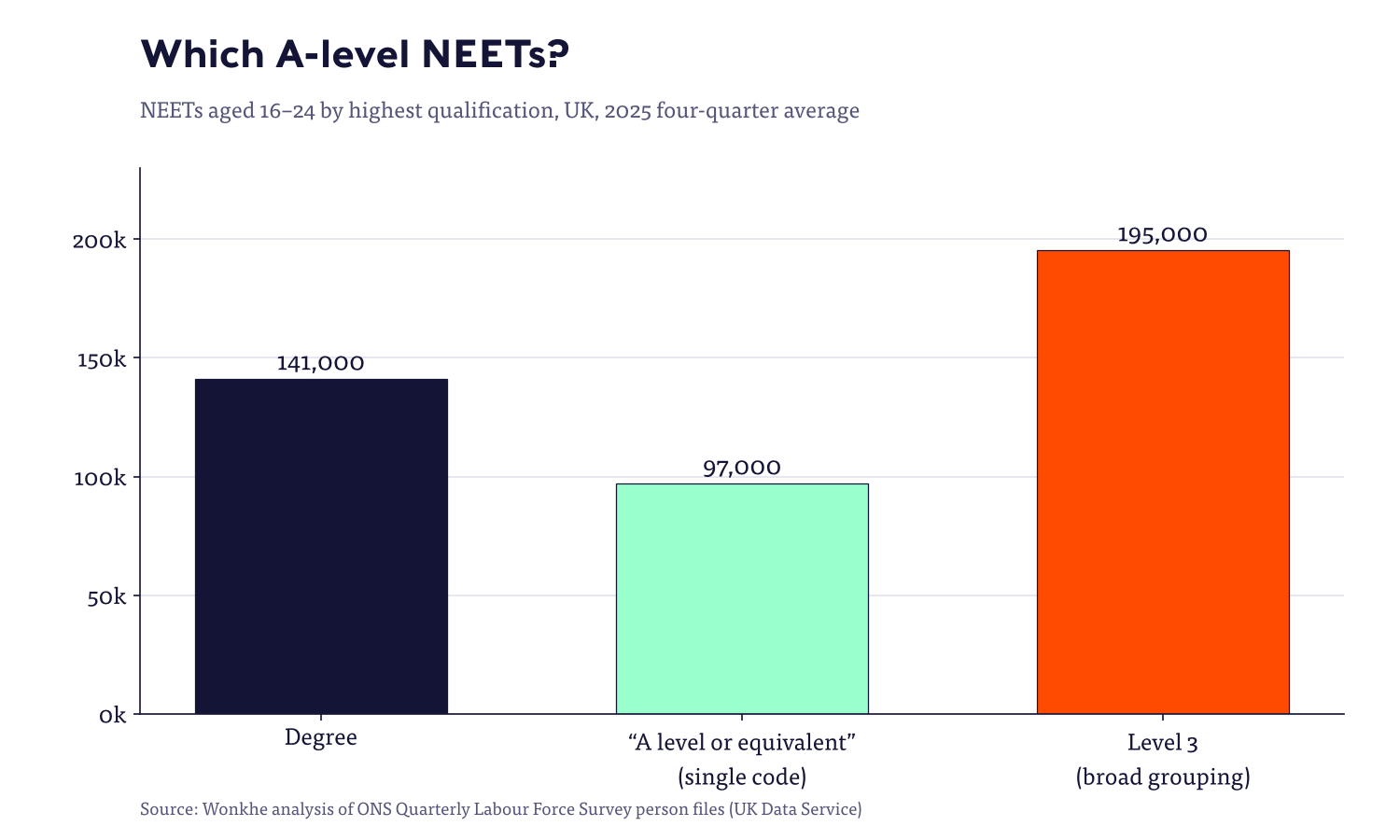
In 2025, an estimated 141,000 NEETs had a degree as their highest qualification. Compare that with the narrow “A level or equivalent” code and you get about 97,000 – so on that comparison, Haldane is right.
Compare it with the broader Level 3 group and you get about 195,000 – which matches the published ONS figures – and graduates come out well behind.
Is it new?
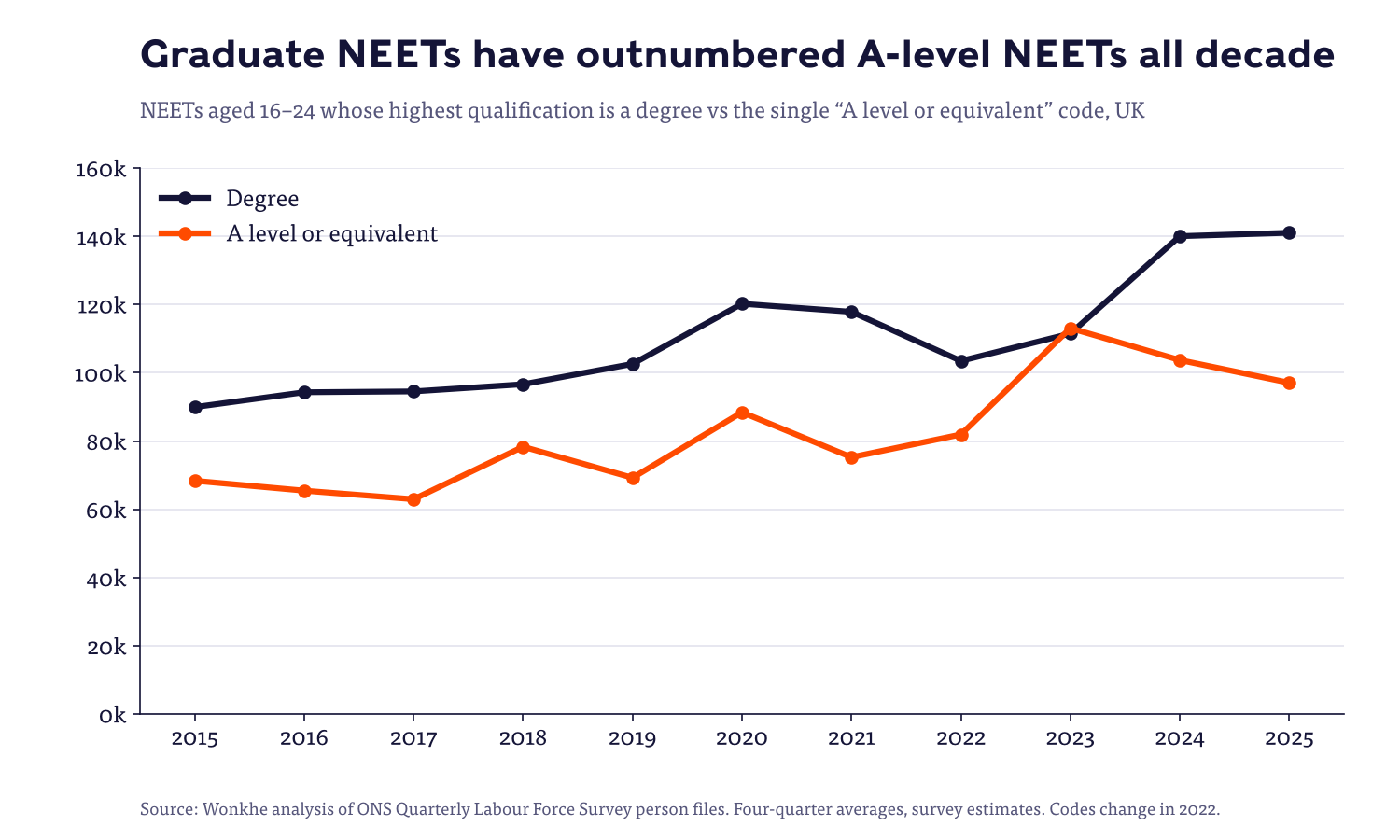
The word “now” suggests a recent crossover, but there isn’t one. On the narrow measure, degree-holding NEETs already outnumbered A-level-code NEETs in 2015 – roughly 90,000 to 68,000. The ordering briefly flipped in 2023, then flipped back. Whatever is going on, it isn’t a story about a line being crossed this year.
There’s also the age problem. A 16-year-old is not going to have a degree, so counting graduate NEETs against everyone aged 16–24 says something about the make-up of the NEET population but very little about the risk facing any individual graduate.
What has actually changed
The better measure of graduate risk is the share of graduates aged 21–24 who are NEET, and Milburn’s corrected table puts that at 9.6 per cent in 2015 and 11.6 per cent in 2025 – a two point rise.
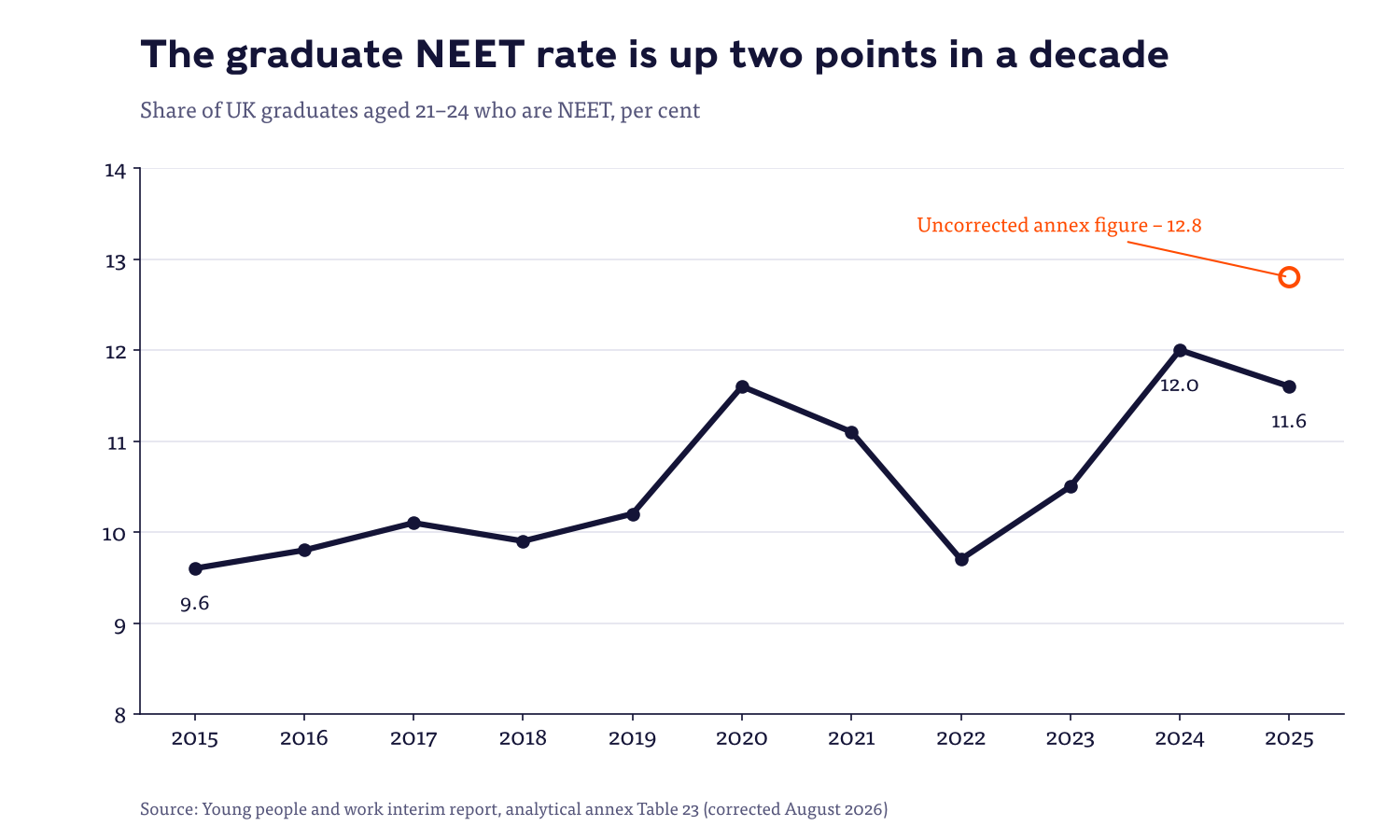
The DWP had to correct a formula error in that table in August, and the annex prose still carries the old, higher numbers, with 12.8 per cent for 2025 – so anyone quoting those is quoting a mistake. Nor is 11.6 per cent a ten-year high – the rate was the same in 2020 and hit 12 per cent in 2024.
A dive into the data shows the number of degree-holding NEETs rising from about 90,000 in 2015 to 141,000 in 2025. But the number of 16–24-year-olds holding degrees grew by about a fifth over the same period, so a good chunk of the increase is just that there are more graduates around to be NEET.
A big increase came between 2023 and 2024, when the graduate NEET estimate jumped by about 28,500. Around three quarters of that rise was among women, almost all of it was unemployment rather than inactivity, and it was concentrated in the second half of the year – the point at which new graduates hit the labour market. The NEET rate among female degree holders went from 8 per cent to 11 per cent in a year, and has stayed there.
That would be an interesting finding if we could trust it. But the 2023 survey sample for degree-holding NEETs averaged fewer than 50 people a quarter, and the extra 28,500 depends on around 25 more survey records every quarter.
Within that, personal interviews account for about 21,600 of the 28,500 increase from 2023 to 2024. The 2023 personal-interview figure came from just 19 qualifying records across all four quarters (only 4 in July–September and 3 in October–December). There were 64 such records in 2024 and 91 in 2025.
The ONS itself warns that estimates for 2023 and 2024 are “volatile”, and that changes to how the survey was run may explain some of the movement. Yeah.
So, is it true?
It depends on what he meant. If “NEETs having finished A levels” means people whose highest qualification is the single A-level code, then yes – and it has been true for at least a decade. If it means the broader Level 3 group that Milburn actually reports, then no – by some distance.
Either way, the comparison isn’t in the review he was citing, the “now” doesn’t hold, and setting the number of graduate NEETs against the number of A-level NEETs is a daft way of judging whether degrees are worth it.
A rising graduate NEET rate would be a real thing worth worrying about – particularly if the recent jump among women turns out to be more than survey noise – but it deserves a better argument than one that falls apart as soon as someone asks which A levels he meant.