Everyone’s into clearing in DfE’s post qualification admissions scramble
Jim Dickinson explains what is and isn’t on the table in the government’s long awaited review of admissions.
This article is more than 5 years old
Policy Watch|

Jim Dickinson
Jim is an Associate Editor (SUs) at Wonkhe
Just to manage expectations at the outset on this one - if you’re looking for major change to the structure of the academic year, or for radical proposals on what universities should use to assess applicant suitability, the Department for Education’s admissions review is not for you.
Nor are you going to be thrilled if you were looking for big, strategic level change to our "boarding school" model of residential higher education, or were looking for a less selective and more comprehensive system of who-goes-where.
In November you’ll remember that there was a week of high farce where it looked like UCAS, Universities UK, the Office for Students and DfE were each running their own reviews of university admissions.
So with the kaleidoscope shaken and the pieces in flux, it was clear that they would need to settle again - and it looks like DfE, with its oodles of spare time, capacity and credibility, is going to take the lead on reordering this world of applying to university around us, using the modern science of PQA to provide fairness for all.
A few other things that are explicitly not in scope here before we dig in. The consultation is at pains to point out that it principally considers changes to when students receive and accept university offers. It does not consider or propose changes to level 3 (A level and equivalent) assessments, the use of UCAS as an application tool for undergraduate courses, the application processes for postgraduate courses, or even the Government’s wider policy on access and participation.
There’s also no challenge here in DfE’s mind to the “autonomy of higher education institutions to determine the criteria for the admission of students and applying those criteria in particular cases”, although there sort of is if you’re the sort of higher education institution that thinks that autonomy does or should equal unconditional offers.
I’ll not rehearse or summarise here DfE’s justification for considering PQA now - there is a chunk of text that does that in the consultation document, but it’s all stuff we’ve seen and critiqued before on the site.
The TL;DR is that DfE reckons the current system is complex, lacks transparency, works against the interests of some students, and encourages undesirable admissions practices - and that PQA could address some of these challenges. And bearing in mind the Government’s ongoing obsession with the two magic metrics of value (drop out and employment), PQA could even mean:
...more students making better informed decisions, improve continuation rates in higher education and potentially lead to better career outcomes for students.”
The solution? Two options for removing teacher predictions from the system altogether and relying even more on exam results, which given what's happened this year, feels... bold.
Model 1
Two models are placed onto the table, which are almost identical to the two that were being floated in that high farce week just before Christmas.
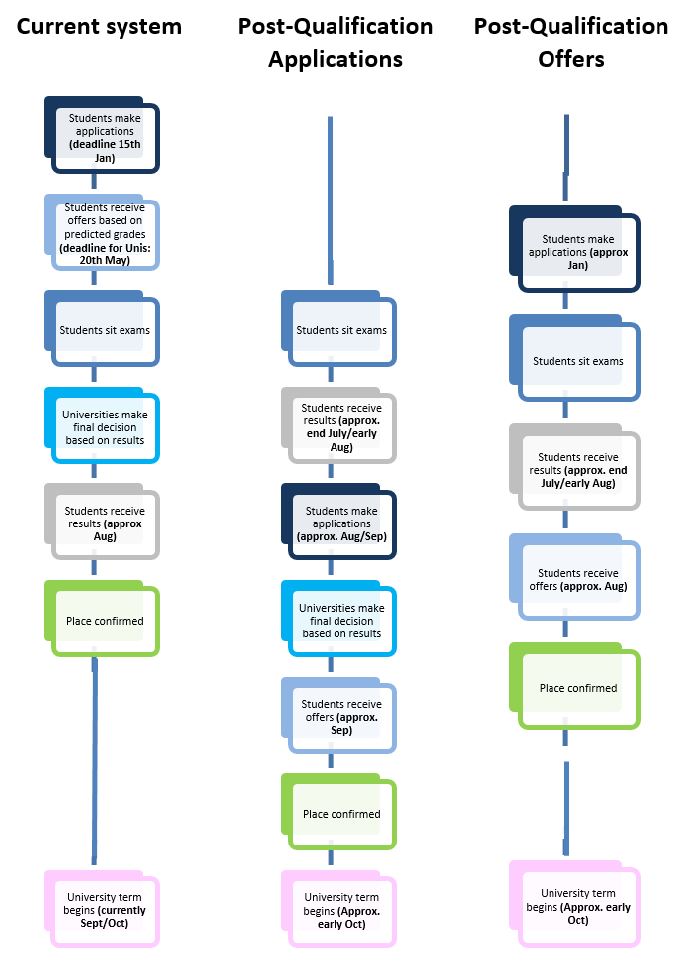
The first, called “post-qualification applications and offers”, creates a longer application window by moving results dates forward to the end of July, and higher education term dates back to the first week of October.
This, it says, should allow at least six weeks for the processing of applications and the making of offers and would continue to allow universities to provide a 10 week first term before Christmas. Basically, it puts everyone into clearing. Scramble!
Before some of you hit the comments section, DfE recognises that courses which require additional entrance tests, auditions and/ or interviews will also need to be accommodated in this system, and is “welcoming views” on how this could be done.
It’s also exploring different options on how to move results days earlier, with the preference compressing the exam timetable, the marking period and the requirement for UCAS to receive results data well in advance of results day rather than actually moving exams any earlier.
There are knock on impacts of course - applicants could require support in choosing courses and completing their applications:
If teachers were expected to provide this support there could be implications for their statutory terms and conditions. Our preference would be to avoid affecting teachers’ conditions or workloads as much as possible and we would encourage respondents to provide their views and suggestions on how to avoid this.
Naturally, there’s no parallel set of concerns about university staff.
Model 2
There is an alternative. “Pre-qualification applications with post-qualification offers and decisions” (PQAAPQOD) would mean applications being made during term-time (as now), but offers being made after results day.
This is obviously a less disruptive version, but in being less disruptive it also is less satisfactory at addressing the challenges DfE outlines with the current system. If Gavin Williamson is worried that students who do surprisingly well at A level don’t “shoot for the stars” or whatever, this isn’t a version that fixes that problem.
DfE notes that under this model students would require significantly less support over the summer with their applications, but some would need support in deciding which offer to accept. Again, it spots and notes potential implications for teachers without clocking and parallel potential impact on university staff.
To ensure that no offers are made in advance of results day, DfE imagines that full application data would be held in a special safe by UCAS, and then released after results day - with headline data released to providers to enable the planning of intakes and facilitation of additional recruitment procedures where necessary.
Again, thoughts on how courses that require auditions and/or interviews can be accommodated before results days are welcomed - as are views on how providers might be prevented from bypassing the agreed system. That’s surely an OfS concern, but would doubtless manifest in strategic guidance from DfE asking the regulator to implement a new registration condition.
Process matters
Admissions only works as a UK-wide system, and we are told here that the Scottish and Welsh governments, along with the Northern Ireland Minister for the Economy all welcome this consultation. Whether they’ll welcome the outcome is a different question.
It feels longer ago now, but it’s less than a year since the Office for Students launched its own consultation on the higher education admissions system in England (with similar “we’ll consult the devolved nations” noises). That review must surely now be taken off “pause” and filed in the bin - although it would be a real shame if all of the aspects of its broader scope were now to be lost.
OfS was going to look at the disparity between advertised and actual entry requirements; the use of assessment methods other than grades (personal statements and references, auditions, portfolios, admissions tests and interviews); and the role of contextual offers and contextual admissions.
It was also going to look at that press favourite of the use of offer incentives, inducements and false marketing claims, along with a long overdue look at the use of recruitment agents in relation to the recruitment of both domestic and international students.
DfE’s consultation runs until mid-May.
Comments
New comments will come back with sign-in later this year.
Related articles

Counting the cost of teaching higher education in England
David Kernohan | Policy Watch | 18/09/26

The tone has changed on free speech, but the architecture hasn’t
Jim Dickinson | Policy Watch | 17/09/26

Student loans are still broken and unfair
Jim Dickinson | Policy Watch | 13/09/26

We’re very sorry, and we won’t do it again
David Kernohan | Policy Watch | 4/09/26

Assessing Scotland’s sector finances
David Kernohan | Policy Watch | 28/08/26

The absolutism is watered down in OfS’ amendments to its free speech guidance
Jim Dickinson | Policy Watch | 5/08/26